English


Michelangelo di Lodovico Buonarroti Simoni
Michelangelo was an Italian sculptor, painter, architect…
Reads at Grades 6–8 Listens at Grades 4–8
Print & create
Answer keys·No prep·Free with an account
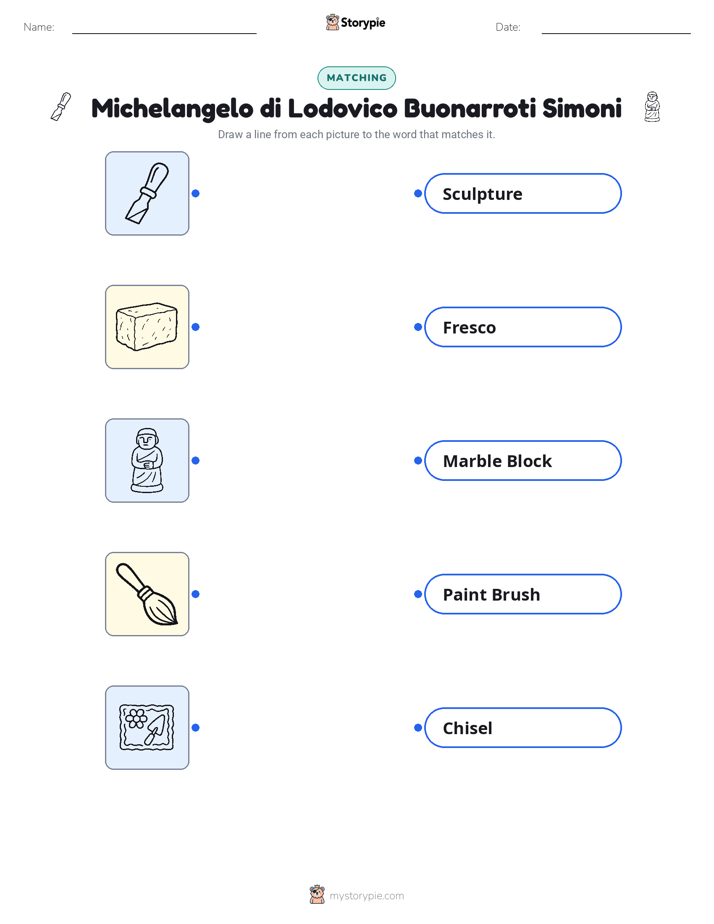
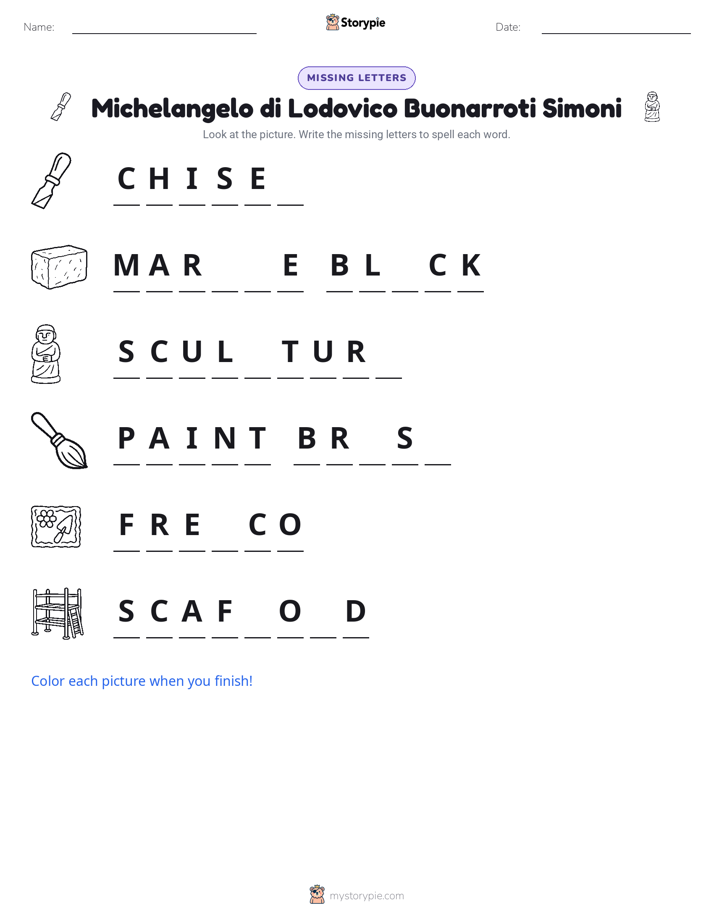
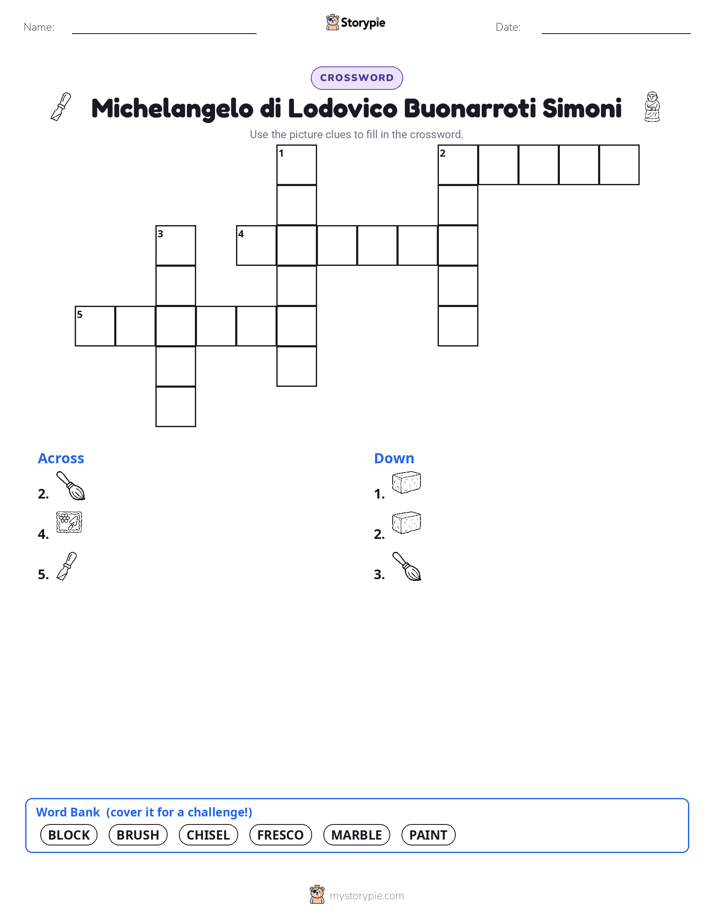
28 worksheets · answer keys · full story · quiz · Ages 10-12 · CEFR B2
Plus adds 280,000+ more stories in 27 languages, audio for every one, and printables for all of them.
Just want Michelangelo di Lodovico Buonarroti Simoni?

Hello, my name is Michelangelo Buonarroti, and I spent my life seeing the figures hidden inside blocks of stone and the stories waiting to be told on blank ceilings. I was born in a small Italian town called Caprese on March 6th, 1475. My father had practical plans for me; he hoped I would become a successful businessman and manage the family's finances. But from my earliest days, I was not drawn to numbers and ledgers. Instead, I found magic in stone, clay, and charcoal. I loved to draw and create, and my heart was set on becoming an artist. It took some convincing, but when I was thirteen years old, in 1488, my father finally allowed me to follow my dream. I became an apprentice to a well-known painter in the great city of Florence, Domenico Ghirlandaio. While I learned a great deal about painting frescoes on walls, I quickly discovered that my true passion lay elsewhere. It was the three-dimensional world that called to me. I wanted to carve, to chip away at marble until a lifelike form emerged. I knew then that I was not just an artist; I was a sculptor at heart.
My life took an extraordinary turn around the year 1490. I was invited to live in the palace of the most powerful man in Florence, Lorenzo de' Medici. He was a great patron of the arts, and his home was more than just a residence; it was a vibrant school filled with philosophers, poets, and the most brilliant artists of the time. Living there, I was surrounded by genius and had access to a magnificent collection of ancient Roman and Greek sculptures. This was where I truly learned the craft of sculpting, studying the masters of the past to find my own voice in stone. After my time in Florence, I traveled to Rome, a city filled with history and ambition. It was there I received a commission that would establish my reputation. Between 1498 and 1499, I was asked to carve a sculpture of Mary holding the body of Jesus after the crucifixion. This piece, which I called the *Pietà*, was a work of deep emotion and technical skill. I poured all of my talent into the marble, making the stone look as soft as fabric and as real as flesh. I was so immensely proud of the result that I did something I would never do again: I carved my name, 'Michelangelo Buonarroti, Florentine, made this,' onto the sash across Mary's chest. It was the only work I ever signed.
Michelangelo: A Life in Stone and Paint
Hello, my name is Michelangelo Buonarroti, and I spent my life seeing the figures hidden inside blocks of stone and the stories waiting to be told on blank ceilings. I was born in a small Italian town called Caprese on March 6th, 1475. My father had practical plans for me; he hoped I would become a successful businessman and manage the family's finances. But from my earliest days, I was not drawn to numbers and ledgers. Instead, I found magic in stone, clay, and charcoal. I loved to draw and create, and my heart was set on becoming an artist. It took some convincing, but when I was thirteen years old, in 1488, my father finally allowed me to follow my dream. I became an apprentice to a well-known painter in the great city of Florence, Domenico Ghirlandaio. While I learned a great deal about painting frescoes on walls, I quickly discovered that my true passion lay elsewhere. It was the three-dimensional world that called to me. I wanted to carve, to chip away at marble until a lifelike form emerged. I knew then that I was not just an artist; I was a sculptor at heart.
My life took an extraordinary turn around the year 1490. I was invited to live in the palace of the most powerful man in Florence, Lorenzo de' Medici. He was a great patron of the arts, and his home was more than just a residence; it was a vibrant school filled with philosophers, poets, and the most brilliant artists of the time. Living there, I was surrounded by genius and had access to a magnificent collection of ancient Roman and Greek sculptures. This was where I truly learned the craft of sculpting, studying the masters of the past to find my own voice in stone. After my time in Florence, I traveled to Rome, a city filled with history and ambition. It was there I received a commission that would establish my reputation. Between 1498 and 1499, I was asked to carve a sculpture of Mary holding the body of Jesus after the crucifixion. This piece, which I called the Pietà, was a work of deep emotion and technical skill. I poured all of my talent into the marble, making the stone look as soft as fabric and as real as flesh. I was so immensely proud of the result that I did something I would never do again: I carved my name, 'Michelangelo Buonarroti, Florentine, made this,' onto the sash across Mary's chest. It was the only work I ever signed.
I returned to my home city of Florence around 1501 to face one of the greatest challenges of my career. The city leaders presented me with an enormous block of marble that many considered unusable. It had been worked on by other artists decades before and then abandoned, left with awkward cuts that made it seem ruined. They called it 'the Giant.' But where others saw a spoiled piece of stone, I saw a figure trapped inside, waiting to be freed. For nearly three years, I worked on this colossal block in secret, often in solitude. I studied its flaws and envisioned the hero it could become. Day after day, I chipped away with my hammer and chisel, slowly revealing the form I held in my mind. In 1504, my work was finally complete, and I unveiled the statue to the city. It was the famous figure of David, the young biblical hero who defeated a giant with courage and faith. The statue stood over seventeen feet tall, a powerful symbol of the strength, independence, and defiant spirit of my beloved Florence. It was placed in a public square, a guardian for all to see.
My reputation as a sculptor was well known, but my next major commission would force me to become a painter on a grand scale. I was called back to Rome by the powerful Pope Julius II. He did not want a sculpture; instead, he commanded me to paint the vast, curved ceiling of his private chapel, the Sistine Chapel. I protested, telling him plainly, 'I am a sculptor, not a painter!' My skills were with a chisel, not a paintbrush, and the task seemed impossible. But the Pope was a man who would not take no for an answer. He insisted, and so I began the most grueling project of my life. From 1508 to 1512, for four long years, my world was a wooden scaffold high above the chapel floor. I spent my days lying on my back, with paint constantly dripping into my eyes, my neck and back aching from the strain. Across more than five thousand square feet of ceiling, I painted hundreds of figures, telling the great stories from the Book of Genesis. The most famous of these scenes is The Creation of Adam, showing the moment God gives life to the first man. When it was finished, I had created a masterpiece that would be studied by artists for centuries to come.
In the later years of my life, my creative energy turned increasingly toward architecture, the art of designing buildings. I had the honor of designing the Medici Chapel in Florence, creating a space that blended sculpture and structure into a harmonious whole. But my greatest architectural challenge began in 1546, when I was in my seventies. I was appointed the chief architect of St. Peter's Basilica in Rome, the most important church in the Christian world. The project had been started by other architects, but it was in need of a unified vision. I focused my design on its most defining feature: the massive, soaring dome. I imagined a dome that would rise majestically over the city, a symbol of faith and human ingenuity that could be seen from miles away. I created the models and plans, overseeing the beginning of its construction. Though I did not live to see it finished, the magnificent dome that crowns St. Peter's Basilica today was built following my design, becoming a timeless landmark for the entire world.
I lived a very long and creative life, working on my art until the very end. I lived to be 88 years old. My work was my way of communicating with the world, of showing the power, beauty, and complexity I saw in the human spirit. Whether I was freeing a figure from a block of marble, covering a ceiling with stories from the heavens, or designing a dome to reach for the sky, I was always striving to create something lasting and meaningful. Today, people from all over the world still travel to Florence and Rome to see the David, the Pietà, and the Sistine Chapel. I hope my work continues to inspire people to look for the beauty around them and to find the strength and potential that lies within themselves.
Wow facts
About
Michelangelo was an Italian sculptor, painter, architect, and poet of the High Renaissance who exerted an unparalleled influence on the development of Western art. His most famous works include the sculptures David and Pietà, and the ceiling paintings of the Sistine Chapel.
Take a Quiz
Question 1 of 5
What was the main reason Michelangelo was hesitant to paint the Sistine Chapel ceiling?
Explore next





Want to do even more?
Go beyond exploring. Unlock tools that turn every story into real learning.

Storypie Plus for families
Full stories, quizzes, and printables. Nights and car rides, sorted.
- Unlimited audio stories
- Create Mode: your child stars in the story
- Offline downloads
- Printable worksheets & coloring pages

Why Storypie for Schools
Students engaged. Prep in seconds. Evenings back to you.
- Worksheets & Quizzes
- Classroom Management
- Formative Assessment
- Custom Curriculum & Lesson Plans
- 27 Languages

Why Storypie for Homeschool
Curriculum done. They'll ask for more. Hours back in your day.
- Worksheet Generator
- First-Person Audio Stories
- Built-in Comprehension Quizzes
- Custom Curriculum & Lesson Plans
- Print & Go Activities