

 English

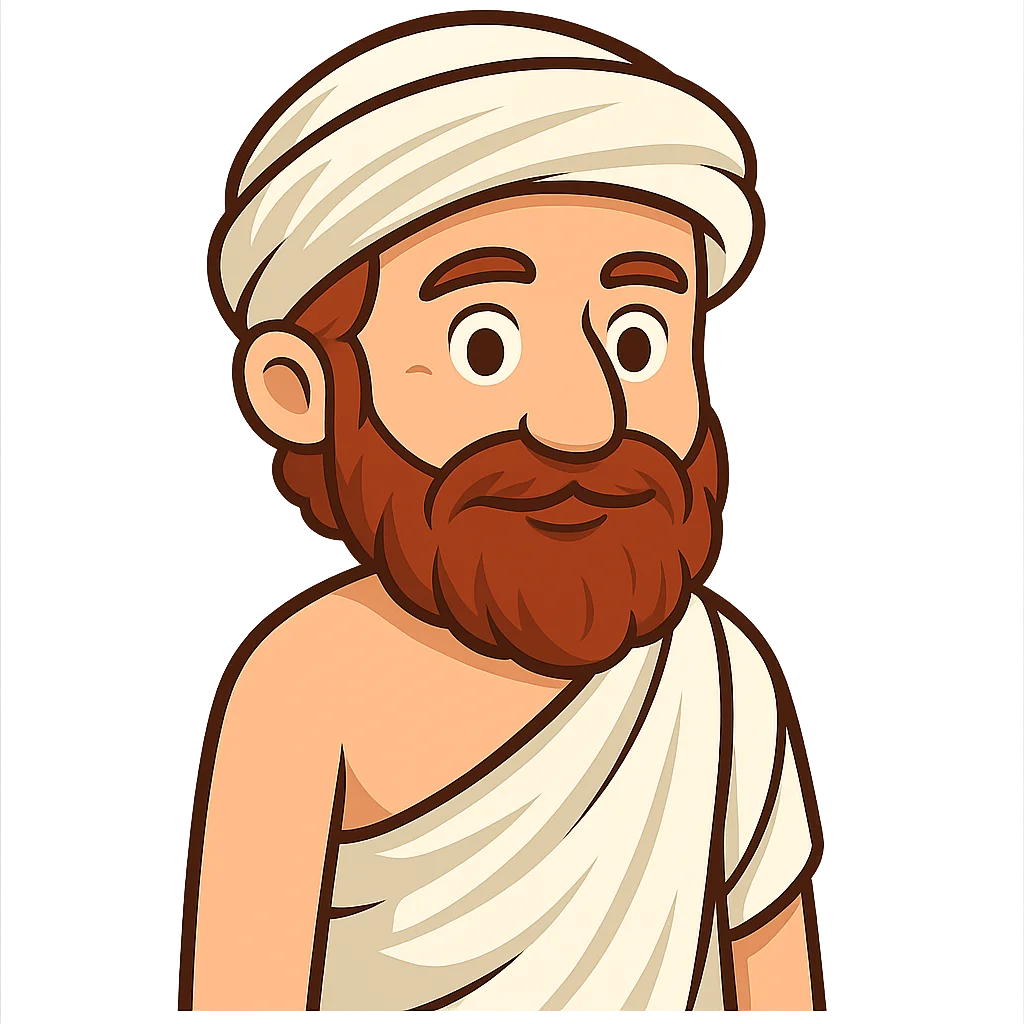
Pythagoras: The Man Who Heard Music in Numbers
Hello! My name is Pythagoras. You might have heard of me in your math class, but my story is about more than just triangles. I was born on a beautiful Greek island called Samos around the year 570 BCE. From a young age, the world fascinated me, but I was interested in more than just what my eyes could see. I felt a deep curiosity about the hidden rules that made everything work, from the smallest flower to the largest star. I had a strong feeling that the secret to understanding it all was hidden within numbers.
To find the answers I was looking for, I knew I had to travel and learn from others. I left my home on Samos and began a long journey to faraway lands like Egypt and Babylon. For many years, I dedicated myself to studying with the wisest priests and scholars I could find. In Egypt, I was amazed by their incredible pyramids and studied the geometry they used to build such perfect structures. Later, in Babylon, I learned about astronomy. The scholars there showed me how numbers could be used to understand and even predict the movements of the stars across the night sky. These travels taught me a profound lesson: numbers were a universal language that connected everything in the world, from music and art to the vastness of the cosmos.
After my years of travel and study, around the year 530 BCE, I settled in a Greek city in southern Italy called Croton. It was there that I started a school, but it was a very special and unusual kind of school. My students, who were called the Pythagoreans, included both men and women, which was uncommon for that time. We all lived together like a large, dedicated family, sharing our belongings and our knowledge. We dedicated our entire lives to learning. Our studies went beyond just mathematics; we also explored philosophy, music, and the principles of living a good and honorable life. We shared a core belief that by understanding the order and harmony of the universe, we could bring that same harmony into our own souls.
One of our most exciting ideas was born from the connection we found between numbers and music. I discovered that musical notes that sound pleasant together are not random; they are based on simple, elegant number ratios. An octave, for example, has a ratio of 2:1. This insight led me to a much grander idea: if numbers could create such beautiful harmony in music, perhaps they were the basis for harmony in the entire universe! I imagined that the planets and stars, as they moved through space in their perfect orbits, created a magnificent and divine sound. I called this the 'music of the spheres,' a perfect symphony that our souls could hear even if our ears could not.
Of course, I must tell you about the discovery my school is most famous for, one that students still learn about today. We spent a great deal of time studying geometry and the properties of different shapes, especially triangles. We uncovered what felt like a magical rule that is true for every single right-angled triangle in existence. If you take the lengths of the two shorter sides, multiply each length by itself to get its square, and then add those two squares together, the result will always be the exact same number you get when you square the longest side! This powerful idea, which you now call the Pythagorean Theorem, was more than just a formula to us. It was a perfect example of how beautiful, orderly, and predictable the world of numbers truly is.
I lived a long life, until about 495 BCE, and I was around 75 years old. The ideas that my students and I explored have traveled through thousands of years. The theorem we proved is still one of the most important principles you will learn in geometry. But I hope you also remember me for the bigger idea that drove my life's work: the belief that the world is a beautiful, understandable place. I hope my story shows you that numbers, logic, and a curious mind are powerful keys to unlocking its many secrets.
Activities
Take a Quiz
Test what you learned with a fun quiz!
Get creative with colors!
Print a coloring book page of this topic.












 Free for Educators