

 English

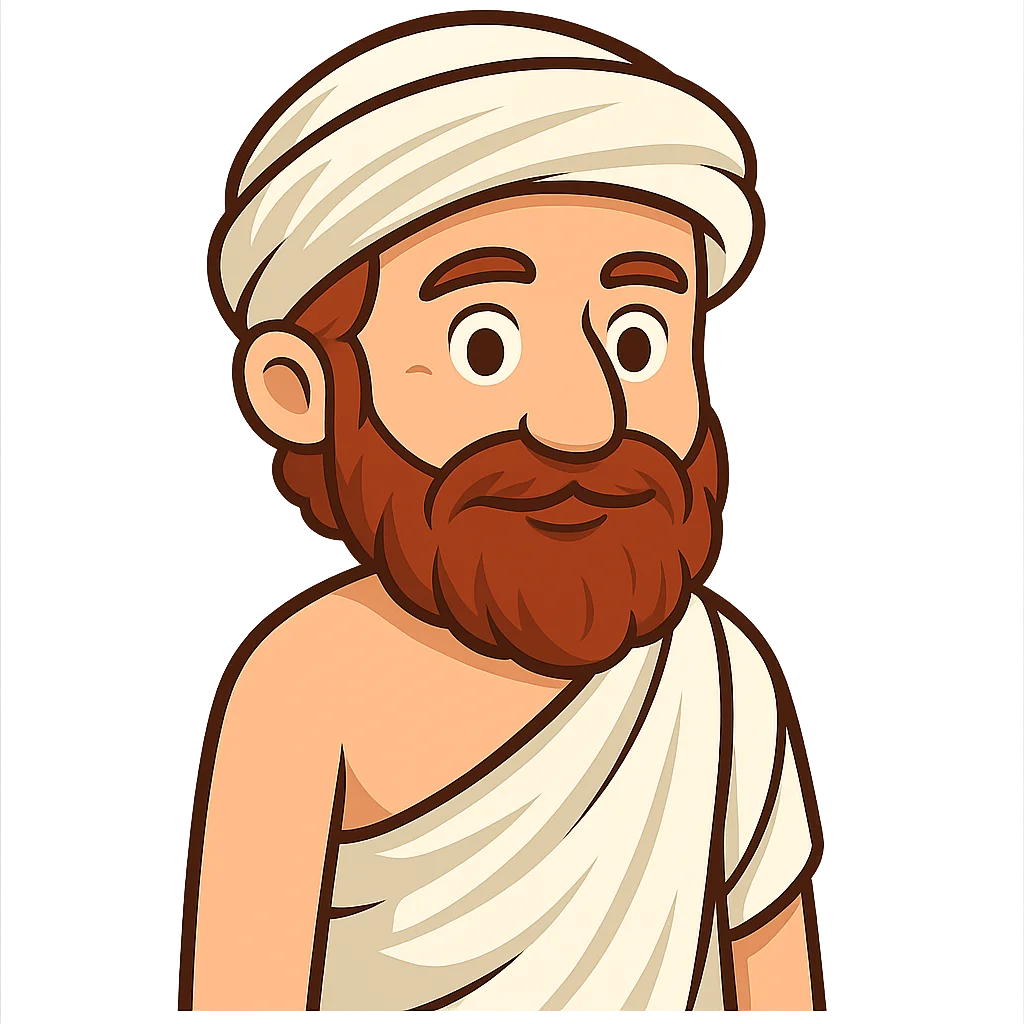
Pythagoras: The Man Who Loved Numbers
Hello! My name is Pythagoras. I was born on a beautiful Greek island called Samos around the year 570 BCE. My father was a merchant who carved amazing designs into gemstones. Growing up in a busy port, I saw ships and people from faraway lands like Egypt and Babylon, which made me curious about the world. From a very young age, I loved to learn. I didn't just want to play games; I wanted to understand how everything worked, especially numbers and music. I felt there was a special magic hidden inside them.
When I grew up, my curiosity couldn't be contained on one small island. I wanted to learn all the secrets of the world! So, I traveled for many years. I sailed to Egypt and saw the giant pyramids, wondering about the mathematics they used to build such perfect shapes. I may have also traveled to Babylon, where I learned about the stars and how people used numbers to predict the movement of the planets. I listened to wise teachers everywhere I went. Each new idea was like a piece of a giant puzzle, and I was determined to see how they all fit together.
After many years of travel, around 530 BCE, I settled in a Greek city called Croton, in what is now southern Italy. There, I started a special school for people who, like me, wanted to live a life of learning. We were called the Pythagoreans. We were like a big family with special rules. We believed in treating all living things with kindness, so we didn't eat meat. We shared everything we owned and worked together to solve problems. We studied mathematics, music, and philosophy, believing that these subjects helped us understand the universe and live better lives. We kept our discoveries secret, sharing them only with each other.
I taught my students that everything in the universe is connected through numbers. Think about music! I discovered that the beautiful sounds made by a harp or a lyre followed mathematical rules. The length of the strings created different notes that worked together perfectly. My biggest idea, and the one you might know me for, has to do with right-angled triangles. I found a rule that is always true for them: if you take the two shorter sides, square them, and add them together, they will always equal the square of the longest side. This is now called the Pythagorean Theorem, and it's a powerful tool in building and measuring things!
I lived a long and full life, exploring the world of ideas. I lived to be about 75 years old, passing away around 495 BCE. Though my time on Earth ended, my ideas about numbers have lived on for thousands of years. Every time you solve a math problem in school, listen to a beautiful piece of music, or look at a well-built building, you are seeing the power of the mathematical patterns I loved so much. I hope you, too, will look for the numbers and patterns that connect everything in our amazing universe.
Activities
Take a Quiz
Test what you learned with a fun quiz!
Get creative with colors!
Print a coloring book page of this topic.














 Free for Educators