English
 Continue with Google
 Continue with Apple

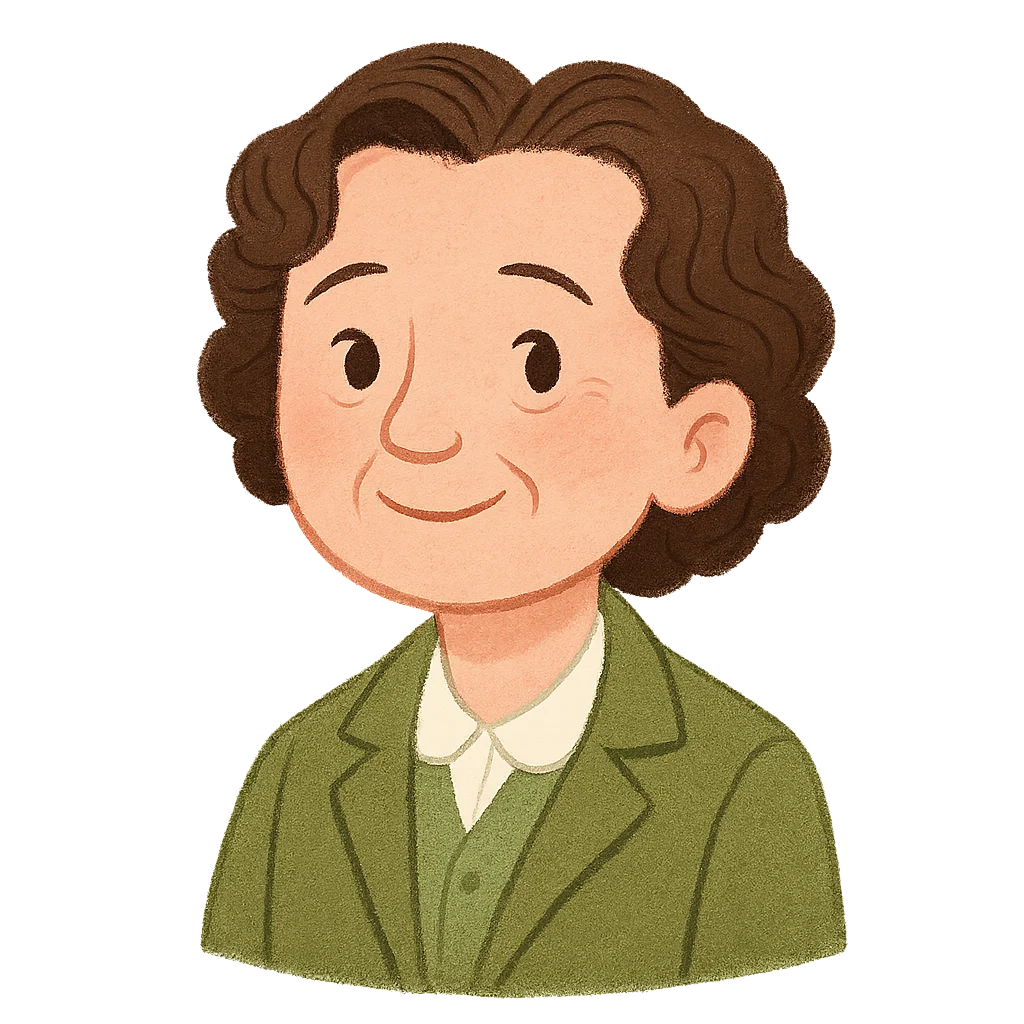
Rachel Carson: A Voice for Nature
Hello there. My name is Rachel Carson, and I am a writer and a scientist who found a way to use the power of words to protect the world I loved. My story begins not in a laboratory, but on a beautiful 65-acre farm in Springdale, Pennsylvania, where I was born on May 27th, 1907. The world back then was a bit different, a place of horse-drawn buggies and quiet country lanes. My childhood was filled with the rustling of leaves, the songs of birds, and the gentle hum of insects. My mother, Maria, was my first and most important teacher. Every day, she would take me by the hand and lead me on explorations through our woods and fields. She didn't just tell me the names of the plants and animals; she taught me to observe them, to understand their secret lives, and to feel a sense of wonder for the intricate web of life all around us. She taught me that the smallest creature had its own important story.
Besides my love for the outdoors, I had another great passion: reading and writing. I would lose myself in books for hours, and soon I began creating my own stories. I wrote about brave animals and magical adventures in the forest. It was my way of sharing the wonder I felt with others. When I was just eleven years old, something incredible happened. A magazine for children called St. Nicholas published one of my stories. Seeing my name in print was one of the most exciting moments of my young life. It planted a seed in my mind: perhaps I could spend my life sharing stories about the natural world that I cherished so deeply. My two loves, nature and writing, were already beginning to weave themselves together, shaping the path I would one day follow.
When it came time for college in the 1920s, I went to the Pennsylvania College for Women, fully intending to become a professional writer. I studied English and wrote poems and articles for the school newspaper. But then, a required biology class changed everything. The professor opened my eyes to the incredible, complex world that lived beneath the surface of what we could see. Looking through a microscope, I saw a universe in a single drop of water. I was completely captivated. I knew then that I had to study science. It was a difficult decision, as being a female scientist was very unusual at that time. Most people thought science was a man's world. But my curiosity was stronger than anyone's doubts, so I changed my major to biology. My journey continued at Johns Hopkins University, where I dove into the study of marine life and earned my master's degree in zoology in 1932. However, these were the years of the Great Depression, and jobs were scarce, especially for a woman in my field. After my father's death, I became the sole provider for my mother. I finally found a position that seemed made for me at the U.S. Bureau of Fisheries. They needed a scientist who could also write. I was hired to write scripts for a radio series about marine life called 'Romance Under the Waters.' At last, my two passions had come together. I was a scientist telling the stories of the sea.
My work for the government was fulfilling, but my desire to write for a wider audience grew stronger. I spent my evenings and weekends crafting books that would bring the mysteries of the ocean to life for everyone. After years of hard work, my book, 'The Sea Around Us,' was published on July 2nd, 1951. To my astonishment, it became a massive success. It stayed on the bestseller list for 86 weeks and was translated into dozens of languages. People were fascinated by the stories of deep-sea trenches, powerful currents, and the strange, beautiful creatures that lived in the dark. The book's success gave me the financial freedom to leave my job and dedicate myself completely to writing. I built a small cottage on the coast of Maine, where I could watch the tides and listen to the seabirds. I wrote other books, like 'The Edge of the Sea,' hoping to share my belief that wonder is one of the most important things we can have. I felt that if people could feel a sense of awe for the natural world, they would be more likely to protect it. I wanted my words to be a window into a world that most people would never see, to make them feel connected to the vast, powerful, and fragile life within our oceans.
My life took a serious turn in the late 1950s. I began receiving letters from people across the country who were worried about what they were seeing. Birds were falling silent in their towns, fish were dying in the rivers, and mysterious illnesses were appearing. Many of them pointed to one cause: the widespread spraying of powerful new chemical pesticides, like one called DDT. These poisons were being used everywhere, on farms and in neighborhoods, to kill insects. I felt a deep sense of responsibility. With my background as a scientist and my ability to reach the public, I knew I was one of the few people who could investigate this problem and sound the alarm. For four long years, I dedicated myself to researching the effects of these chemicals. I read thousands of scientific reports and spoke with experts from all over the world. The evidence I uncovered was terrifying. These pesticides were not only killing insects; they were moving through the food chain, poisoning birds, fish, and even humans. The result of this exhaustive work was my book, 'Silent Spring,' which was published on September 27th, 1962. It described a future where the spring might come without the sound of birdsong because they had all been poisoned. The powerful chemical companies were furious. They spent a fortune trying to convince the public that I was just a hysterical woman who didn't know what she was talking about. All of this was happening while I was privately battling cancer, a fight that took much of my strength. But I refused to be silenced because I knew the truth had to be told. I stood by my research, understanding that all life is connected, and what we do to one part of nature, we ultimately do to ourselves.
My fight for the environment became the final chapter of my life. On April 14th, 1964, after a long struggle with my illness, my life came to an end. But my voice did not fall silent. The echo of 'Silent Spring' grew louder and louder. My book opened people's eyes to the fact that humans had the power to destroy the natural world. It inspired a generation of activists and helped launch the modern environmental movement. Because of the questions I dared to ask, the United States eventually banned the use of DDT in 1972. The movement I helped start led to the creation of the Environmental Protection Agency, a government body dedicated to protecting our air, water, and land. My story shows that one person, armed with curiosity, courage, and a love for the world, can make a difference. I hope you will carry that lesson with you. Never stop asking questions. Never lose your sense of wonder. And never doubt your power to be a voice for the beautiful, fragile planet we all call home.
Reading Comprehension Questions
Click to see answer