English

Rani Lakshmibai
The queen of the princely state of Jhansi in central India…
Reads at Grades 6–8 Listens at Grades 4–8
Print & create
Answer keys·No prep·Free with an account
28 worksheets · answer keys · full story · quiz · Ages 10-12 · CEFR B2
Plus adds 280,000+ more stories in 27 languages, audio for every one, and printables for all of them.
Just want Rani Lakshmibai?
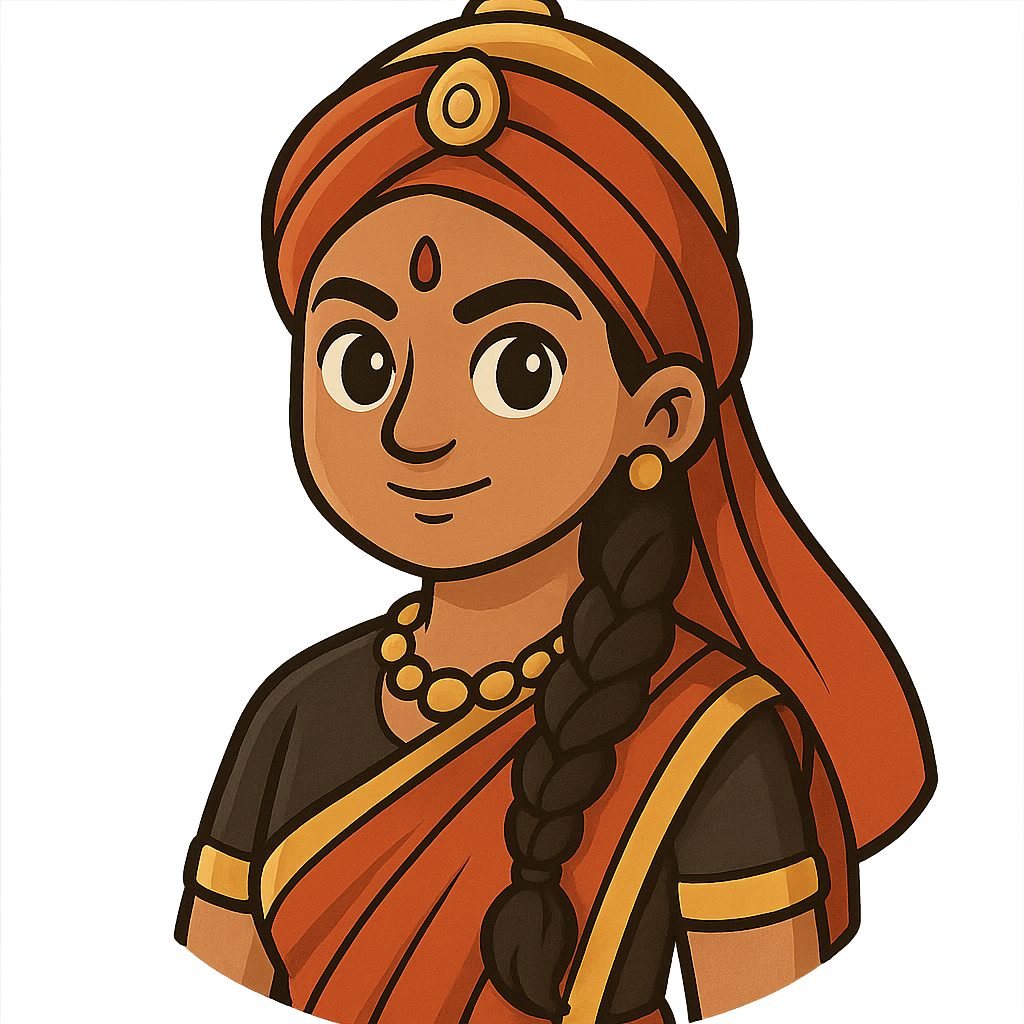
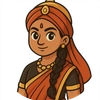
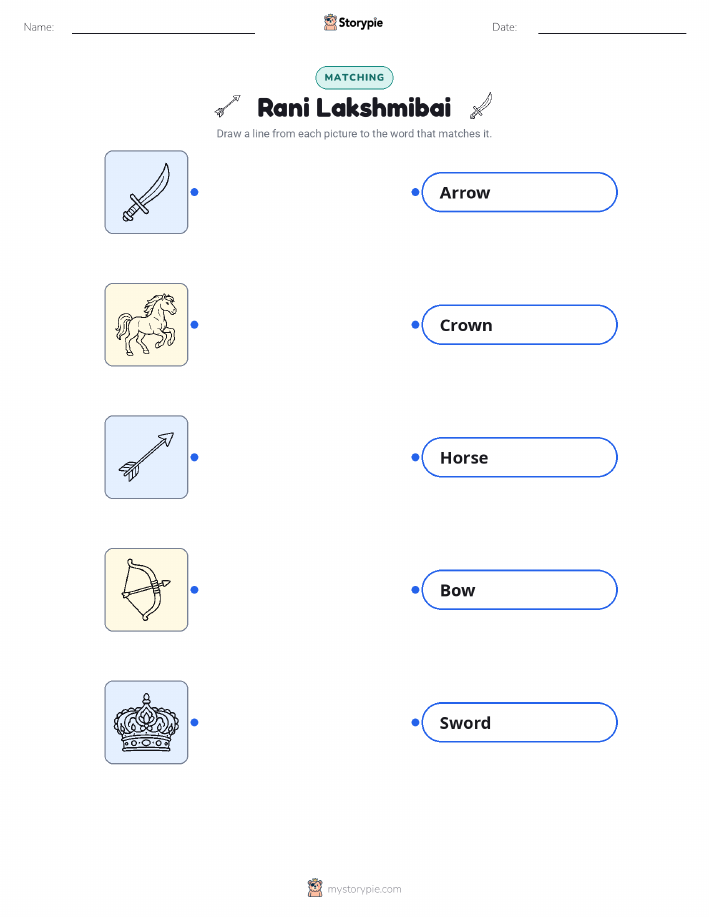
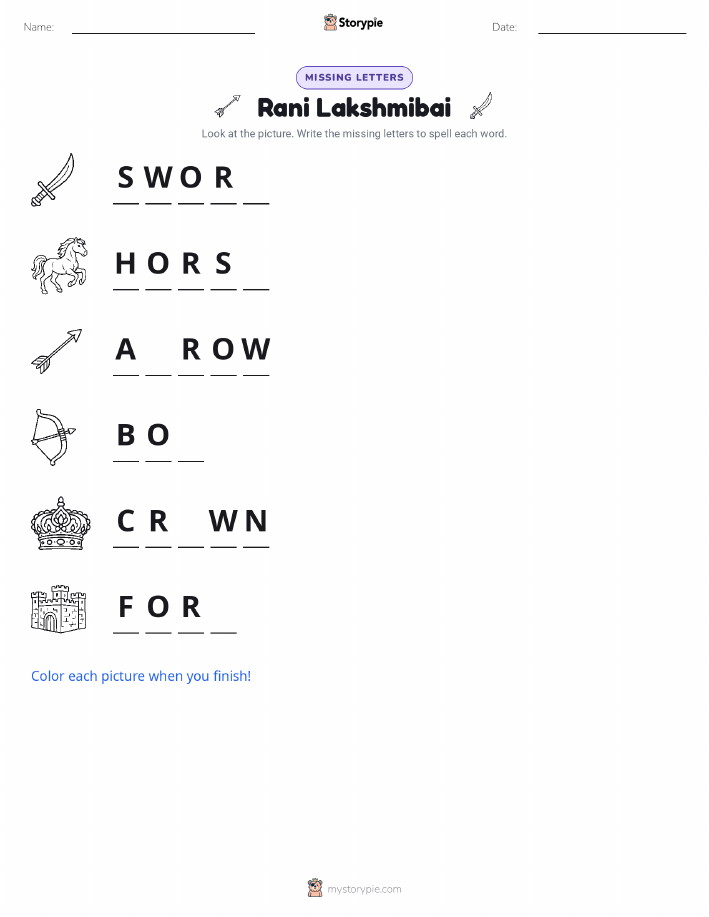
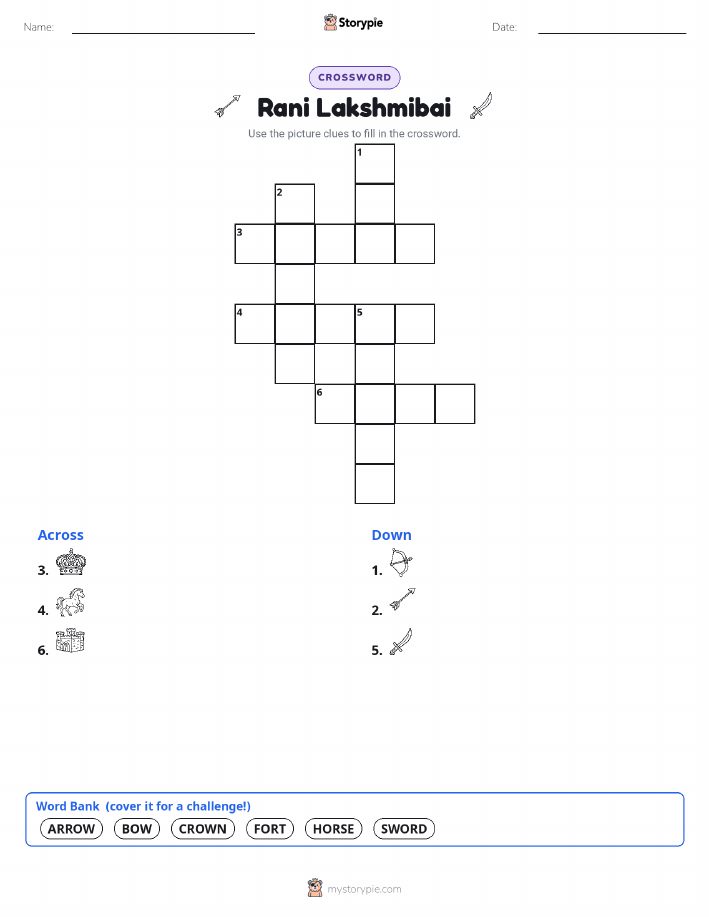
You may know me as Rani Lakshmibai, the warrior queen of Jhansi, but my story begins with a different name. I was born Manikarnika Tambe on November 19th, 1828, in the sacred city of Varanasi. My family and friends affectionately called me 'Manu.' Growing up during that time in India, my childhood was quite unusual for a girl. While other girls learned household tasks, my days were spent in the court of the Peshwa in Bithoor. There, I learned to read and write, but I also trained in skills usually reserved for boys. I became skilled in sword fighting, archery, and riding my favorite horse. I trained right alongside boys who would one day become important leaders, and I learned the arts of a warrior, which would shape the entire course of my life.
My life took a dramatic turn in 1842 when, at a young age, I married the Maharaja of Jhansi, Gangadhar Rao. It was upon my marriage that I was given my new name, Lakshmibai, and I officially became the Rani, or Queen, of the kingdom of Jhansi. Adjusting to life in the palace was a significant change, but I grew to love my new home and felt a deep responsibility for the people I now ruled. In 1851, our kingdom was filled with joy when I gave birth to a son and heir. Tragically, our happiness was short-lived, as he passed away only a few months later, leaving the kingdom in sorrow. To secure the future of Jhansi, my husband and I adopted a young boy named Damodar Rao in 1853, making him our legal heir. The very next day, my beloved husband, the Maharaja, also passed away. Suddenly, I found myself a widow and the regent, ruling the kingdom on behalf of our young son.
Rani Lakshmibai
You may know me as Rani Lakshmibai, the warrior queen of Jhansi, but my story begins with a different name. I was born Manikarnika Tambe on November 19th, 1828, in the sacred city of Varanasi. My family and friends affectionately called me 'Manu.' Growing up during that time in India, my childhood was quite unusual for a girl. While other girls learned household tasks, my days were spent in the court of the Peshwa in Bithoor. There, I learned to read and write, but I also trained in skills usually reserved for boys. I became skilled in sword fighting, archery, and riding my favorite horse. I trained right alongside boys who would one day become important leaders, and I learned the arts of a warrior, which would shape the entire course of my life.
My life took a dramatic turn in 1842 when, at a young age, I married the Maharaja of Jhansi, Gangadhar Rao. It was upon my marriage that I was given my new name, Lakshmibai, and I officially became the Rani, or Queen, of the kingdom of Jhansi. Adjusting to life in the palace was a significant change, but I grew to love my new home and felt a deep responsibility for the people I now ruled. In 1851, our kingdom was filled with joy when I gave birth to a son and heir. Tragically, our happiness was short-lived, as he passed away only a few months later, leaving the kingdom in sorrow. To secure the future of Jhansi, my husband and I adopted a young boy named Damodar Rao in 1853, making him our legal heir. The very next day, my beloved husband, the Maharaja, also passed away. Suddenly, I found myself a widow and the regent, ruling the kingdom on behalf of our young son.
During this period, a powerful British organization, the East India Company, was expanding its control over many parts of India. The British Governor-General, Lord Dalhousie, had established a policy called the 'Doctrine of Lapse.' This rule was a political tool that stated if an Indian ruler died without a natural-born son to inherit the throne, the British could take over his kingdom. In 1854, the British decided to apply this harsh rule to my kingdom. They refused to recognize my adopted son, Damodar, as the rightful heir to the throne of Jhansi. Citing their own doctrine, they declared that Jhansi now belonged to them. I was ordered to leave my ancestral fort and was offered a yearly pension as compensation. I refused their offer. With all the strength and determination I possessed, I made a promise to my people and to myself: 'Mera Jhansi nahi denge'—I will not give up my Jhansi.
The year 1857 marked the beginning of a great uprising against British rule that swept across India, and I knew it was my duty to join the struggle for my kingdom’s independence. I began to prepare for war, gathering my army and organizing my defenses. My forces were unique because they included a regiment of brave women soldiers whom I had personally trained for battle. In March of 1858, our resolve was put to the test when a massive British army laid siege to my fort. For two long weeks, we fought with everything we had, day and night, to defend our home. When it became clear that the fort's walls would eventually be breached, I knew that my fight could not end there. In the dark of night, I tied my son Damodar securely to my back, mounted my horse, and made a courageous escape, leaping over the high walls of the fort to safety. I rode to join other rebel leaders, including Tantia Tope, and together we continued to challenge the British forces. Our combined armies were even strong enough to capture the mighty fort of Gwalior.
My relentless fight for the freedom of my kingdom came to an end during a fierce battle near Gwalior on June 18th, 1858. Dressed as a soldier, I led my troops from the front, fighting bravely until my final moments. I lived to be just 29 years old. Although my life was short, my story did not end with my death. Today, people all across India and the world remember me not just as a queen, but as a fearless warrior who fought with incredible courage for her people and her homeland. My life has become a symbol of patriotism and resistance against injustice, inspiring countless people to stand up for what they believe in, no matter how difficult the challenge may seem.
Wow facts
About
The queen of the princely state of Jhansi in central India, who became a leading figure in the Indian Rebellion of 1857 and is remembered as a national heroine and symbol of resistance to British rule.
Take a Quiz
Question 1 of 5
What was the 'Doctrine of Lapse,' and how did the British use it against Rani Lakshmibai?
Explore next






Want to do even more?
Go beyond exploring. Unlock tools that turn every story into real learning.

Storypie Plus for families
Full stories, quizzes, and printables. Nights and car rides, sorted.
- Unlimited audio stories
- Create Mode: your child stars in the story
- Offline downloads
- Printable worksheets & coloring pages

Why Storypie for Schools
Students engaged. Prep in seconds. Evenings back to you.
- Worksheets & Quizzes
- Classroom Management
- Formative Assessment
- Custom Curriculum & Lesson Plans
- 27 Languages

Why Storypie for Homeschool
Curriculum done. They'll ask for more. Hours back in your day.
- Worksheet Generator
- First-Person Audio Stories
- Built-in Comprehension Quizzes
- Custom Curriculum & Lesson Plans
- Print & Go Activities