English

Robert E. Lee
Robert E.
Reads at Grades 6–8 Listens at Grades 4–8
Print & create
Answer keys·No prep·Free with an account
28 worksheets · answer keys · full story · quiz · Ages 10-12 · CEFR B2
Plus adds 102,000+ more stories in 27 languages, audio for every one, and printables for all of them.
Just want Robert E. Lee?
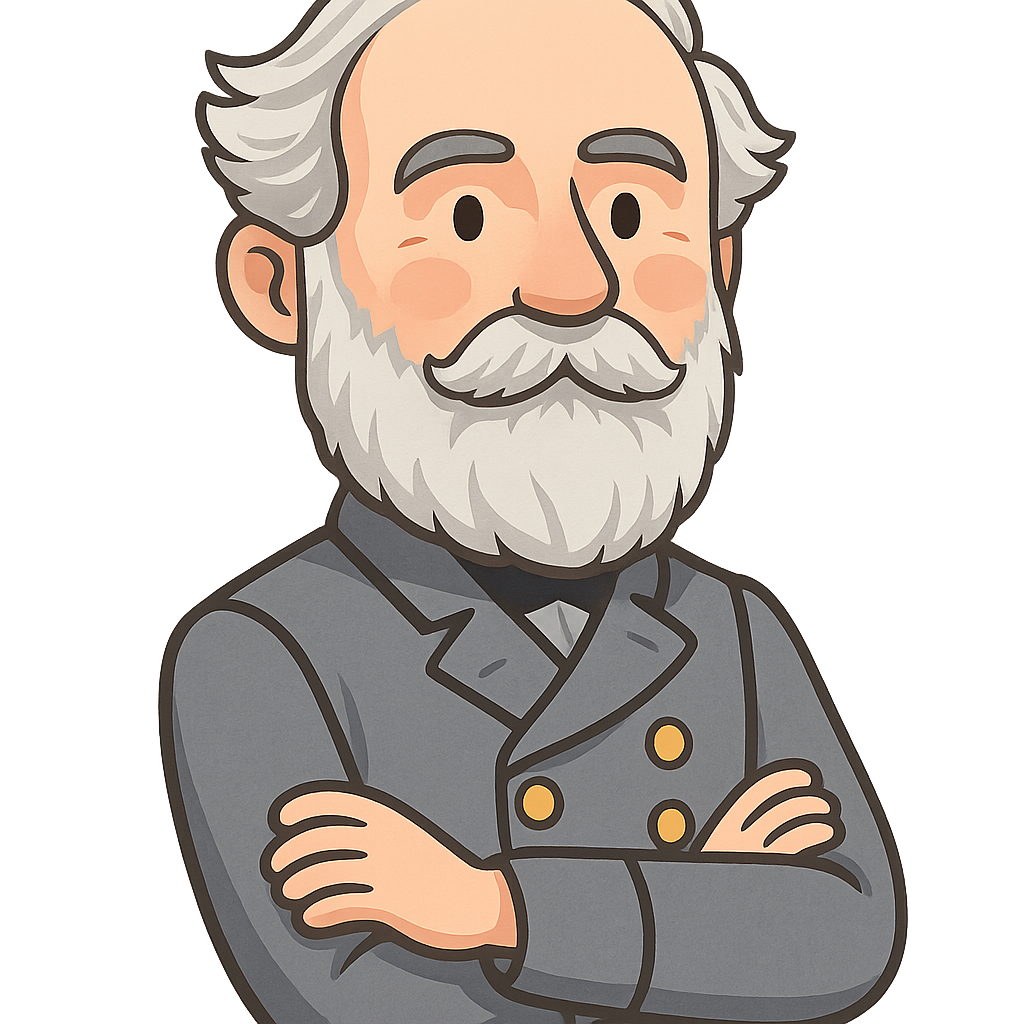
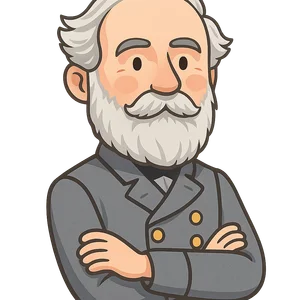
Hello, my name is Robert E. Lee. My story begins on January 19th, 1807, at my family's beautiful home, Stratford Hall, in Virginia. I grew up in a world that valued duty and honor, largely because of my father, Henry 'Light-Horse Harry' Lee III, who was a celebrated hero in the American Revolution. The stories of his service inspired me from a young age. In 1825, I decided to follow a similar path of service to my country by enrolling at the United States Military Academy at West Point. The life of a cadet was demanding, but I dedicated myself completely to my studies and training. My hard work paid off, and in 1829, I graduated second in my class. I was proud to have finished my four years without ever receiving a single demerit, which is a mark given for poor conduct.
After graduating from West Point, my career began in the U.S. Army Corps of Engineers. For many years, my work took me across the country, where I was responsible for important projects like building coastal forts and surveying major rivers. This work was crucial for strengthening our nation's defenses and improving its infrastructure. My skills as a soldier and leader were truly put to the test during the Mexican-American War, which lasted from 1846 to 1848. During the conflict, I had the privilege of serving as a staff officer for General Winfield Scott. Observing him taught me invaluable lessons about military strategy and leadership under pressure. A few years later, in 1852, I was given a great honor: I was asked to return to West Point to serve as its Superintendent. In this role, I had the opportunity to help shape the next generation of military officers, a responsibility I took very seriously.
Robert E. Lee: A Soldier's Story
Hello, my name is Robert E. Lee. My story begins on January 19th, 1807, at my family's beautiful home, Stratford Hall, in Virginia. I grew up in a world that valued duty and honor, largely because of my father, Henry 'Light-Horse Harry' Lee III, who was a celebrated hero in the American Revolution. The stories of his service inspired me from a young age. In 1825, I decided to follow a similar path of service to my country by enrolling at the United States Military Academy at West Point. The life of a cadet was demanding, but I dedicated myself completely to my studies and training. My hard work paid off, and in 1829, I graduated second in my class. I was proud to have finished my four years without ever receiving a single demerit, which is a mark given for poor conduct.
After graduating from West Point, my career began in the U.S. Army Corps of Engineers. For many years, my work took me across the country, where I was responsible for important projects like building coastal forts and surveying major rivers. This work was crucial for strengthening our nation's defenses and improving its infrastructure. My skills as a soldier and leader were truly put to the test during the Mexican-American War, which lasted from 1846 to 1848. During the conflict, I had the privilege of serving as a staff officer for General Winfield Scott. Observing him taught me invaluable lessons about military strategy and leadership under pressure. A few years later, in 1852, I was given a great honor: I was asked to return to West Point to serve as its Superintendent. In this role, I had the opportunity to help shape the next generation of military officers, a responsibility I took very seriously.
By the year 1861, the United States was a nation in turmoil. Deep and bitter disagreements, especially over the issue of slavery, were tearing the country apart. This period was the most challenging and heartbreaking of my entire life. As states began to leave the Union, I was faced with an impossible choice. President Abraham Lincoln, through an associate, offered me the command of the main Union Army. I was deeply opposed to the idea of the country breaking apart, and I had served the United States Army my entire adult life. However, my home state of Virginia was leaving the Union, and I could not bear the thought of fighting against my own family, my neighbors, and my home. On April 20th, 1861, I made the agonizing decision to resign from the U.S. Army. As I explained to my sister, 'I cannot raise my hand against my relatives, my children, my home.' My loyalty to Virginia was paramount, and I chose to offer my military services for its defense.
Shortly after my resignation, I became a general in the Confederate Army. In June of 1862, I was given command of the primary Confederate force in the east, which became known as the Army of Northern Virginia. For the next three years, my soldiers and I fought in the American Civil War, a conflict that brought immense sorrow to our nation. We faced incredible challenges, as we were often outnumbered and had far fewer supplies, weapons, and food than the Union armies we fought against. We participated in many famous and brutal battles that defined the war. The fighting was long and devastating for everyone involved. By the spring of 1865, my army was exhausted, and our resources were gone. On April 9th, 1865, I met with the Union General, Ulysses S. Grant, at a small home in a village called Appomattox Court House, Virginia. There, I surrendered my army, an act that helped bring the long and painful war to a close.
After the war ended, my main focus was on helping the country heal and reunify. I firmly believed it was time for all Americans to move forward as one nation again. In the fall of 1865, I accepted an offer to become the president of Washington College in Lexington, Virginia. I spent my final years there, dedicated to educating young men and promoting peace and reconciliation between the North and South. I lived to be 63 years old, and my life came to an end on October 12th, 1870. Today, I am remembered as a skilled military commander. But my legacy is complex, as I led an army that fought to preserve a way of life that included the institution of slavery. My story is a significant part of America's history, a reminder of a difficult time when the nation was divided and of the profound choices people faced.
Wow facts
About
Robert E. Lee was an American military officer best known for commanding the Confederate Army of Northern Virginia during the American Civil War from 1861 until his surrender in 1865. After the war, he became the president of Washington College, which was renamed Washington and Lee University in 1870.
Take a Quiz
Question 1 of 5
What was the main reason I gave for resigning from the U.S. Army in 1861?
Explore next




Want to do even more?
Go beyond exploring. Unlock tools that turn every story into real learning.

Storypie Plus for families
Full stories, quizzes, and printables. Nights and car rides, sorted.
- Unlimited audio stories
- Create Mode: your child stars in the story
- Offline downloads
- Printable worksheets & coloring pages

Why Storypie for Schools
Students engaged. Prep in seconds. Evenings back to you.
- Worksheets & Quizzes
- Classroom Management
- Formative Assessment
- Custom Curriculum & Lesson Plans
- 27 Languages

Why Storypie for Homeschool
Curriculum done. They'll ask for more. Hours back in your day.
- Worksheet Generator
- First-Person Audio Stories
- Built-in Comprehension Quizzes
- Custom Curriculum & Lesson Plans
- Print & Go Activities