English

Robert Recorde
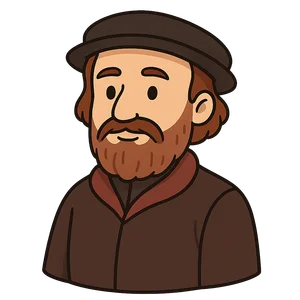
A 16th-century Welsh physician and mathematician who authored several important books on math in English…
Reads at Grades 3–5 Listens at Grades 1–5
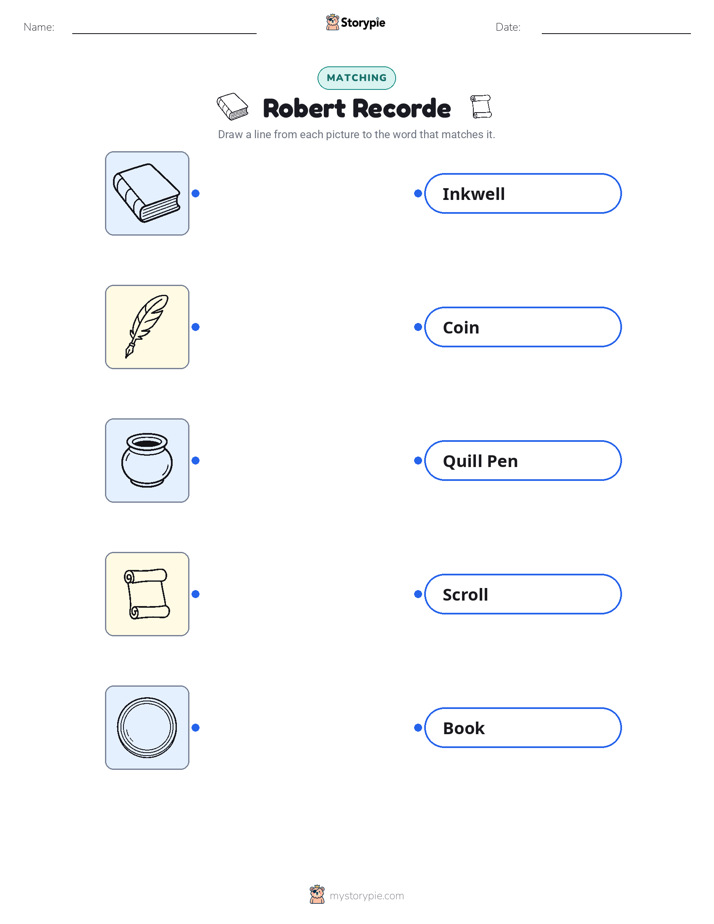
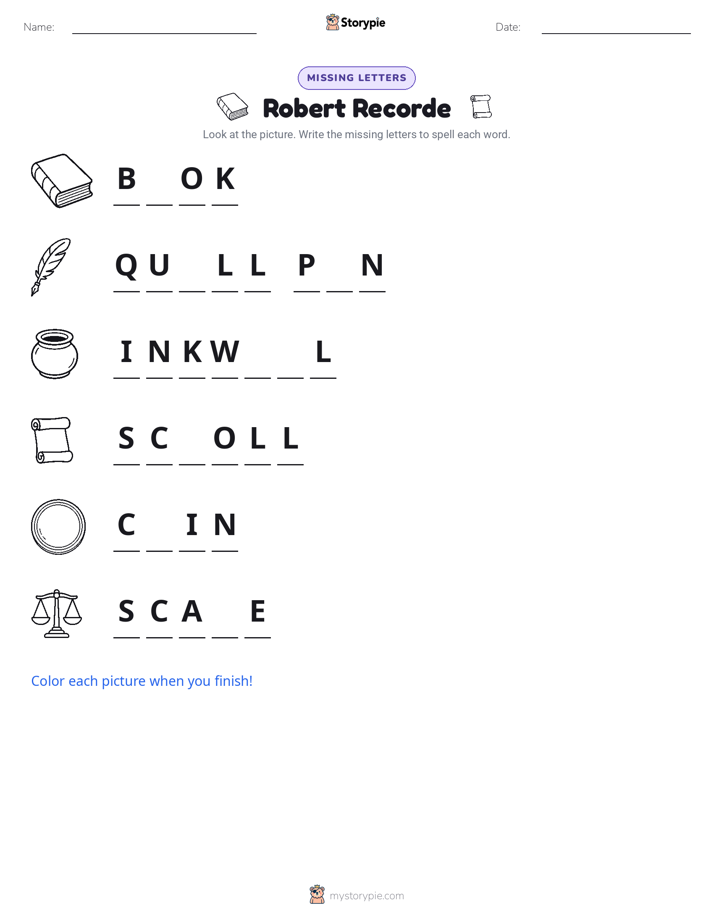
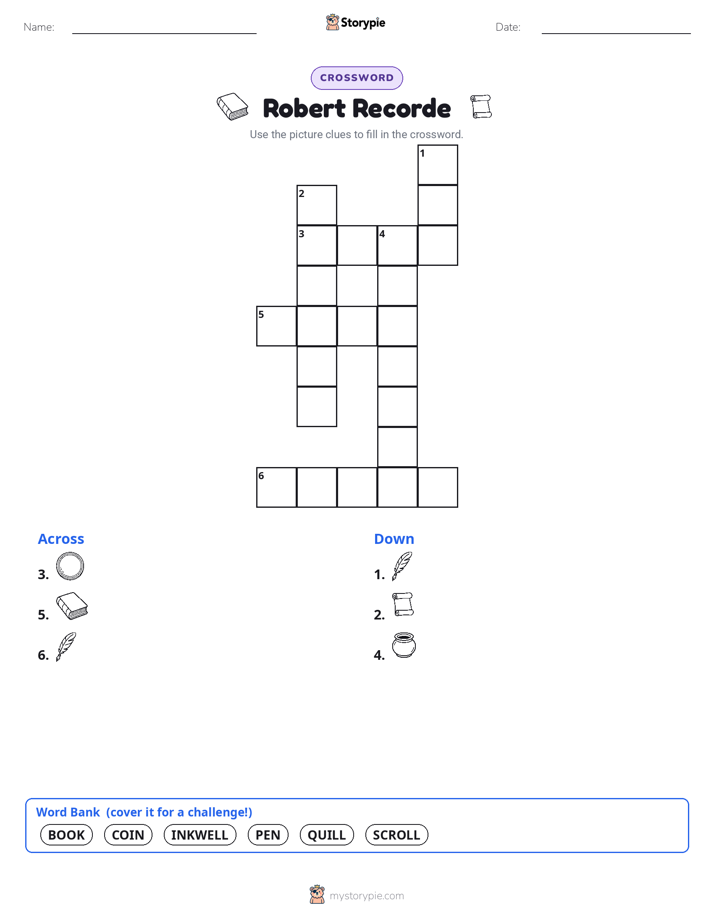
Print & create
Answer keys·No prep·Free with an account
28 worksheets · answer keys · full story · quiz · Ages 8-10 · CEFR B1
Plus adds 244,000+ more stories in 27 languages, audio for every one, and printables for all of them.
Just want Robert Recorde?
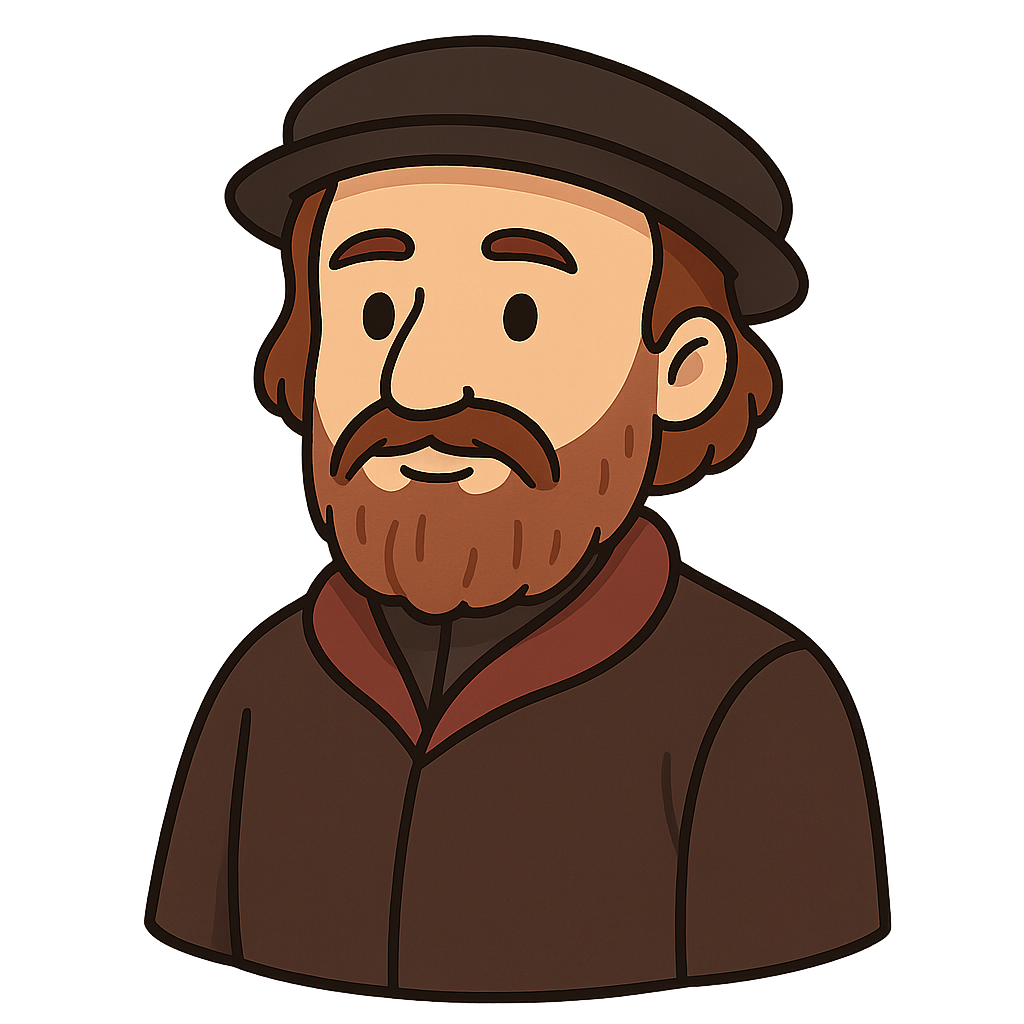
Hello, my name is Robert Recorde. My story begins in a lovely seaside town in Wales called Tenby, where I was born around the year 1512. From a very young age, I had a great love for learning. This passion for knowledge took me far from my home. Around the year 1525, I began my studies at the famous University of Oxford. I continued my education at another great school, Cambridge University. It was there that I worked hard and finally earned my degree to become a medical doctor in 1545. I was so proud to have achieved my goal, but I soon discovered that my heart had another, even greater passion.
After finishing my studies, I became a physician, and I was quite successful. I even had the honor of being the personal doctor to very important people, including King Edward VI and Queen Mary I. It was a great responsibility to care for the health of royalty. However, as much as I valued my work as a doctor, my true love was for mathematics and teaching. In my time, during the 1500s, most books about math were written in a language called Latin. This was a problem because only scholars and wealthy people could read Latin, which meant most ordinary people couldn't learn about numbers and equations. I believed that mathematics should be for everyone. So, in 1543, I wrote my very first book, 'The Ground of Arts,' in English to make arithmetic easy and even fun for all.
After my first book, I knew I had to keep going. I wanted to unlock all the different parts of mathematics for English speakers. In 1551, I published another book called 'The Pathway to Knowledge,' which was all about geometry—the study of shapes and spaces. But my most famous work came a few years later. In 1557, I wrote a book about algebra called 'The Whetstone of Witte.' While writing it, I noticed I was writing the same words over and over: 'is equal to.' It was taking up so much time and space. I thought there must be a better way. An idea came to me. I decided to use two parallel lines to mean 'is equal to.' As I explained in my book, 'I will set a pair of parallels... because no two things can be more equal.' And just like that, I invented the equals sign (=), a symbol that students all over the world still use today.
Robert Recorde
Hello, my name is Robert Recorde. My story begins in a lovely seaside town in Wales called Tenby, where I was born around the year 1512. From a very young age, I had a great love for learning. This passion for knowledge took me far from my home. Around the year 1525, I began my studies at the famous University of Oxford. I continued my education at another great school, Cambridge University. It was there that I worked hard and finally earned my degree to become a medical doctor in 1545. I was so proud to have achieved my goal, but I soon discovered that my heart had another, even greater passion.
After finishing my studies, I became a physician, and I was quite successful. I even had the honor of being the personal doctor to very important people, including King Edward VI and Queen Mary I. It was a great responsibility to care for the health of royalty. However, as much as I valued my work as a doctor, my true love was for mathematics and teaching. In my time, during the 1500s, most books about math were written in a language called Latin. This was a problem because only scholars and wealthy people could read Latin, which meant most ordinary people couldn't learn about numbers and equations. I believed that mathematics should be for everyone. So, in 1543, I wrote my very first book, 'The Ground of Arts,' in English to make arithmetic easy and even fun for all.
After my first book, I knew I had to keep going. I wanted to unlock all the different parts of mathematics for English speakers. In 1551, I published another book called 'The Pathway to Knowledge,' which was all about geometry—the study of shapes and spaces. But my most famous work came a few years later. In 1557, I wrote a book about algebra called 'The Whetstone of Witte.' While writing it, I noticed I was writing the same words over and over: 'is equal to.' It was taking up so much time and space. I thought there must be a better way. An idea came to me. I decided to use two parallel lines to mean 'is equal to.' As I explained in my book, 'I will set a pair of parallels... because no two things can be more equal.' And just like that, I invented the equals sign (=), a symbol that students all over the world still use today.
My life wasn't just about writing books and practicing medicine. I also held an important position working for the government at the Royal Mint, which was in charge of making coins for the kingdom. Unfortunately, this work led to some very serious trouble. I got into a major disagreement with a powerful nobleman. This argument had very bad consequences for me. Because of this powerful man's influence, I was blamed for problems at the Mint and was eventually sent to prison. It was there, in a London prison, that my life came to an end in the year 1558.
I lived to be about 46 years old. Even though my life had a sad and difficult ending, I am very proud that my ideas have lived on for hundreds of years. I am remembered not just as a doctor to kings and queens, but as a teacher who wanted to make mathematics understandable for everyone by writing books in English. Every time you solve a math problem and write the equals sign, you are using my simple invention to show that two things are perfectly in balance. My hope was to make learning easier, and I am happy to know that my work still helps people do that today.
Wow facts
About
A 16th-century Welsh physician and mathematician who authored several important books on math in English, including "The Grounde of Artes" (1543) and "The Pathway to Knowledge" (1551), and invented the equals sign (=).
Take a Quiz
Question 1 of 5
Why did Robert Recorde decide to write his math books in English instead of Latin?
Explore next






Want to do even more?
Go beyond exploring. Unlock tools that turn every story into real learning.

Storypie Plus for families
Full stories, quizzes, and printables. Nights and car rides, sorted.
- Unlimited audio stories
- Create Mode: your child stars in the story
- Offline downloads
- Printable worksheets & coloring pages

Why Storypie for Schools
Students engaged. Prep in seconds. Evenings back to you.
- Worksheets & Quizzes
- Classroom Management
- Formative Assessment
- Custom Curriculum & Lesson Plans
- 27 Languages

Why Storypie for Homeschool
Curriculum done. They'll ask for more. Hours back in your day.
- Worksheet Generator
- First-Person Audio Stories
- Built-in Comprehension Quizzes
- Custom Curriculum & Lesson Plans
- Print & Go Activities