English

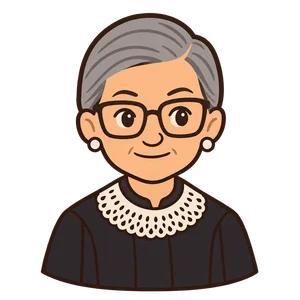
Ruth Bader Ginsburg
An American lawyer and jurist who served as an associate justice of the U.S.
Reads at Grades 6–8 Listens at Grades 4–8
Print & create
Answer keys·No prep·Free with an account
28 worksheets · answer keys · full story · quiz · Ages 10-12 · CEFR B2
Plus adds 290,000+ more stories in 27 languages, audio for every one, and printables for all of them.
Just want Ruth Bader Ginsburg?
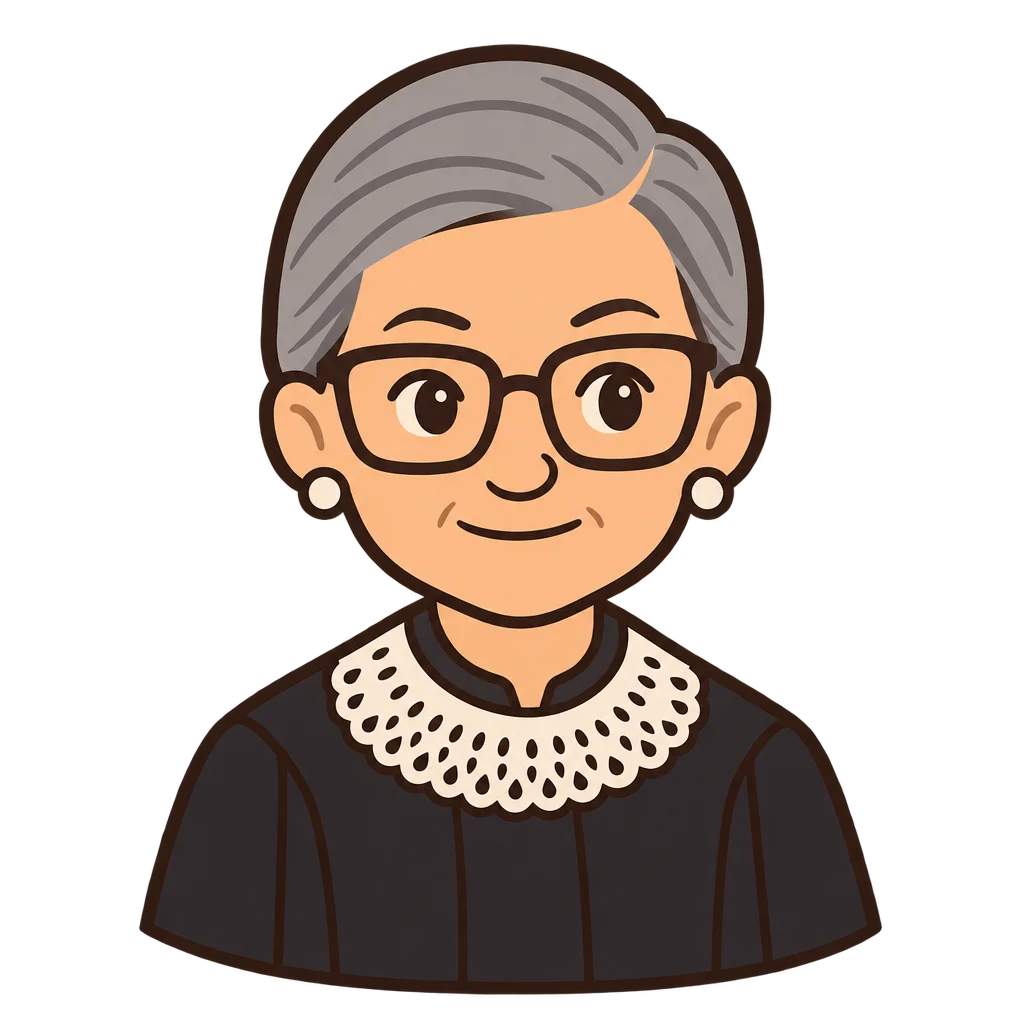
Hello, my name is Ruth Bader Ginsburg, and I want to tell you my story. I was born in a busy neighborhood in Brooklyn, New York, on March 15th, 1933. My parents, Celia and Nathan, were hardworking people who believed deeply in the power of knowledge. My mother, Celia, was my greatest inspiration. She taught me to be independent and to value my education above all else. She wanted me to have a full life, one filled with more opportunities than she ever had. Tragically, my mother battled cancer and passed away just before my high school graduation. Losing her was incredibly difficult, but her dream for me became a fire inside my own heart. I was determined to live the life she had imagined for me, and that ambition guided every step I took from that day forward.
After high school, I went to Cornell University in the early 1950s. It was an exciting time, and it was there that I met a wonderful and supportive young man named Martin Ginsburg, who everyone called 'Marty'. We fell in love and decided to build a life together. After college, I set my sights on law school. In 1956, I enrolled at Harvard Law School, but it was a challenging environment. In a class of over 500 students, I was one of only nine women. The world was very different then, and not everyone believed women belonged in places like a law school. I remember the dean asking all of the female students to stand up and explain why we felt we deserved a spot that could have gone to a man. It was a difficult question, but it made me more determined. My journey became even more complex when Marty was diagnosed with cancer. I attended his classes as well as my own, typing up his notes so he wouldn't fall behind, all while caring for him and our young daughter, Jane. I eventually transferred to Columbia Law School to be with Marty after he recovered and took a job in New York, and in 1959, I graduated at the top of my class.
A Story of Justice: My Life as Ruth Bader Ginsburg
Hello, my name is Ruth Bader Ginsburg, and I want to tell you my story. I was born in a busy neighborhood in Brooklyn, New York, on March 15th, 1933. My parents, Celia and Nathan, were hardworking people who believed deeply in the power of knowledge. My mother, Celia, was my greatest inspiration. She taught me to be independent and to value my education above all else. She wanted me to have a full life, one filled with more opportunities than she ever had. Tragically, my mother battled cancer and passed away just before my high school graduation. Losing her was incredibly difficult, but her dream for me became a fire inside my own heart. I was determined to live the life she had imagined for me, and that ambition guided every step I took from that day forward.
After high school, I went to Cornell University in the early 1950s. It was an exciting time, and it was there that I met a wonderful and supportive young man named Martin Ginsburg, who everyone called 'Marty'. We fell in love and decided to build a life together. After college, I set my sights on law school. In 1956, I enrolled at Harvard Law School, but it was a challenging environment. In a class of over 500 students, I was one of only nine women. The world was very different then, and not everyone believed women belonged in places like a law school. I remember the dean asking all of the female students to stand up and explain why we felt we deserved a spot that could have gone to a man. It was a difficult question, but it made me more determined. My journey became even more complex when Marty was diagnosed with cancer. I attended his classes as well as my own, typing up his notes so he wouldn't fall behind, all while caring for him and our young daughter, Jane. I eventually transferred to Columbia Law School to be with Marty after he recovered and took a job in New York, and in 1959, I graduated at the top of my class.
Despite my excellent grades, my journey as a lawyer started with rejection. In the early 1960s, many law firms simply would not hire a woman. They told me no, time and time again. It was disheartening, but I refused to give up. Since the traditional path was closed to me, I found another way to use my law degree and became a law professor. This new path led me to the work that would define my career. In the 1970s, I began working with the American Civil Liberties Union, or ACLU. There, I saw an opportunity to fight for fairness on a national level. In 1972, I co-founded the Women's Rights Project. My strategy was to show the courts that laws based on gender were unfair to everyone, not just women. I carefully selected cases to argue before the Supreme Court that demonstrated how these laws harmed men and families, too. For example, in a 1973 case called Frontiero v. Richardson, I argued against a rule that made it harder for a woman in the Air Force to get housing benefits for her husband than it was for a man to get them for his wife. I wanted the judges to see that making rules based on gender was illogical and hurt everyone's freedom.
My work arguing for equality eventually led me to become a judge myself. In 1980, President Jimmy Carter appointed me to the U.S. Court of Appeals for the District of Columbia Circuit, one of the most important courts in the nation. I served there for thirteen years, carefully writing opinions and making decisions based on the law. Then, in 1993, I received the highest honor a lawyer could imagine. President Bill Clinton appointed me to be a Justice on the Supreme Court of the United States. It was a momentous occasion, and I became the second woman ever to serve on the nation's highest court. I was thrilled to join Justice Sandra Day O'Connor, the first woman justice. As a Supreme Court Justice, my job was to interpret the Constitution and decide if the country's laws were fair. Sometimes, the court would make a decision that I strongly disagreed with. In those moments, I would write what is called a 'dissent'. My dissents explained my reasoning and offered a different point of view, hoping that my words might persuade future generations to see things differently.
As the years went on, I was surprised to find that I had become a well-known figure, especially among young people. They gave me the nickname 'The Notorious R.B.G.', and it made me smile to see that my life's work was inspiring others to stand up for their beliefs. It was a great joy to know that my story encouraged people to believe in the power of thoughtful disagreement and steady persistence. I served on the Supreme Court for 27 years, working for as long as I could to make our country a more fair and just place. I lived to be 87 years old. My hope is that my life serves as a reminder that real and lasting change happens one step at a time. Fighting for what is right is always worth it, even when the path is long and difficult.
Wow facts
About
An American lawyer and jurist who served as an associate justice of the U.S. Supreme Court from 1993 until her death in 2020, becoming a prominent advocate for gender equality.
Take a Quiz
Question 1 of 5
In your own words, retell the main events of Ruth Bader Ginsburg's journey from law student to Supreme Court Justice.
Explore next





Want to do even more?
Go beyond exploring. Unlock tools that turn every story into real learning.

Storypie Plus for families
Full stories, quizzes, and printables. Nights and car rides, sorted.
- Unlimited audio stories
- Create Mode: your child stars in the story
- Offline downloads
- Printable worksheets & coloring pages

Why Storypie for Schools
Students engaged. Prep in seconds. Evenings back to you.
- Worksheets & Quizzes
- Classroom Management
- Formative Assessment
- Custom Curriculum & Lesson Plans
- 27 Languages

Why Storypie for Homeschool
Curriculum done. They'll ask for more. Hours back in your day.
- Worksheet Generator
- First-Person Audio Stories
- Built-in Comprehension Quizzes
- Custom Curriculum & Lesson Plans
- Print & Go Activities