English


Sima Qian
Sima Qian was a Chinese historian of the early Han dynasty…
Reads at Grades 6–8 Listens at Grades 4–8
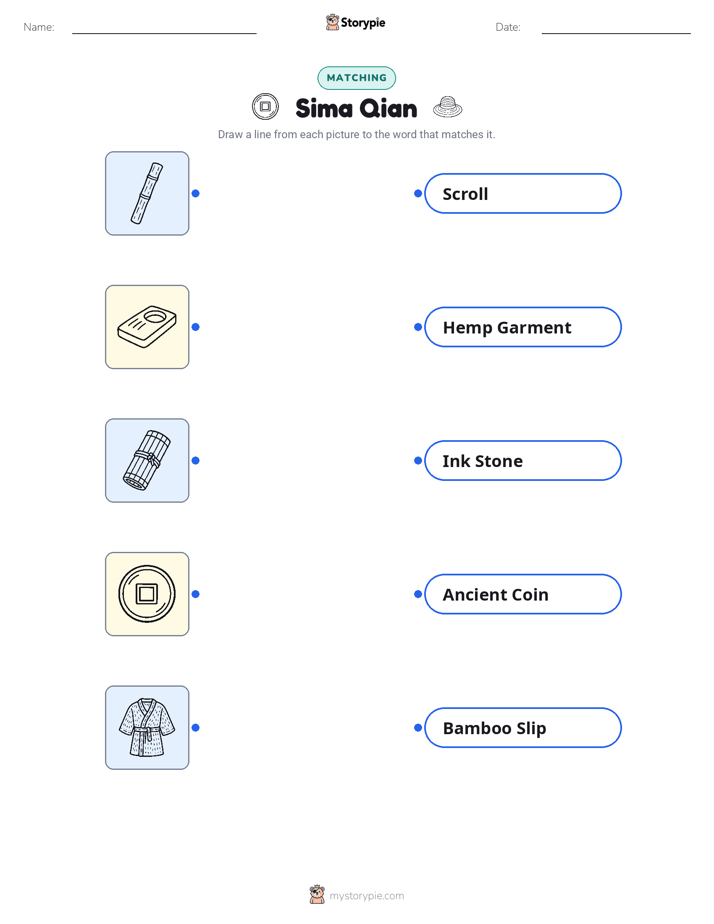
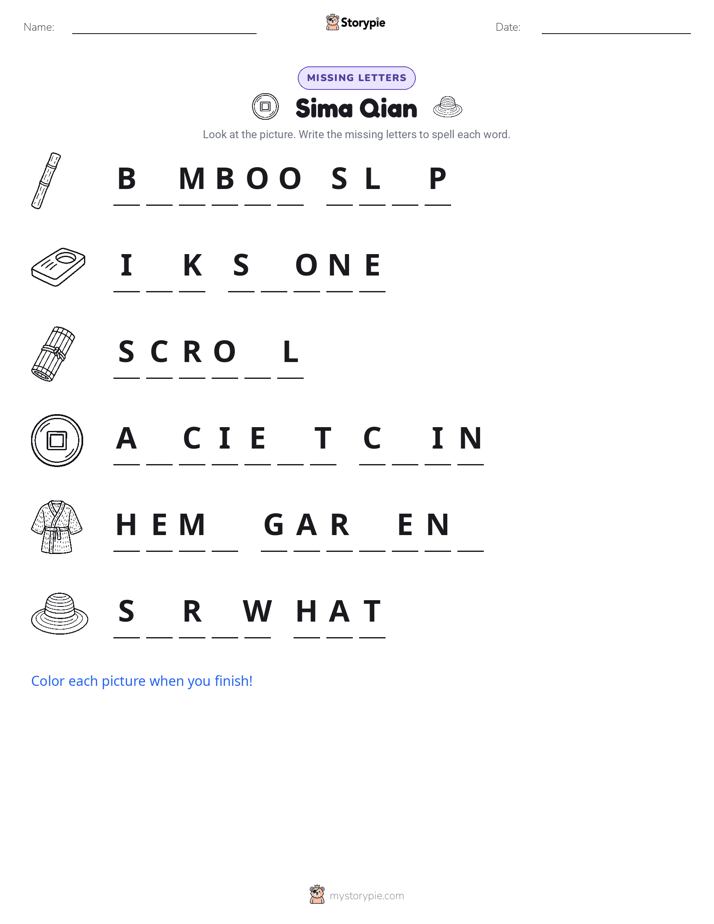
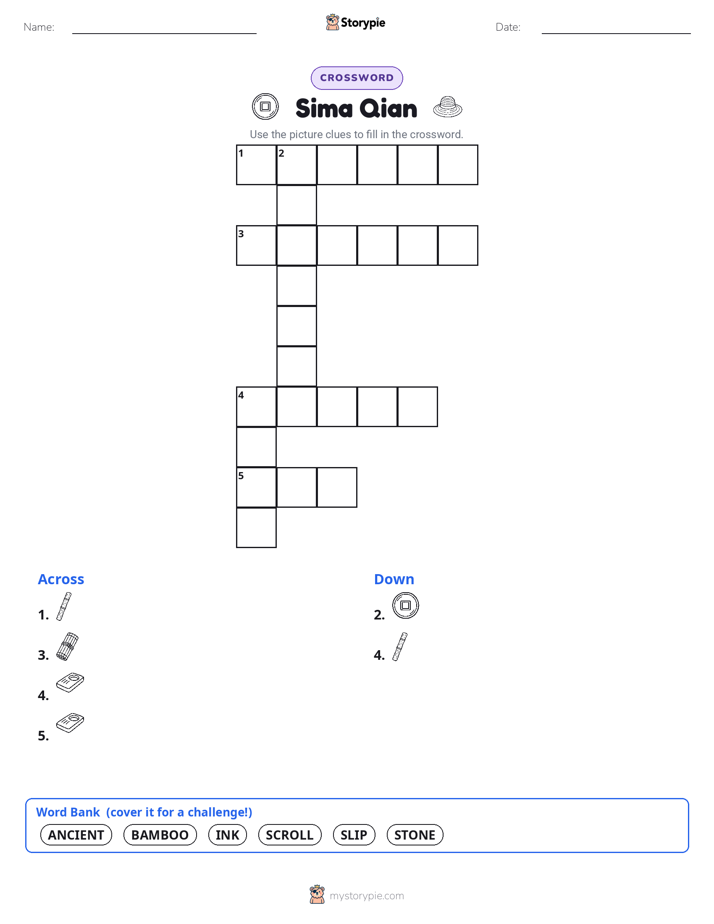
Print & create
Answer keys·No prep·Free with an account
28 worksheets · answer keys · full story · quiz · Ages 10-12 · CEFR B2
Plus adds 280,000+ more stories in 27 languages, audio for every one, and printables for all of them.
Just want Sima Qian?

My name is Sima Qian, and I am known as the father of Chinese history. My story begins around the year 145 BCE in a place called Longmen, during the height of the powerful Han Dynasty in China. The world I was born into was full of ancient traditions and stories waiting to be told. My father, Sima Tan, held one of the most respected positions in the empire: he was the Grand Historian. His job was to observe the heavens, keep records, and advise the emperor. From my earliest days, he was my greatest teacher. He taught me to read the ancient texts written on bamboo slips and filled my mind with tales of heroes, emperors, and philosophers from centuries past. His passion for history became my own. When I turned twenty years old, around 125 BCE, I embarked on a great journey across China. I wanted to see the land with my own eyes and hear its stories from the people who lived them. I traveled to ancient battlefields, visited the tombs of legendary kings, and sat with elders in quiet villages, carefully writing down every story and memory they shared with me. This journey was my real education, teaching me that history was not just a collection of dates, but the living story of our people.
My father, Sima Tan, had a dream that consumed him. He wanted to write a single, great book that would tell the entire history of China, from the mythical Yellow Emperor down to our own time. It was a project of enormous scale, one that no one had ever attempted before. He spent years gathering materials and planning its structure, but time was not on his side. In the year 110 BCE, my father fell gravely ill. As he lay dying, he called me to his side and made me promise that I would complete the work he had started. With tears in my eyes, I gave him my word. It was a heavy responsibility, but also a profound honor. After his death, I inherited his title, becoming the Prefect of the Grand Scribes, or Grand Historian, just as he had been. Around 109 BCE, I officially began the monumental project. I decided to call it the 'Shiji,' which means 'Records of the Grand Historian.' My goal was not just to fulfill my promise, but to create a history so complete that future generations would always know where they came from.
Sima Qian: The Grand Historian of China
My name is Sima Qian, and I am known as the father of Chinese history. My story begins around the year 145 BCE in a place called Longmen, during the height of the powerful Han Dynasty in China. The world I was born into was full of ancient traditions and stories waiting to be told. My father, Sima Tan, held one of the most respected positions in the empire: he was the Grand Historian. His job was to observe the heavens, keep records, and advise the emperor. From my earliest days, he was my greatest teacher. He taught me to read the ancient texts written on bamboo slips and filled my mind with tales of heroes, emperors, and philosophers from centuries past. His passion for history became my own. When I turned twenty years old, around 125 BCE, I embarked on a great journey across China. I wanted to see the land with my own eyes and hear its stories from the people who lived them. I traveled to ancient battlefields, visited the tombs of legendary kings, and sat with elders in quiet villages, carefully writing down every story and memory they shared with me. This journey was my real education, teaching me that history was not just a collection of dates, but the living story of our people.
My father, Sima Tan, had a dream that consumed him. He wanted to write a single, great book that would tell the entire history of China, from the mythical Yellow Emperor down to our own time. It was a project of enormous scale, one that no one had ever attempted before. He spent years gathering materials and planning its structure, but time was not on his side. In the year 110 BCE, my father fell gravely ill. As he lay dying, he called me to his side and made me promise that I would complete the work he had started. With tears in my eyes, I gave him my word. It was a heavy responsibility, but also a profound honor. After his death, I inherited his title, becoming the Prefect of the Grand Scribes, or Grand Historian, just as he had been. Around 109 BCE, I officially began the monumental project. I decided to call it the 'Shiji,' which means 'Records of the Grand Historian.' My goal was not just to fulfill my promise, but to create a history so complete that future generations would always know where they came from.
Working for the emperor was a great honor, but it was also very dangerous. The Emperor Wu was a powerful and brilliant ruler, but he had a fierce temper, and his favor could turn in an instant. My life took a dramatic and terrible turn in the year 99 BCE. A general named Li Ling, whom I respected, suffered a major defeat against our enemies in the north. The entire court was in an uproar, and everyone rushed to blame the general for the failure. I believed Li Ling was an honorable man who had fought bravely against impossible odds, so I spoke up in his defense before the emperor. This was a grave mistake. Emperor Wu became furious that I would dare to contradict him. He offered me a terrible choice: I could accept an honorable death, or I could suffer a punishment that was considered the ultimate shame, but which would allow me to live. For a scholar and a gentleman, death was often seen as the better option. However, I thought of my promise to my father and the unfinished pages of the 'Shiji.' I chose to endure the shame and live, because my duty to history was more important than my own pride or reputation. I knew that if I died, our history might be lost forever.
After that dark period, I dedicated every moment of my life to my work. The promise I made to my father was the light that guided me through my personal suffering. I spent years writing, editing, and organizing the thousands of stories I had collected. My book, the 'Shiji,' was not just a simple timeline of events. I wanted to capture the soul of our civilization. I wrote detailed biographies of not only emperors and nobles but also of scholars, soldiers, merchants, and even famous assassins, because I believed everyone's story was a part of the larger whole. I created separate sections that described important aspects of our culture, such as the history of music, the development of the calendar, and the principles of our economy. I wanted to give a full, three-dimensional picture of our world. Finally, around the year 94 BCE, after decades of relentless effort, I completed the 'Records of the Grand Historian.' Holding the finished work, a collection of over half a million written characters on bamboo slips, I felt an immense sense of relief and pride. I had fulfilled my promise and finished my life's purpose.
I lived a full life until about the year 86 BCE, reaching the age of around 59. My greatest hope was that my work would outlive me, ensuring that the stories of our ancestors would never be forgotten. That hope came true. My book, the 'Shiji,' became the foundation of Chinese historical writing, setting the standard for every official history written for the next two thousand years. It was copied and studied by countless scholars and rulers who came after me. Today, people still read my words to learn about the great figures and epic stories of China's past. I am remembered as the father of Chinese history, not just for writing a book, but for establishing the idea that to understand our future, we must first deeply and honestly understand our past.
Wow facts
About
Sima Qian was a Chinese historian of the early Han dynasty, widely regarded as the father of Chinese historiography for his monumental work, the 'Records of the Grand Historian' (Shiji).
Take a Quiz
Question 1 of 5
What was the main problem Sima Qian faced after his father's death, and how did he resolve it?
Explore next






Want to do even more?
Go beyond exploring. Unlock tools that turn every story into real learning.

Storypie Plus for families
Full stories, quizzes, and printables. Nights and car rides, sorted.
- Unlimited audio stories
- Create Mode: your child stars in the story
- Offline downloads
- Printable worksheets & coloring pages

Why Storypie for Schools
Students engaged. Prep in seconds. Evenings back to you.
- Worksheets & Quizzes
- Classroom Management
- Formative Assessment
- Custom Curriculum & Lesson Plans
- 27 Languages

Why Storypie for Homeschool
Curriculum done. They'll ask for more. Hours back in your day.
- Worksheet Generator
- First-Person Audio Stories
- Built-in Comprehension Quizzes
- Custom Curriculum & Lesson Plans
- Print & Go Activities