English

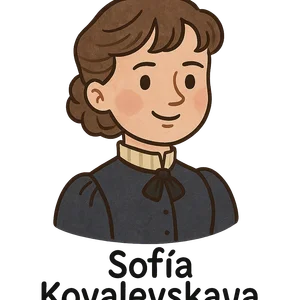
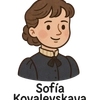
Sofía Kovalevskaya
A pioneering Russian mathematician, writer, and advocate for women's rights in education.
Reads at Grades 3–5 Listens at Grades 1–5
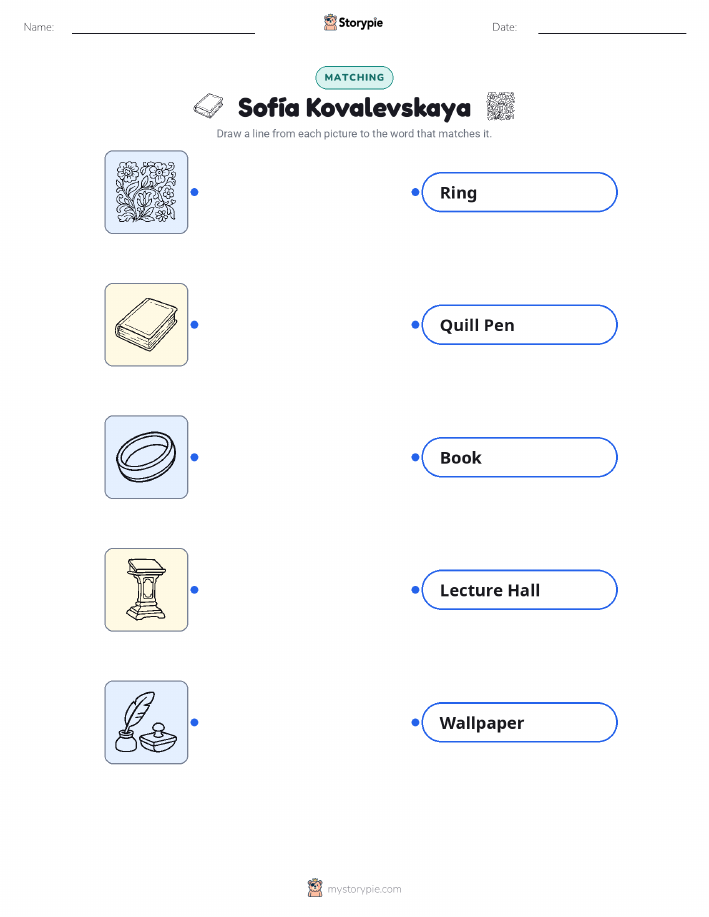
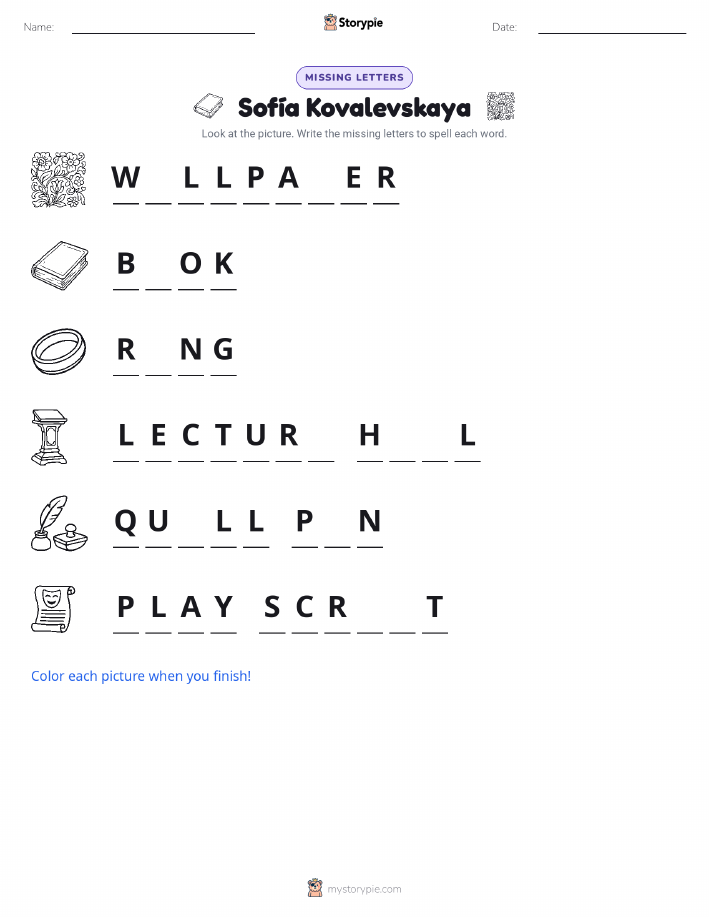
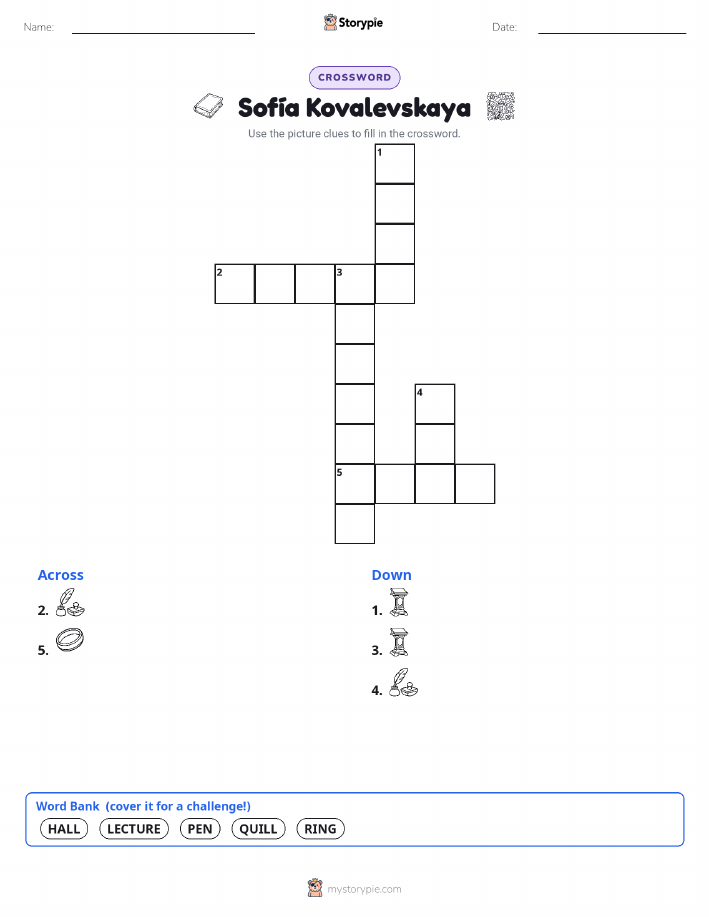
Print & create
Answer keys·No prep·Free with an account
28 worksheets · answer keys · full story · quiz · Ages 8-10 · CEFR B1
Plus adds 279,000+ more stories in 27 languages, audio for every one, and printables for all of them.
Just want Sofía Kovalevskaya?
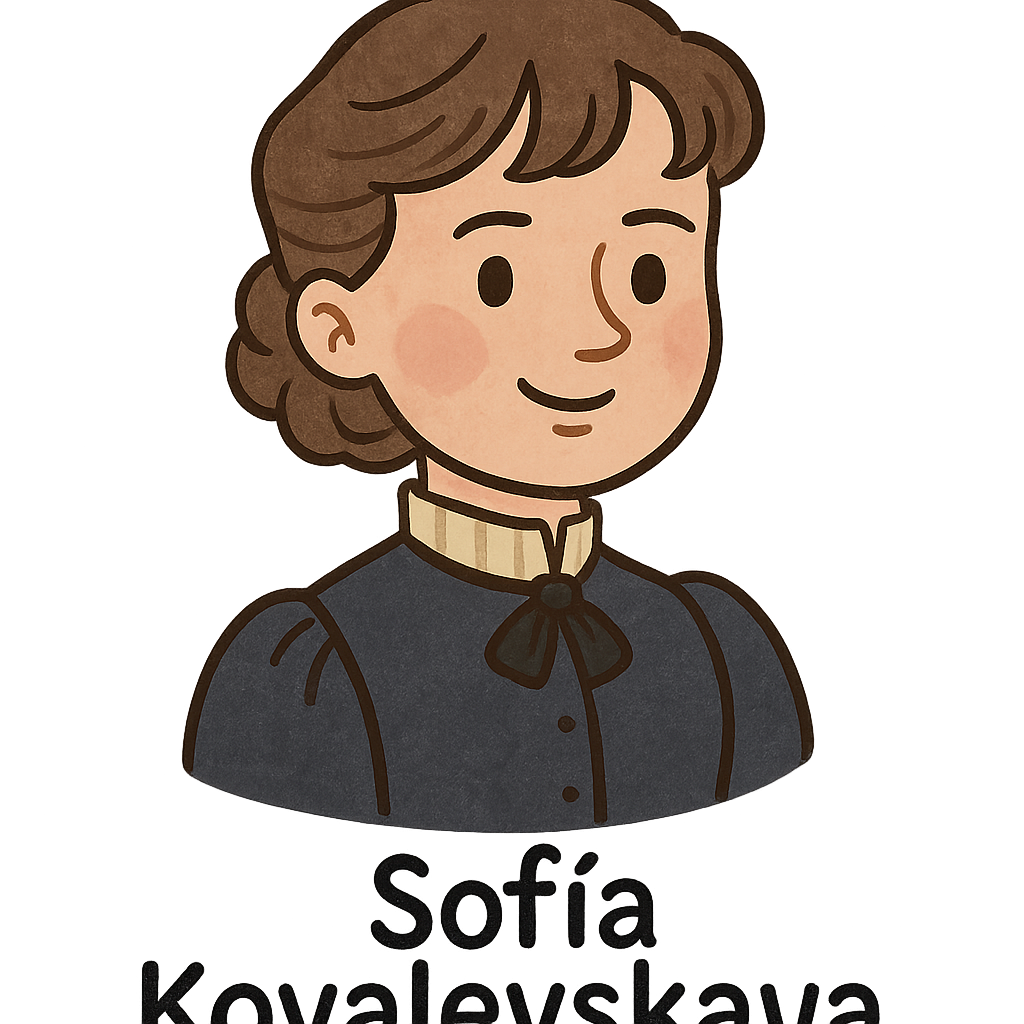
Hello, my name is Sofía Kovalevskaya, and I want to tell you the story of my love for numbers. I was born on January 15th, 1850, in Moscow, Russia. From a very young age, I was fascinated by mathematics. A funny thing happened when I was a little girl that made me even more curious. My parents ran out of wallpaper for my nursery, so instead, they covered the walls with pages from my father's old calculus lecture notes. I would spend hours staring at all the strange symbols and equations, trying to figure out what they meant. The patterns were like a secret code that I wanted to understand. My uncle saw how much I loved numbers and encouraged my curiosity, helping me explore the world of mathematics even more.
As I grew older, my greatest wish was to study mathematics at a university. However, in the 1800s, universities in Russia did not allow women to be students. I was determined not to let this stop me. I knew that if I were married, I would be allowed to travel outside of Russia to study. So, in 1868, I made a plan and entered into a 'marriage of convenience' with a young man named Vladimir Kovalevsky. This meant we married so I could have the freedom to pursue my education. In 1869, our plan worked, and I was able to travel to Germany to attend university lectures. My journey eventually took me to Berlin, where I hoped to study with a famous mathematician named Karl Weierstrass. But once again, the university would not let me enroll because I was a woman. Mr. Weierstrass saw my talent and agreed to teach me privately, and I worked incredibly hard to prove I belonged in the world of mathematics.
Sofía Kovalevskaya: The Girl Who Loved Numbers
Hello, my name is Sofía Kovalevskaya, and I want to tell you the story of my love for numbers. I was born on January 15th, 1850, in Moscow, Russia. From a very young age, I was fascinated by mathematics. A funny thing happened when I was a little girl that made me even more curious. My parents ran out of wallpaper for my nursery, so instead, they covered the walls with pages from my father's old calculus lecture notes. I would spend hours staring at all the strange symbols and equations, trying to figure out what they meant. The patterns were like a secret code that I wanted to understand. My uncle saw how much I loved numbers and encouraged my curiosity, helping me explore the world of mathematics even more.
As I grew older, my greatest wish was to study mathematics at a university. However, in the 1800s, universities in Russia did not allow women to be students. I was determined not to let this stop me. I knew that if I were married, I would be allowed to travel outside of Russia to study. So, in 1868, I made a plan and entered into a 'marriage of convenience' with a young man named Vladimir Kovalevsky. This meant we married so I could have the freedom to pursue my education. In 1869, our plan worked, and I was able to travel to Germany to attend university lectures. My journey eventually took me to Berlin, where I hoped to study with a famous mathematician named Karl Weierstrass. But once again, the university would not let me enroll because I was a woman. Mr. Weierstrass saw my talent and agreed to teach me privately, and I worked incredibly hard to prove I belonged in the world of mathematics.
All of my dedication and hard work finally led to a wonderful achievement. In 1874, I earned my doctorate degree in mathematics from the University of Göttingen. It was a very proud moment for me. The professors were so impressed with my research that they gave me the degree with the highest honors, summa cum laude, and said I did not even need to take the final exam. My mind was always busy with new ideas, and my research covered many different topics, including a study on the beautiful rings of the planet Saturn. Even with this high honor, it was still very difficult for a woman to find a job as a professor. The world was not yet ready for female mathematicians to lead a classroom, but I was not ready to give up.
My patience and persistence paid off. I moved to Sweden, and in 1884, I was given the job of professor at Stockholm University. This was a historic moment because I became the first woman in modern Europe to hold such an important position in mathematics. I loved teaching and continuing my research. My most famous discovery was about the way spinning objects, like a top, move through space. My work on this topic became known as the 'Kovalevskaya top,' and it is still studied today. For this important contribution to mathematics, I proudly accepted a famous award called the Prix Bordin in 1888. It felt wonderful to be recognized for the work that I loved so much.
My life was a journey filled with challenges, but also with the great joy of discovery. I fell ill and my life ended in 1891. I lived to be 41 years old. Looking back, I am proud that my work showed everyone that women could be brilliant mathematicians and scientists. I hope that by following my passion for numbers, I helped open doors for many other girls who dream of studying science. My ideas are still studied today, and I am remembered for my determination to follow my dreams no matter the obstacle.
Wow facts
About
A pioneering Russian mathematician, writer, and advocate for women's rights in education. She was the first woman to obtain a doctorate in mathematics in modern Europe and the first woman appointed to a full professorship in Northern Europe.
Take a Quiz
Question 1 of 5
Why did the mathematician Karl Weierstrass have to teach Sofía privately?
Explore next


Want to do even more?
Go beyond exploring. Unlock tools that turn every story into real learning.

Storypie Plus for families
Full stories, quizzes, and printables. Nights and car rides, sorted.
- Unlimited audio stories
- Create Mode: your child stars in the story
- Offline downloads
- Printable worksheets & coloring pages

Why Storypie for Schools
Students engaged. Prep in seconds. Evenings back to you.
- Worksheets & Quizzes
- Classroom Management
- Formative Assessment
- Custom Curriculum & Lesson Plans
- 27 Languages

Why Storypie for Homeschool
Curriculum done. They'll ask for more. Hours back in your day.
- Worksheet Generator
- First-Person Audio Stories
- Built-in Comprehension Quizzes
- Custom Curriculum & Lesson Plans
- Print & Go Activities