English

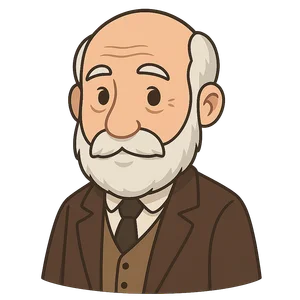
Santiago Ramón y Cajal
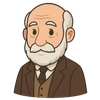
Santiago Ramón y Cajal was a Spanish neuroscientist, pathologist…
Reads at Grades 3–5 Listens at Grades 1–5
Print & create
Answer keys·No prep·Free with an account
28 worksheets · answer keys · full story · quiz · Ages 8-10 · CEFR B1
Plus adds 280,000+ more stories in 27 languages, audio for every one, and printables for all of them.
Just want Santiago Ramón y Cajal?
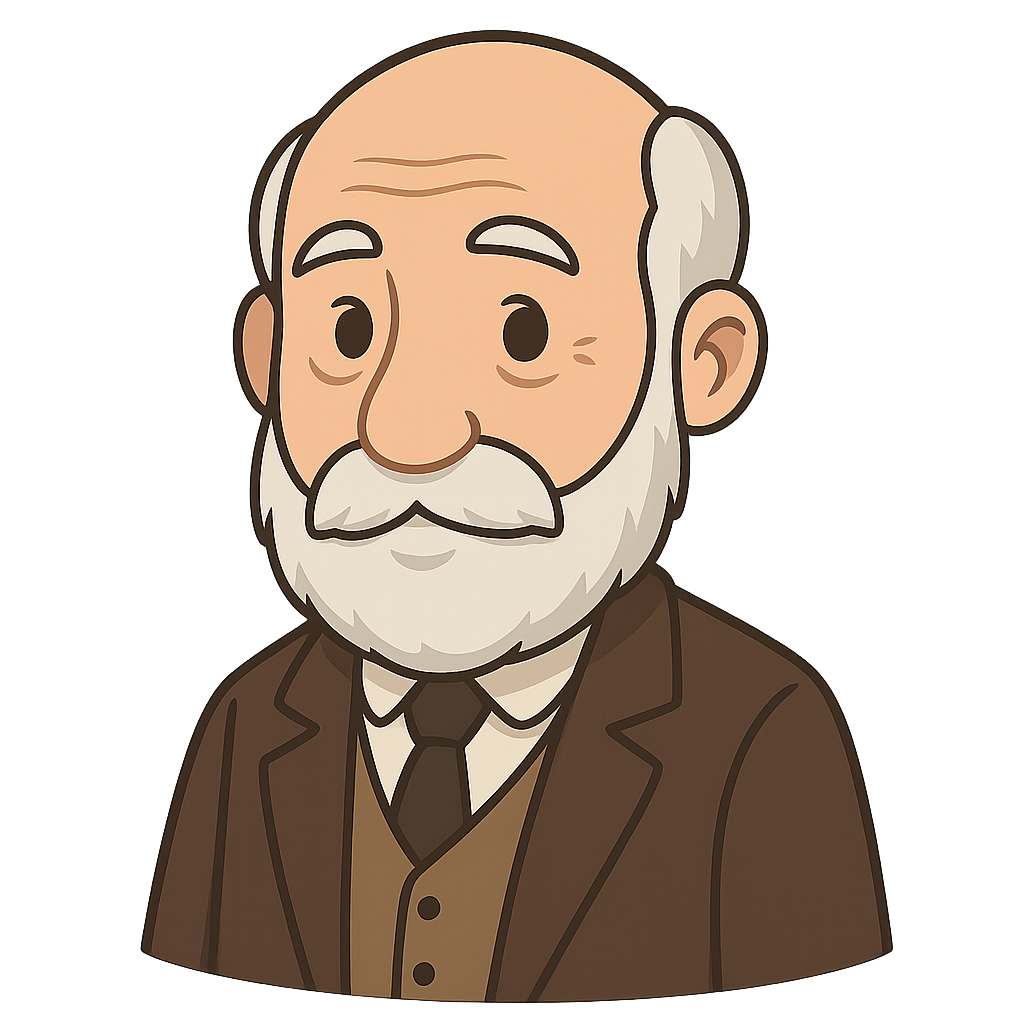
Hello! My name is Santiago Ramón y Cajal. I was born on May 1st, 1852, in a small town in Spain called Petilla de Aragón. My father was a doctor, and he hoped that I would follow in his footsteps and study medicine. My real passion, however, was art! I absolutely loved to draw everything I saw around me. My adventurous spirit sometimes got me into a bit of trouble, but it was all because my curiosity about the world was endless. From the tiniest bug to the largest animal, I wanted to understand how everything worked and capture it on paper.
Even though I loved art with all my heart, I also found science completely fascinating. To please my father, I agreed to study medicine, and I graduated from the University of Zaragoza in 1873. Just one year later, in 1874, a new adventure began when I joined the Spanish Army as a medical officer. My duties took me all the way across the ocean to Cuba. It was a very difficult journey, and while I was there, I became very sick with a disease called malaria. That challenging experience taught me so much about illness and the human body. When I returned to Spain, I was more determined than ever to use my knowledge to help other people.
Back in Spain, my scientific curiosity led me to buy my very own microscope in 1877. When I looked through its powerful lenses for the first time, it was like discovering a secret universe hidden from sight! I was completely amazed by the tiny, detailed patterns inside the body. My focus soon turned to one of the biggest mysteries of all: the brain and the nervous system. At that time, scientists had many questions about how the brain worked. Around 1887, I learned about a special staining method created by an Italian scientist named Camillo Golgi. This technique could make some cells turn black, which allowed them to be seen clearly under a microscope. I knew I had to try it, and I decided to improve his method to see even more details.
Santiago Ramón y Cajal: The Artist Who Drew the Brain
Hello! My name is Santiago Ramón y Cajal. I was born on May 1st, 1852, in a small town in Spain called Petilla de Aragón. My father was a doctor, and he hoped that I would follow in his footsteps and study medicine. My real passion, however, was art! I absolutely loved to draw everything I saw around me. My adventurous spirit sometimes got me into a bit of trouble, but it was all because my curiosity about the world was endless. From the tiniest bug to the largest animal, I wanted to understand how everything worked and capture it on paper.
Even though I loved art with all my heart, I also found science completely fascinating. To please my father, I agreed to study medicine, and I graduated from the University of Zaragoza in 1873. Just one year later, in 1874, a new adventure began when I joined the Spanish Army as a medical officer. My duties took me all the way across the ocean to Cuba. It was a very difficult journey, and while I was there, I became very sick with a disease called malaria. That challenging experience taught me so much about illness and the human body. When I returned to Spain, I was more determined than ever to use my knowledge to help other people.
Back in Spain, my scientific curiosity led me to buy my very own microscope in 1877. When I looked through its powerful lenses for the first time, it was like discovering a secret universe hidden from sight! I was completely amazed by the tiny, detailed patterns inside the body. My focus soon turned to one of the biggest mysteries of all: the brain and the nervous system. At that time, scientists had many questions about how the brain worked. Around 1887, I learned about a special staining method created by an Italian scientist named Camillo Golgi. This technique could make some cells turn black, which allowed them to be seen clearly under a microscope. I knew I had to try it, and I decided to improve his method to see even more details.
Using my improved staining technique, I placed a piece of brain tissue under my microscope and saw something truly incredible. The nerve cells, which we now call neurons, looked like beautiful, tiny trees with complex, spreading branches. It was in that moment that I made a breakthrough discovery. For the first time, I could clearly see that each neuron was its own separate, individual cell. Before my work, most scientists believed the nervous system was a single, tangled net of connected wires. I realized that these separate 'tree-like' neurons 'talked' to each other across tiny gaps. I called this idea the 'neuron doctrine.' My lifelong love for drawing was a huge help, as I spent countless hours sketching exactly what I saw, creating detailed and beautiful maps of the brain's hidden forests.
My discoveries completely changed the way scientists understood the brain. In 1906, my hard work was recognized with the most famous award in science: the Nobel Prize in Physiology or Medicine. I was honored to share the prize with Camillo Golgi, the very scientist whose staining method had inspired my own research. It was interesting because he and I had different ideas about how the brain was structured, but the world celebrated both of our contributions to science and our quest for knowledge.
I continued my work for many years after that, teaching students and making new discoveries at my laboratory in Madrid. I lived to be 82 years old. Today, people remember me as the 'father of modern neuroscience' because my work laid the groundwork for understanding the brain. My drawings are still admired not only for their scientific accuracy but also for their beauty. My discovery that the brain is made of individual neurons is the foundation for everything we know about how we think, feel, and remember. I hope my story shows you that following your curiosity, and even combining different passions like art and science, can lead to the most amazing discoveries.
Wow facts
About
Santiago Ramón y Cajal was a Spanish neuroscientist, pathologist, and histologist who is widely considered the father of modern neuroscience. His pioneering work on the microscopic structure of the nervous system led to the establishment of the Neuron Doctrine and earned him the Nobel Prize in Physiology or Medicine in 1906.
Take a Quiz
Question 1 of 5
What does the story mean when it says the microscope revealed a 'secret universe'?
Explore next


Want to do even more?
Go beyond exploring. Unlock tools that turn every story into real learning.

Storypie Plus for families
Full stories, quizzes, and printables. Nights and car rides, sorted.
- Unlimited audio stories
- Create Mode: your child stars in the story
- Offline downloads
- Printable worksheets & coloring pages

Why Storypie for Schools
Students engaged. Prep in seconds. Evenings back to you.
- Worksheets & Quizzes
- Classroom Management
- Formative Assessment
- Custom Curriculum & Lesson Plans
- 27 Languages

Why Storypie for Homeschool
Curriculum done. They'll ask for more. Hours back in your day.
- Worksheet Generator
- First-Person Audio Stories
- Built-in Comprehension Quizzes
- Custom Curriculum & Lesson Plans
- Print & Go Activities