English

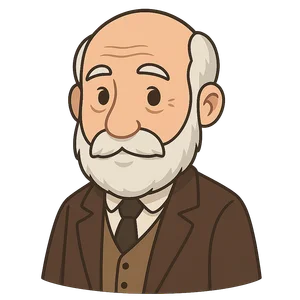
Santiago Ramón y Cajal
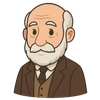
Santiago Ramón y Cajal was a Spanish neuroscientist, pathologist…
Reads at Grades 6–8 Listens at Grades 4–8
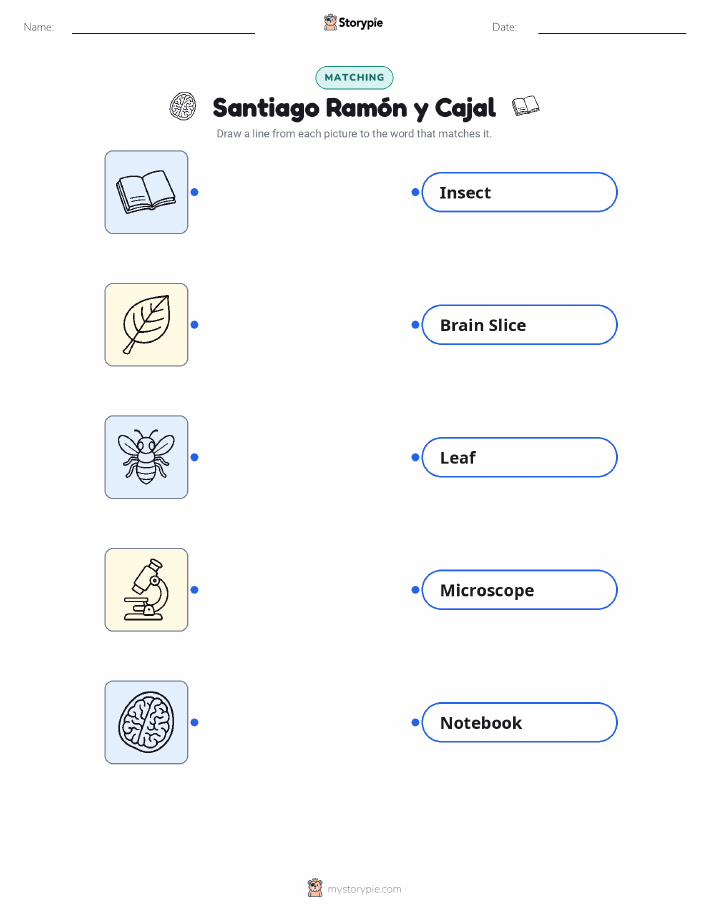
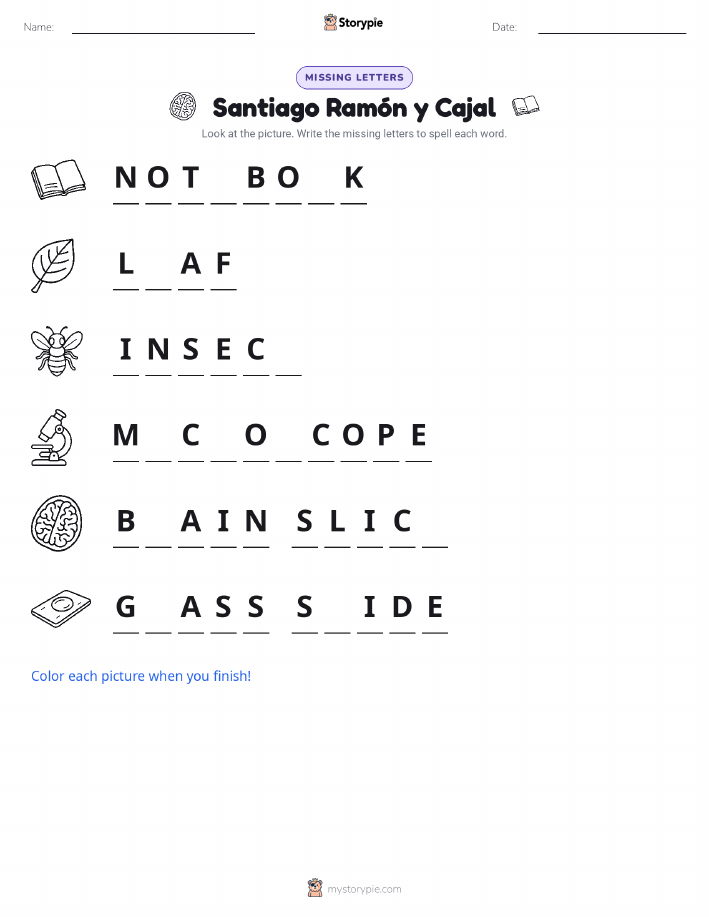
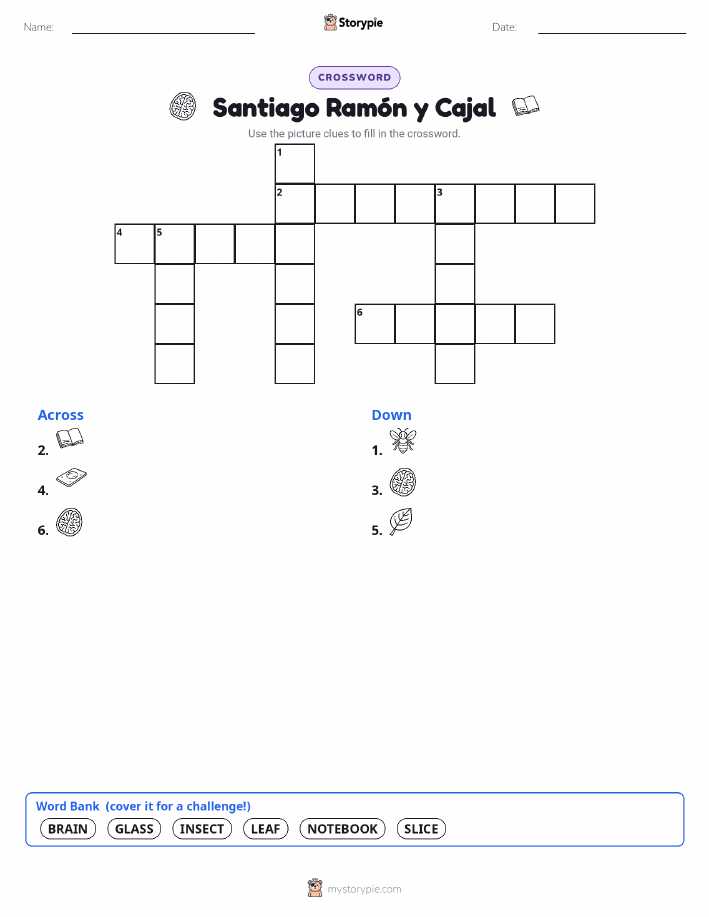
Print & create
Answer keys·No prep·Free with an account
28 worksheets · answer keys · full story · quiz · Ages 10-12 · CEFR B2
Plus adds 280,000+ more stories in 27 languages, audio for every one, and printables for all of them.
Just want Santiago Ramón y Cajal?
Hello! My name is Santiago Ramón y Cajal. I want to tell you the story of how a boy from a small town in Spain who loved to draw ended up uncovering the biggest secrets of the human brain. I was born on May 1st, 1852, in a little town called Petilla de Aragón. As a boy, I wasn't the best-behaved student. I loved art and nature far more than my school lessons. I spent hours sketching everything I saw—birds, trees, and people. My father, who was a doctor, wanted me to follow in his footsteps, but I dreamed of being an artist. He didn't think art was a serious career, and we often argued about my future. He even destroyed my drawings once, hoping to steer me toward medicine. Little did either of us know that my passion for drawing would one day become my greatest scientific tool.
Eventually, I did agree to study medicine. I attended the University of Zaragoza and earned my medical degree in 1873. My life took an unexpected turn when I was sent to Cuba, which was then a Spanish colony, to serve as a medical officer in the army from 1874 to 1875. The conditions were very difficult, and I became seriously ill with malaria and dysentery. That experience was tough, but it taught me a lot about life and disease. When I returned to Spain, I knew I didn't want to just treat patients; I wanted to understand the very causes of their illnesses. My curiosity was pulling me toward scientific research, a world where I could ask big questions and search for the answers myself.
My scientific journey truly began in 1877 when I used my own money, saved from my army service, to buy my very own microscope. Looking through that lens for the first time was like discovering a hidden universe. I was fascinated by histology, the study of the body's tissues. I spent countless hours in my small home laboratory, looking at slides of animal and human tissue. This is where my love for art and my new passion for science came together perfectly. I could draw with great detail everything I saw under the microscope. My drawings weren't just pretty pictures; they were precise scientific records that allowed me to study the intricate structures of life. I became a professor, first in Valencia in 1883 and later in Barcelona in 1887, always with my microscope and drawing pencils by my side.
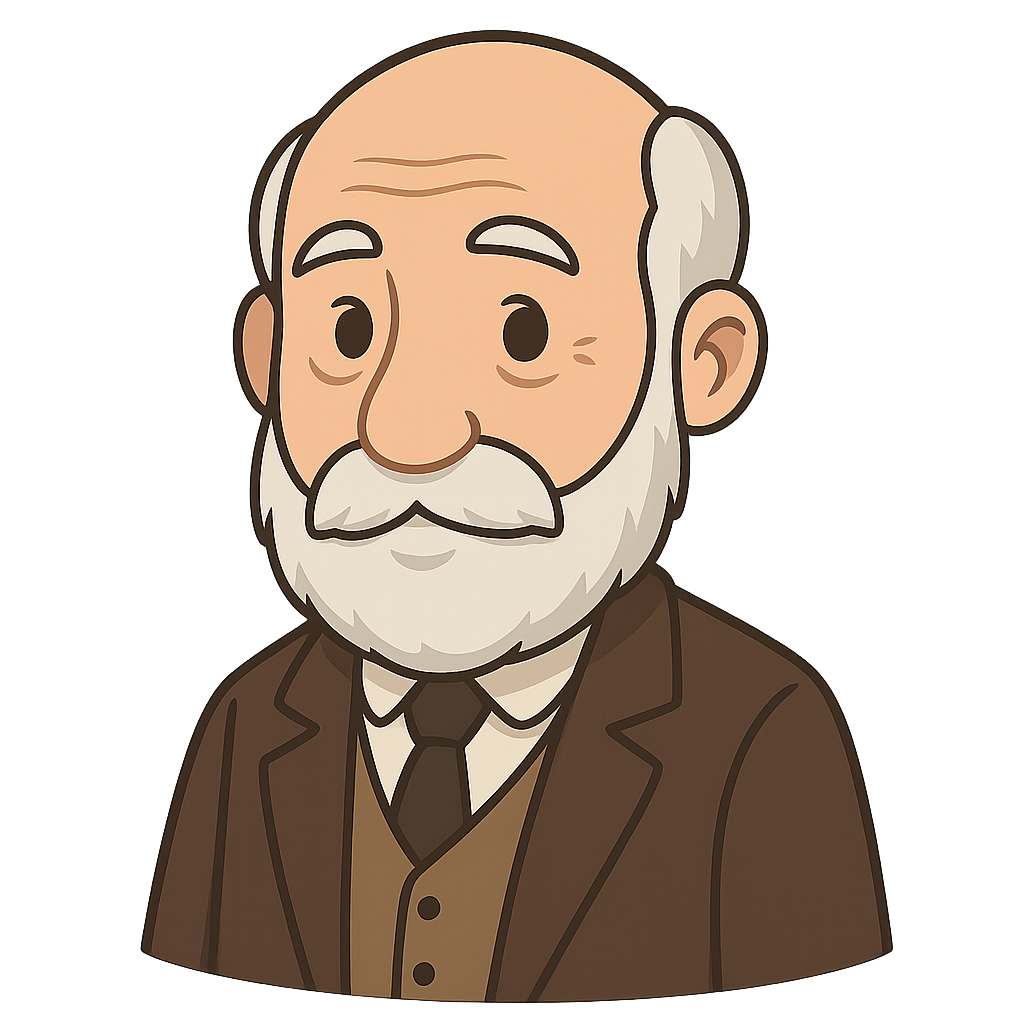
Santiago Ramón y Cajal
Hello! My name is Santiago Ramón y Cajal. I want to tell you the story of how a boy from a small town in Spain who loved to draw ended up uncovering the biggest secrets of the human brain. I was born on May 1st, 1852, in a little town called Petilla de Aragón. As a boy, I wasn't the best-behaved student. I loved art and nature far more than my school lessons. I spent hours sketching everything I saw—birds, trees, and people. My father, who was a doctor, wanted me to follow in his footsteps, but I dreamed of being an artist. He didn't think art was a serious career, and we often argued about my future. He even destroyed my drawings once, hoping to steer me toward medicine. Little did either of us know that my passion for drawing would one day become my greatest scientific tool.
Eventually, I did agree to study medicine. I attended the University of Zaragoza and earned my medical degree in 1873. My life took an unexpected turn when I was sent to Cuba, which was then a Spanish colony, to serve as a medical officer in the army from 1874 to 1875. The conditions were very difficult, and I became seriously ill with malaria and dysentery. That experience was tough, but it taught me a lot about life and disease. When I returned to Spain, I knew I didn't want to just treat patients; I wanted to understand the very causes of their illnesses. My curiosity was pulling me toward scientific research, a world where I could ask big questions and search for the answers myself.
My scientific journey truly began in 1877 when I used my own money, saved from my army service, to buy my very own microscope. Looking through that lens for the first time was like discovering a hidden universe. I was fascinated by histology, the study of the body's tissues. I spent countless hours in my small home laboratory, looking at slides of animal and human tissue. This is where my love for art and my new passion for science came together perfectly. I could draw with great detail everything I saw under the microscope. My drawings weren't just pretty pictures; they were precise scientific records that allowed me to study the intricate structures of life. I became a professor, first in Valencia in 1883 and later in Barcelona in 1887, always with my microscope and drawing pencils by my side.
At the time, scientists had a big puzzle they couldn't solve: how did the brain and nerves work? The most popular idea, called the 'reticular theory,' suggested that the nervous system was like a giant, continuous web or net of fibers. An Italian scientist named Camillo Golgi was the biggest supporter of this idea. Around 1887, I learned about a special staining technique Golgi had invented, called the 'black reaction,' which made nerve cells stand out under the microscope. I decided to improve it and use it to study the brain. As I looked at my slides, I saw something amazing that no one else had seen. The nervous system wasn't one big net at all. It was made of billions of individual, separate cells. I called these cells 'neurons.' I realized they communicated with each other across tiny gaps, sending messages like little messengers. This idea became known as the 'Neuron Doctrine.' My detailed drawings were the proof, showing each neuron as a distinct unit.
At first, many scientists didn't believe me. My idea completely challenged Golgi's popular theory. But I was confident in what I had observed. In 1889, I traveled to a big scientific conference in Berlin, Germany, to show my drawings and explain my findings. Slowly but surely, other scientists began to see the truth in my work. The greatest honor came in 1906, when I was awarded the Nobel Prize in Physiology or Medicine. In a very unusual twist, I had to share the prize with Camillo Golgi himself! It was quite an event. During our Nobel speeches, he defended his old reticular theory, and then I got up and explained my Neuron Doctrine. It showed everyone that science is all about debate, evidence, and the search for the truth.
I continued my research for many years in Madrid, where I established a new laboratory and trained many young scientists. I loved sharing my passion for discovery. I lived to be 82 years old, passing away in 1934. Today, people call me the 'father of modern neuroscience.' The Neuron Doctrine—the idea that the brain is made of individual cells—is the foundation of everything we know about how our brains work, from how we think and feel to how we learn and remember. My story shows that sometimes your unique talents, even ones that don't seem 'scientific' like drawing, can be the key to unlocking the world's greatest secrets. So, always stay curious and never be afraid to look at the world in your own special way.
Wow facts
About
Santiago Ramón y Cajal was a Spanish neuroscientist, pathologist, and histologist who is widely considered the father of modern neuroscience. His pioneering work on the microscopic structure of the nervous system led to the establishment of the Neuron Doctrine and earned him the Nobel Prize in Physiology or Medicine in 1906.
Take a Quiz
Question 1 of 5
What was the major scientific disagreement between Santiago Ramón y Cajal and Camillo Golgi?
Explore next


Want to do even more?
Go beyond exploring. Unlock tools that turn every story into real learning.

Storypie Plus for families
Full stories, quizzes, and printables. Nights and car rides, sorted.
- Unlimited audio stories
- Create Mode: your child stars in the story
- Offline downloads
- Printable worksheets & coloring pages

Why Storypie for Schools
Students engaged. Prep in seconds. Evenings back to you.
- Worksheets & Quizzes
- Classroom Management
- Formative Assessment
- Custom Curriculum & Lesson Plans
- 27 Languages

Why Storypie for Homeschool
Curriculum done. They'll ask for more. Hours back in your day.
- Worksheet Generator
- First-Person Audio Stories
- Built-in Comprehension Quizzes
- Custom Curriculum & Lesson Plans
- Print & Go Activities