English

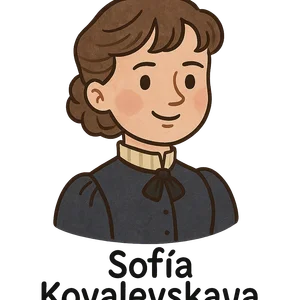
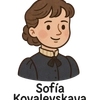
Sofía Kovalevskaya
A pioneering Russian mathematician, writer, and advocate for women's rights in education.
Reads at Grades 6–8 Listens at Grades 4–8
Print & create
Answer keys·No prep·Free with an account
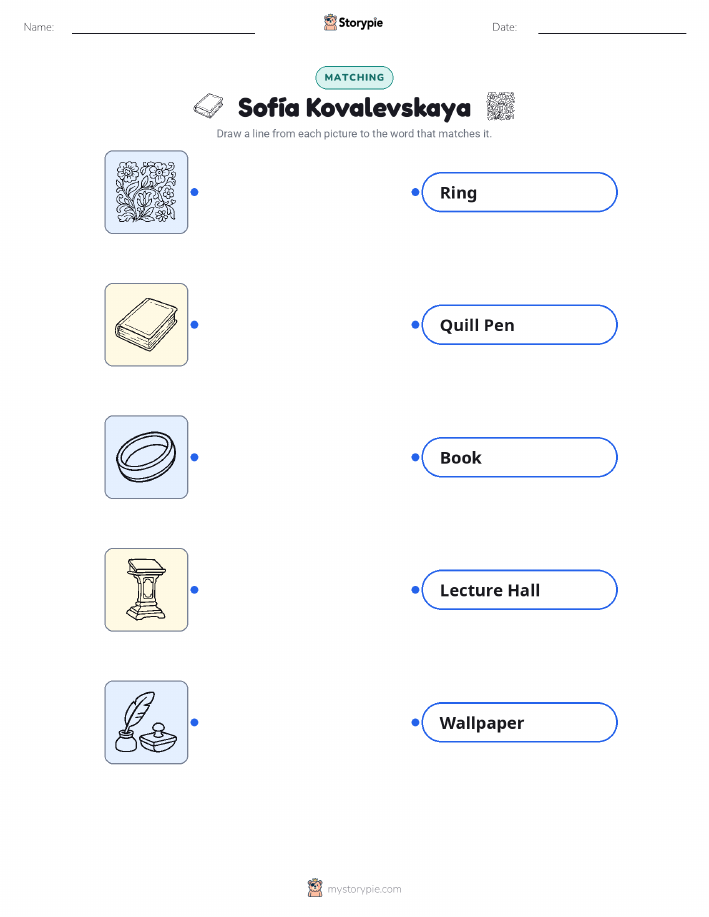
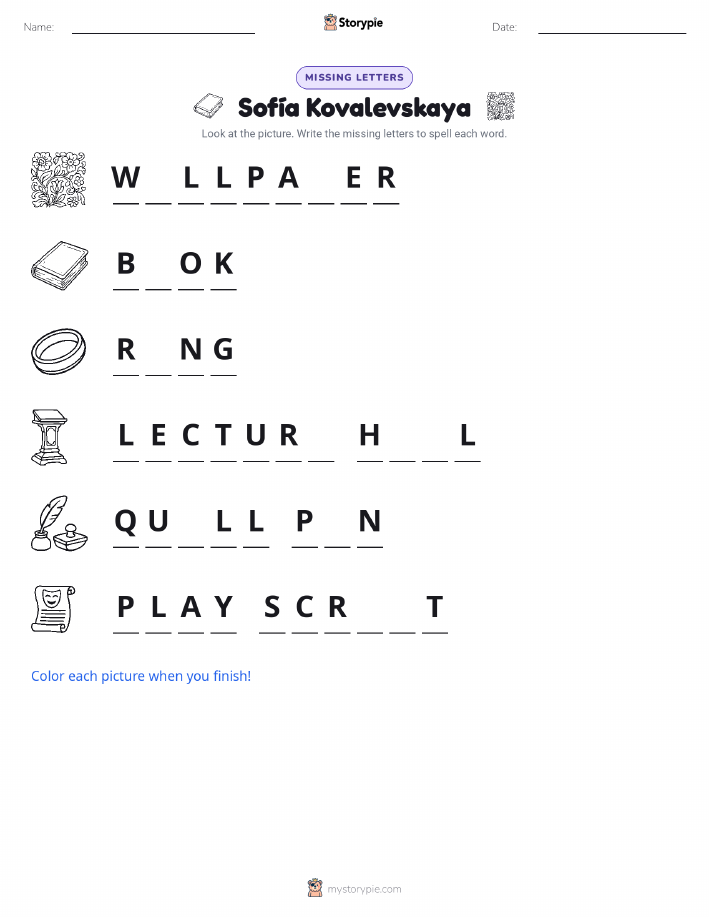
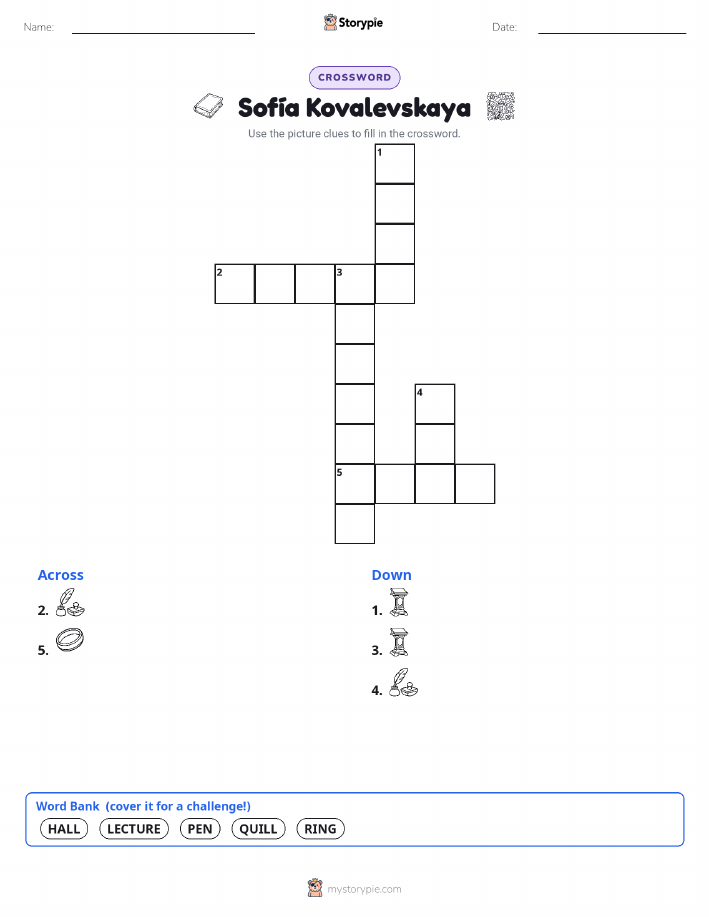
28 worksheets · answer keys · full story · quiz · Ages 10-12 · CEFR B2
Plus adds 280,000+ more stories in 27 languages, audio for every one, and printables for all of them.
Just want Sofía Kovalevskaya?
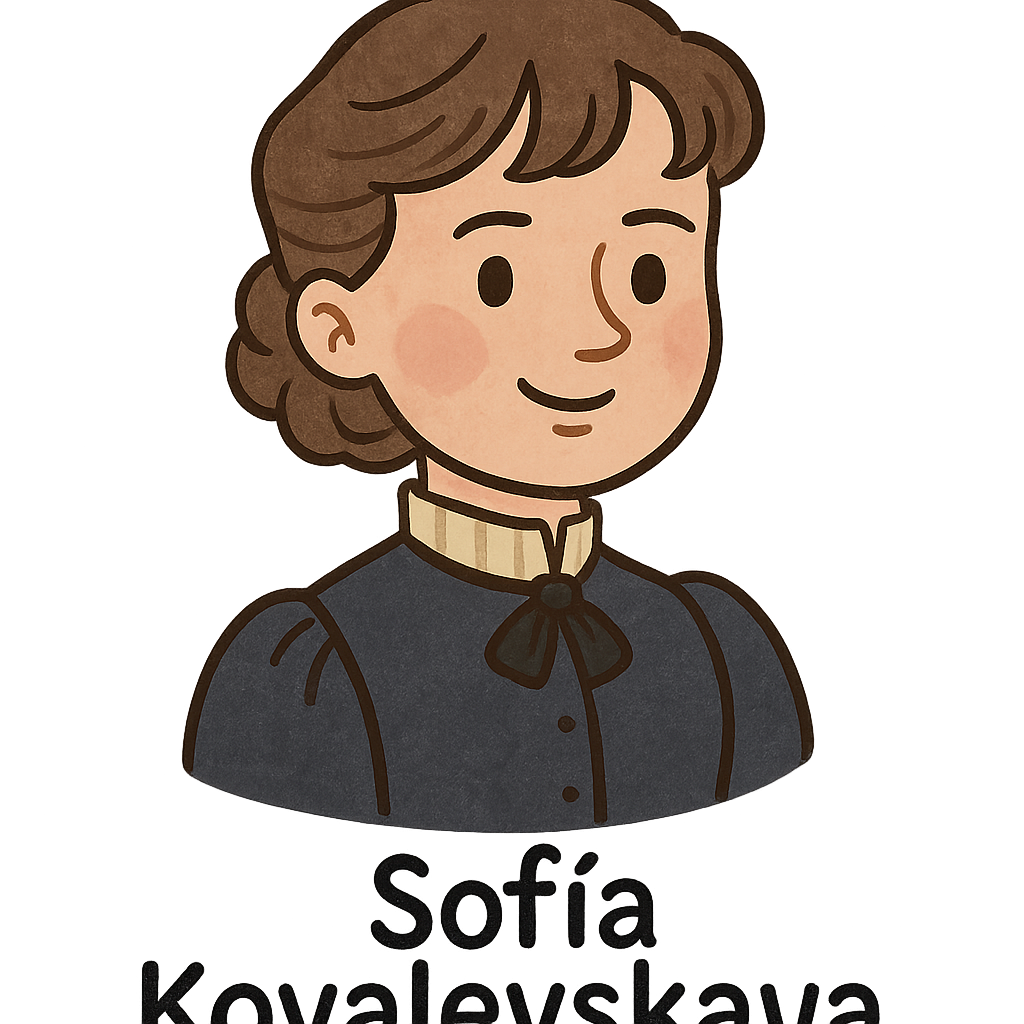
Hello, my name is Sofía Kovalevskaya, and my story is one of passion, perseverance, and numbers. I was born on January 15th, 1850, in Moscow, Russia, into a world that had very specific ideas about what girls could and could not do. When I was a young girl, my family moved to our country estate, Palibino. There, a strange thing happened. The wallpaper for my nursery ran out, so my father decided to paper the walls with pages from a university textbook on calculus. I would lie in my room for hours, staring at the mysterious symbols and equations, trying to understand their meaning. That unusual wallpaper sparked my curiosity and began my lifelong fascination with mathematics, even though it was considered a subject unsuitable for girls.
As I grew older, my desire to formally study mathematics became my greatest dream. However, in the 1860s, Russian universities did not admit women. I knew I couldn't let this obstacle end my journey before it had even begun. I needed a way to travel to a foreign country where I could enroll in a university, but as a young, unmarried woman, I was not allowed to do so without my father's permission, which he would not grant. So, in 1868, I made a bold decision. I entered into a 'fictitious marriage' with a young scientist named Vladimir Kovalevsky. It was a marriage of convenience, a partnership that gave me the legal freedom to leave Russia and pursue the education I so desperately wanted.
Our plan was a success. In 1869, Vladimir and I moved to Germany. I began my studies at the University of Heidelberg, but I longed to learn from the greatest mathematician of the time, Karl Weierstrass, who taught in Berlin. When I arrived, I discovered the University of Berlin would not even permit me to audit his lectures. Undeterred, I went to Professor Weierstrass directly and showed him my work. Seeing my talent and determination, he was so impressed that he agreed to tutor me privately. Beginning in 1870, I spent three years as his devoted student, absorbing every lesson he shared and pushing the boundaries of my own knowledge.
Sofía Kovalevskaya: A Journey in Numbers
Hello, my name is Sofía Kovalevskaya, and my story is one of passion, perseverance, and numbers. I was born on January 15th, 1850, in Moscow, Russia, into a world that had very specific ideas about what girls could and could not do. When I was a young girl, my family moved to our country estate, Palibino. There, a strange thing happened. The wallpaper for my nursery ran out, so my father decided to paper the walls with pages from a university textbook on calculus. I would lie in my room for hours, staring at the mysterious symbols and equations, trying to understand their meaning. That unusual wallpaper sparked my curiosity and began my lifelong fascination with mathematics, even though it was considered a subject unsuitable for girls.
As I grew older, my desire to formally study mathematics became my greatest dream. However, in the 1860s, Russian universities did not admit women. I knew I couldn't let this obstacle end my journey before it had even begun. I needed a way to travel to a foreign country where I could enroll in a university, but as a young, unmarried woman, I was not allowed to do so without my father's permission, which he would not grant. So, in 1868, I made a bold decision. I entered into a 'fictitious marriage' with a young scientist named Vladimir Kovalevsky. It was a marriage of convenience, a partnership that gave me the legal freedom to leave Russia and pursue the education I so desperately wanted.
Our plan was a success. In 1869, Vladimir and I moved to Germany. I began my studies at the University of Heidelberg, but I longed to learn from the greatest mathematician of the time, Karl Weierstrass, who taught in Berlin. When I arrived, I discovered the University of Berlin would not even permit me to audit his lectures. Undeterred, I went to Professor Weierstrass directly and showed him my work. Seeing my talent and determination, he was so impressed that he agreed to tutor me privately. Beginning in 1870, I spent three years as his devoted student, absorbing every lesson he shared and pushing the boundaries of my own knowledge.
My years of intense study and hard work led to a great achievement. In 1874, the University of Göttingen awarded me a doctorate in mathematics, summa cum laude, which is the highest possible honor. I became the first woman in modern Europe to earn such a degree. I felt an incredible sense of accomplishment, but my struggle was far from over. Despite my qualifications, no university would offer me a professorship because of the simple fact that I was a woman. I returned to Russia for a time, and in 1878, my daughter, whom we nicknamed Fufa, was born. For several years, I dedicated myself to raising her and to my passion for writing, but the call of mathematics was never far from my thoughts.
A new and exciting chapter of my professional life began after my husband Vladimir passed away. My friend and fellow mathematician, Gösta Mittag-Leffler, knew of my talent and believed in my work. He invited me to come to Sweden and teach. In 1884, I accepted a position as a lecturer at Stockholm University. This was a monumental step not just for me, but for women everywhere. My lectures were popular and my research was respected, and by 1889, the university promoted me to a full professor with a lifetime position. With that, I became the first woman in Northern Europe to hold such a prestigious academic role.
During my time in Stockholm, I dedicated myself to solving one of the most complex problems in mathematics: the motion of a spinning top. I wrote a paper on my findings, titled 'On the Rotation of a Solid Body about a Fixed Point.' In 1888, I decided to submit it anonymously to a competition held by the French Academy of Sciences for the prestigious Prix Bordin. To my great joy, my paper won the prize. When the judges announced the winner and discovered that the brilliant mind behind the work was a woman, they were astonished. They declared my solution so exceptional that they increased the prize money in my honor.
Beyond my life in mathematics, I was also a writer of stories and plays. I lived to be 41 years old, and my life came to an end in 1891 after a battle with illness. Though my time was shorter than I would have wished, I am proud to be remembered for breaking down barriers for women in science and for my mathematical contributions, such as the Cauchy-Kovalevskaya theorem. I hope my story inspires you to see that with determination and a love for what you do, you can solve any problem you face—whether on a page or in the world.
Wow facts
About
A pioneering Russian mathematician, writer, and advocate for women's rights in education. She was the first woman to obtain a doctorate in mathematics in modern Europe and the first woman appointed to a full professorship in Northern Europe.
Take a Quiz
Question 1 of 5
What is the main lesson Sofía Kovalevskaya's story teaches us?
Explore next


Want to do even more?
Go beyond exploring. Unlock tools that turn every story into real learning.

Storypie Plus for families
Full stories, quizzes, and printables. Nights and car rides, sorted.
- Unlimited audio stories
- Create Mode: your child stars in the story
- Offline downloads
- Printable worksheets & coloring pages

Why Storypie for Schools
Students engaged. Prep in seconds. Evenings back to you.
- Worksheets & Quizzes
- Classroom Management
- Formative Assessment
- Custom Curriculum & Lesson Plans
- 27 Languages

Why Storypie for Homeschool
Curriculum done. They'll ask for more. Hours back in your day.
- Worksheet Generator
- First-Person Audio Stories
- Built-in Comprehension Quizzes
- Custom Curriculum & Lesson Plans
- Print & Go Activities