English


Stephen Hawking
Stephen Hawking was a world-renowned British theoretical physicist, cosmologist, and author…
Reads at Grades 6–8 Listens at Grades 4–8
Print & create
Answer keys·No prep·Free with an account
28 worksheets · answer keys · full story · quiz · Ages 10-12 · CEFR B2
Plus adds 279,000+ more stories in 27 languages, audio for every one, and printables for all of them.
Just want Stephen Hawking?

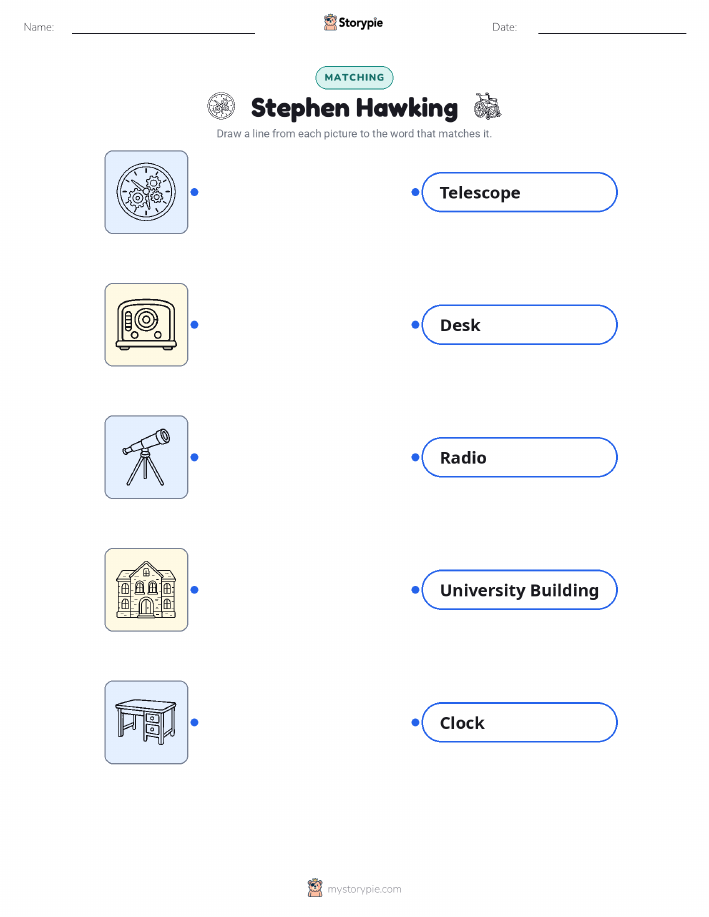
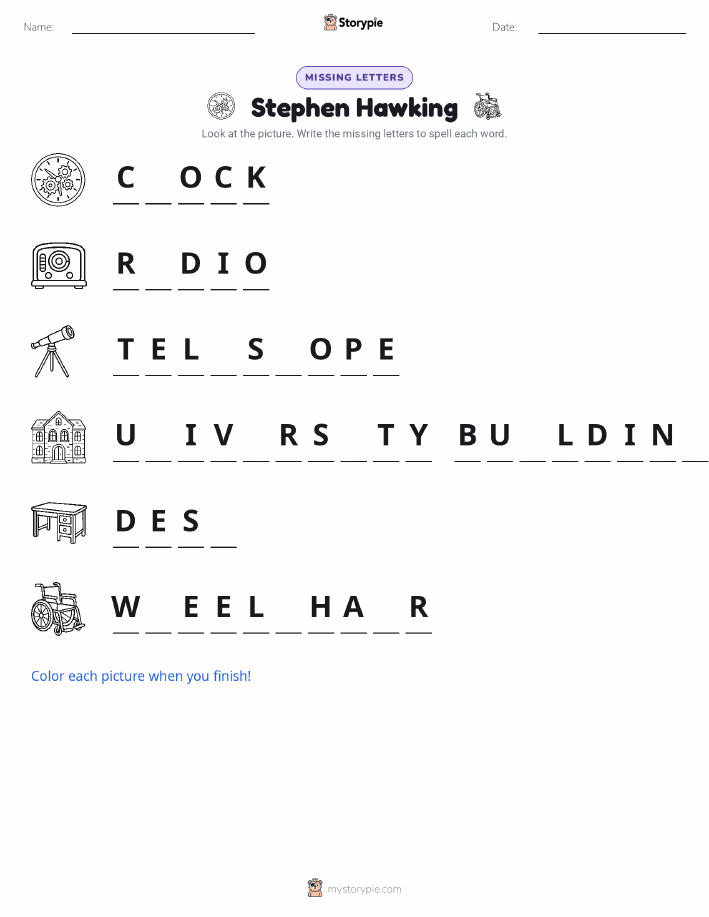
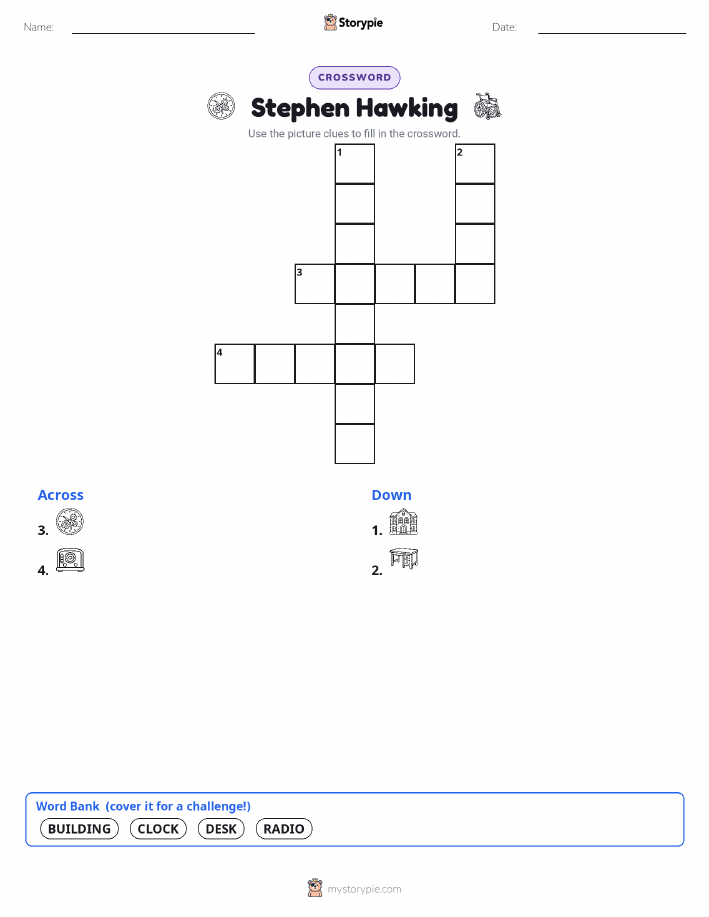
Hello! My name is Stephen Hawking, and I am a theoretical physicist who spent my life trying to understand the universe. I was born on January 8th, 1942, in Oxford, England, during a time of great change in the world. As a young boy, I was more interested in how things worked than in playing games. I loved taking apart clocks and radios, piece by piece, just to see if I could put them back together again. My greatest fascination, however, was with the world beyond our own. I would spend hours staring up at the night sky, filled with countless stars. I wondered what they were made of, how the universe began, and what fundamental laws governed everything from the smallest atoms to the largest galaxies. These big questions set me on a path of discovery that would last my entire life.
In 1959, at the age of 17, I began my studies in physics at the University of Oxford. It was an exciting time, and my mind was constantly buzzing with ideas about the cosmos. My friends there even gave me the nickname 'Einstein' because I was always thinking about the universe's most complex puzzles. After graduating from Oxford, I knew I had to continue my research. In 1962, I went to the University of Cambridge to pursue my PhD in cosmology, which is the study of the origin and evolution of the universe. It was at Cambridge that I truly began to explore the questions that had captivated me since childhood: Where did everything come from? And what is its ultimate fate? I felt that I had found my life's purpose.
Stephen Hawking: A Journey Through the Universe
Hello! My name is Stephen Hawking, and I am a theoretical physicist who spent my life trying to understand the universe. I was born on January 8th, 1942, in Oxford, England, during a time of great change in the world. As a young boy, I was more interested in how things worked than in playing games. I loved taking apart clocks and radios, piece by piece, just to see if I could put them back together again. My greatest fascination, however, was with the world beyond our own. I would spend hours staring up at the night sky, filled with countless stars. I wondered what they were made of, how the universe began, and what fundamental laws governed everything from the smallest atoms to the largest galaxies. These big questions set me on a path of discovery that would last my entire life.
In 1959, at the age of 17, I began my studies in physics at the University of Oxford. It was an exciting time, and my mind was constantly buzzing with ideas about the cosmos. My friends there even gave me the nickname 'Einstein' because I was always thinking about the universe's most complex puzzles. After graduating from Oxford, I knew I had to continue my research. In 1962, I went to the University of Cambridge to pursue my PhD in cosmology, which is the study of the origin and evolution of the universe. It was at Cambridge that I truly began to explore the questions that had captivated me since childhood: Where did everything come from? And what is its ultimate fate? I felt that I had found my life's purpose.
Just as I was beginning this important work, my life took an unexpected turn. In 1963, when I was only 21 years old, I was diagnosed with a motor neuron disease called Amyotrophic Lateral Sclerosis, or ALS. The doctors gave me a grim prognosis, suggesting I only had a few years to live. Hearing this news was devastating, but after the initial shock, it filled me with a powerful sense of determination. I realized I didn't have time to waste. This new perspective pushed me to focus completely on my work and the people I loved. Around this time, I met a remarkable woman named Jane Wilde. We fell in love, and her unwavering support gave me a reason to keep fighting. We were married in 1965, and her presence in my life was a source of great strength.
Throughout the 1970s, I dedicated much of my research to one of the most mysterious objects in the universe: black holes. At that time, scientists believed that black holes were cosmic dead ends, places where gravity was so powerful that once something fell in, it could never get out. But my calculations, which combined the laws of the universe on a large scale with the strange rules of quantum mechanics on a small scale, showed something different. I theorized that black holes were not completely black. I discovered that they could emit a faint glow of energy, which is now known as 'Hawking radiation.' This idea was revolutionary because it suggested that black holes could slowly evaporate and disappear over billions of years, a concept that completely changed our understanding of them.
As the years passed, my physical condition worsened due to ALS. I gradually lost the ability to walk and eventually had to use a wheelchair. Then, in 1985, after an emergency operation, I lost my ability to speak. For a scientist who needed to communicate complex ideas, this was a tremendous challenge. However, I was determined not to be silenced. With the help of some brilliant engineers, I was given a computer system that allowed me to select words on a screen using small movements of my cheek muscle. A speech synthesizer would then speak those words for me, giving me a new, distinctive voice. With this voice, I was able to continue my work and share my ideas with the world. I decided to write a book that would make the universe accessible to everyone, not just scientists. That book, 'A Brief History of Time,' was published in 1988 and became an international bestseller, allowing people everywhere to ponder the same big questions that had fascinated me my whole life.
I never allowed my physical limitations to confine my mind or my ambition. I traveled the globe to give lectures, collaborated with other scientists on new theories, and even experienced weightlessness by floating in zero gravity. In 1963, doctors told me I had only a few years to live, but I defied their expectations. I lived to be 76 years old. My greatest hope was always to inspire people to look up at the stars and not down at their feet, to be curious, and to never give up on trying to understand our magnificent universe. I hope my story reminds you that the human spirit is incredibly resilient and capable of exploring the greatest mysteries of the cosmos.
Wow facts
About
Stephen Hawking was a world-renowned British theoretical physicist, cosmologist, and author, celebrated for his groundbreaking work on black holes and his bestselling book 'A Brief History of Time'.
Take a Quiz
Question 1 of 5
What was the main idea or theme of Stephen Hawking's life story?
Explore next





Want to do even more?
Go beyond exploring. Unlock tools that turn every story into real learning.

Storypie Plus for families
Full stories, quizzes, and printables. Nights and car rides, sorted.
- Unlimited audio stories
- Create Mode: your child stars in the story
- Offline downloads
- Printable worksheets & coloring pages

Why Storypie for Schools
Students engaged. Prep in seconds. Evenings back to you.
- Worksheets & Quizzes
- Classroom Management
- Formative Assessment
- Custom Curriculum & Lesson Plans
- 27 Languages

Why Storypie for Homeschool
Curriculum done. They'll ask for more. Hours back in your day.
- Worksheet Generator
- First-Person Audio Stories
- Built-in Comprehension Quizzes
- Custom Curriculum & Lesson Plans
- Print & Go Activities