English


Stephen Hawking
Stephen Hawking was a world-renowned British theoretical physicist, cosmologist, and author…
Reads at Grades 3–5 Listens at Grades 1–5
Print & create
Answer keys·No prep·Free with an account
28 worksheets · answer keys · full story · quiz · Ages 8-10 · CEFR B1
Plus adds 280,000+ more stories in 27 languages, audio for every one, and printables for all of them.
Just want Stephen Hawking?

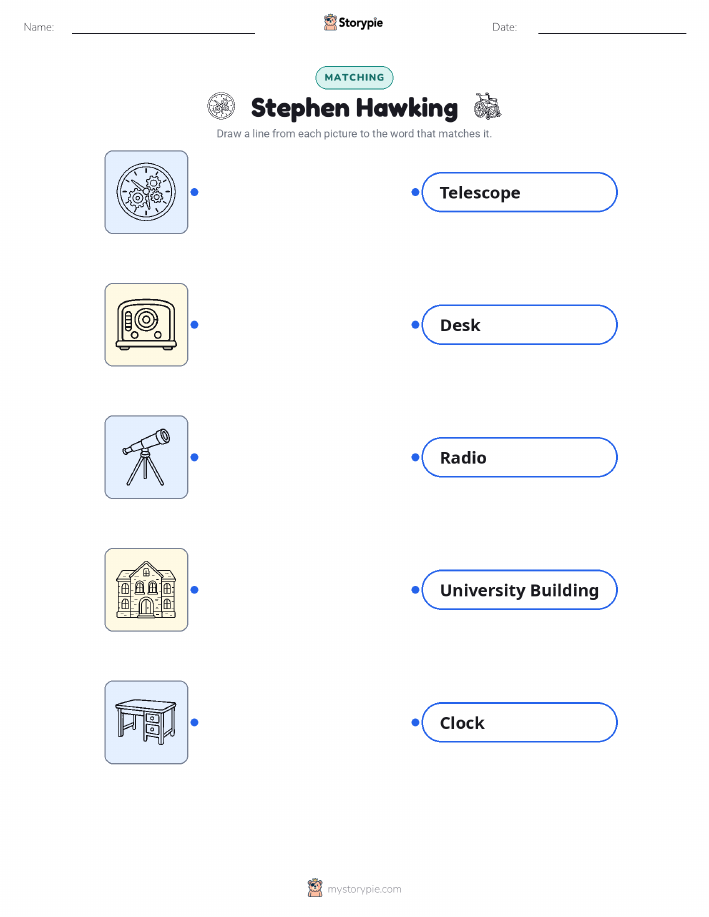
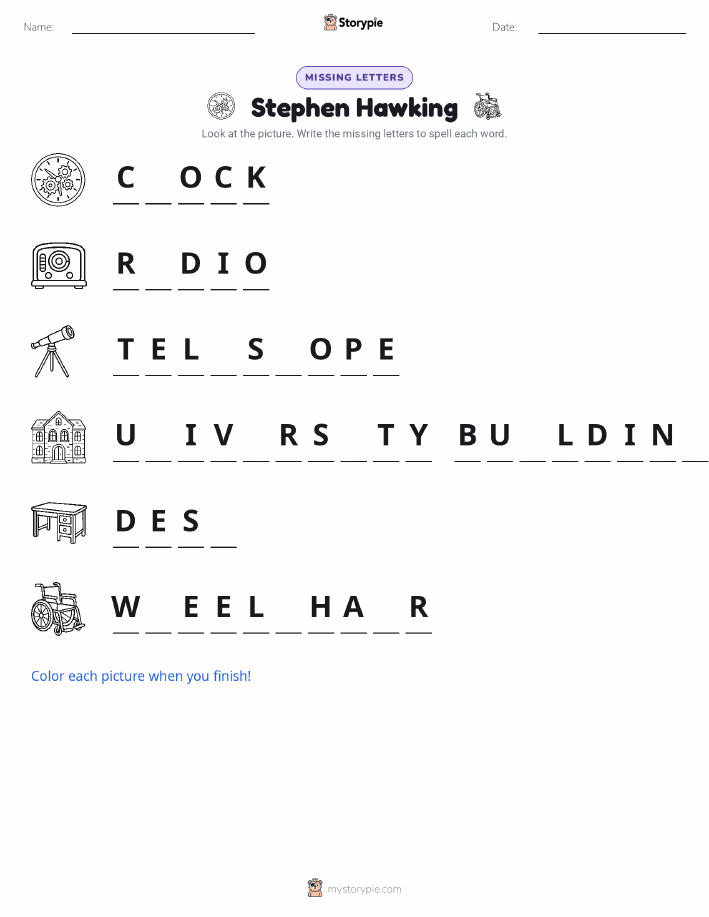
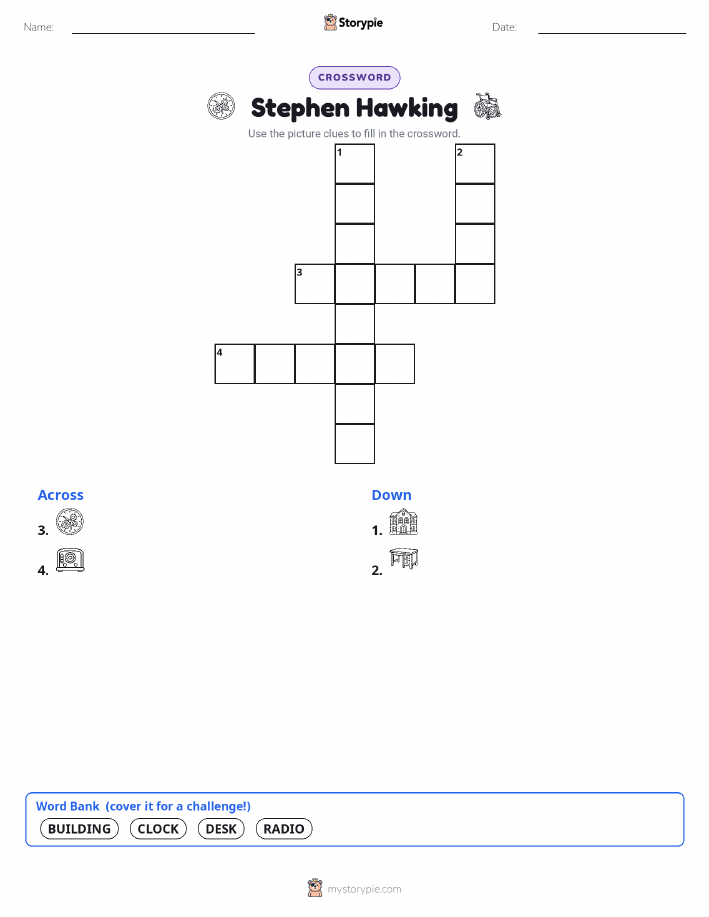
Hello. My name is Stephen Hawking, and I spent my life asking big questions about the universe. I was born on January 8th, 1942, in Oxford, England. Even when I was a little boy, my mind was always buzzing with curiosity. I loved to figure out how things worked. I would often take things like clocks and radios apart just to see the pieces inside and understand their purpose. I wasn't always the top student in my class, but my friends and teachers noticed my love for big ideas. They even gave me the nickname 'Einstein,' after another famous scientist, because I was always thinking about space and time. From a young age, math and science felt like puzzles I was meant to solve. I would look up at the night sky and dream of one day uncovering the secrets hidden among the stars. I knew that my journey was to explore the deepest mysteries of the universe and share what I learned with the world. This passion for understanding everything around me started in my childhood and guided my entire life.
When I was old enough, my love for science took me to university. In 1959, I began my studies at the University of Oxford. It was an exciting time, surrounded by books and brilliant minds. I chose to study physics, which is the science of matter and energy. But what truly captured my imagination was a field called cosmology—the study of the entire universe, from its beginning to its end. I wanted to tackle the biggest questions of all: Where did the universe come from? How did it start? And where is it going? These questions filled my thoughts and drove me to learn as much as I could. After my time at Oxford, I knew I needed to go even deeper. So, in 1962, I moved to the University of Cambridge to continue my studies. There, I could focus entirely on my ideas about space, time, and the very fabric of the cosmos. It was at Cambridge that I truly began the work that would define my life, diving into complex theories about how our universe works.
Stephen Hawking: A Journey Through the Universe
Hello. My name is Stephen Hawking, and I spent my life asking big questions about the universe. I was born on January 8th, 1942, in Oxford, England. Even when I was a little boy, my mind was always buzzing with curiosity. I loved to figure out how things worked. I would often take things like clocks and radios apart just to see the pieces inside and understand their purpose. I wasn't always the top student in my class, but my friends and teachers noticed my love for big ideas. They even gave me the nickname 'Einstein,' after another famous scientist, because I was always thinking about space and time. From a young age, math and science felt like puzzles I was meant to solve. I would look up at the night sky and dream of one day uncovering the secrets hidden among the stars. I knew that my journey was to explore the deepest mysteries of the universe and share what I learned with the world. This passion for understanding everything around me started in my childhood and guided my entire life.
When I was old enough, my love for science took me to university. In 1959, I began my studies at the University of Oxford. It was an exciting time, surrounded by books and brilliant minds. I chose to study physics, which is the science of matter and energy. But what truly captured my imagination was a field called cosmology—the study of the entire universe, from its beginning to its end. I wanted to tackle the biggest questions of all: Where did the universe come from? How did it start? And where is it going? These questions filled my thoughts and drove me to learn as much as I could. After my time at Oxford, I knew I needed to go even deeper. So, in 1962, I moved to the University of Cambridge to continue my studies. There, I could focus entirely on my ideas about space, time, and the very fabric of the cosmos. It was at Cambridge that I truly began the work that would define my life, diving into complex theories about how our universe works.
My time at Cambridge was full of new ideas, but it was also when my life changed in a way I never expected. In 1963, when I was just 21 years old, I was diagnosed with a condition called motor neurone disease, also known as ALS. The doctors told me that the nerves that controlled my muscles would slowly stop working. They explained that it would become harder for me to walk, write, and even speak. At first, the news made me very sad, and I wondered what purpose my life could have. But then, something wonderful happened. I met a young woman named Jane Wilde, and we fell in love. Her support and belief in me gave me a new reason to keep going. I realized that while my body was facing a great challenge, my mind was not affected. My mind was still free to soar across the cosmos, to travel to the edge of black holes, and to think about the beginning of time. This new determination filled me with hope and pushed me forward in my work and in my life.
Even as my illness progressed, I was determined to continue my work and share my ideas with the world. Technology became my partner in this journey. I used a special wheelchair that I could control with small movements, and later, a brilliant computer system that allowed me to select words on a screen and have a voice synthesizer speak for me. This technology allowed my mind to stay connected to the world. And my mind was very busy. In 1974, I made a discovery that changed how we think about black holes. I realized that they are not completely black after all. I theorized that they slowly release a type of energy, which is now called 'Hawking radiation.' This was a groundbreaking idea that connected different parts of physics. I wanted everyone, not just scientists, to be able to wonder about the universe. So, in 1988, I wrote a book called 'A Brief History of Time.' My goal was to explain my complex ideas about space, time, and black holes in a way that almost anyone could understand.
Throughout my life, I wanted to show that no obstacle is too great to overcome. My message to the world has always been to be curious. Look up at the stars, not down at your feet. Try to make sense of what you see, and wonder about what makes the universe exist. I lived to be 76 years old, and my journey on Earth ended in 2018. Even though I am no longer here, my ideas about the universe continue to be studied and discussed by scientists everywhere. I hope my story inspires you to ask big questions and to never give up on your dreams, no matter how difficult they may seem.
Wow facts
About
Stephen Hawking was a world-renowned British theoretical physicist, cosmologist, and author, celebrated for his groundbreaking work on black holes and his bestselling book 'A Brief History of Time'.
Take a Quiz
Question 1 of 5
Why did Stephen's schoolmates give him the nickname 'Einstein'?
Explore next






Want to do even more?
Go beyond exploring. Unlock tools that turn every story into real learning.

Storypie Plus for families
Full stories, quizzes, and printables. Nights and car rides, sorted.
- Unlimited audio stories
- Create Mode: your child stars in the story
- Offline downloads
- Printable worksheets & coloring pages

Why Storypie for Schools
Students engaged. Prep in seconds. Evenings back to you.
- Worksheets & Quizzes
- Classroom Management
- Formative Assessment
- Custom Curriculum & Lesson Plans
- 27 Languages

Why Storypie for Homeschool
Curriculum done. They'll ask for more. Hours back in your day.
- Worksheet Generator
- First-Person Audio Stories
- Built-in Comprehension Quizzes
- Custom Curriculum & Lesson Plans
- Print & Go Activities