English


Zhang Heng
Zhang Heng was a Chinese polymath from the Han dynasty who excelled as an astronomer, mathematician, inventor…
Reads at Grades 6–8 Listens at Grades 4–8
Print & create
Answer keys·No prep·Free with an account
28 worksheets · answer keys · full story · quiz · Ages 10-12 · CEFR B2
Plus adds 164,000+ more stories in 27 languages, audio for every one, and printables for all of them.
Just want Zhang Heng?

Hello, my name is Zhang Heng, and I was a thinker, an inventor, and an astronomer in ancient China. I was born in the year 78 CE in a town called Nanyang. This was during the time of the great Han Dynasty, a period of incredible progress and discovery. From a young age, I was filled with curiosity. I spent my days reading the classics and my nights staring up at the vast, star-filled sky. I was always asking questions about how the world worked. This deep hunger for knowledge led me to leave my home when I was sixteen, around the year 95 CE. I traveled to the grand capitals of Chang'an and Luoyang, determined to study and learn everything I possibly could about the world around me.
My studies eventually led me to a life of service to the emperor. Around 115 CE, I began my career as a government official in the bustling capital city of Luoyang. I was given a very important position: Chief Astronomer. This was a job of great responsibility. I was tasked with carefully observing the heavens, tracking the movements of the stars and planets, and ensuring the official calendar was accurate. In the Han court, astronomy was not just a science; it was believed that events in the sky were connected to events on Earth. My observations helped the emperor understand the world and rule wisely. I reported on celestial events, like comets or eclipses, and helped maintain order and harmony between the heavens and the empire.
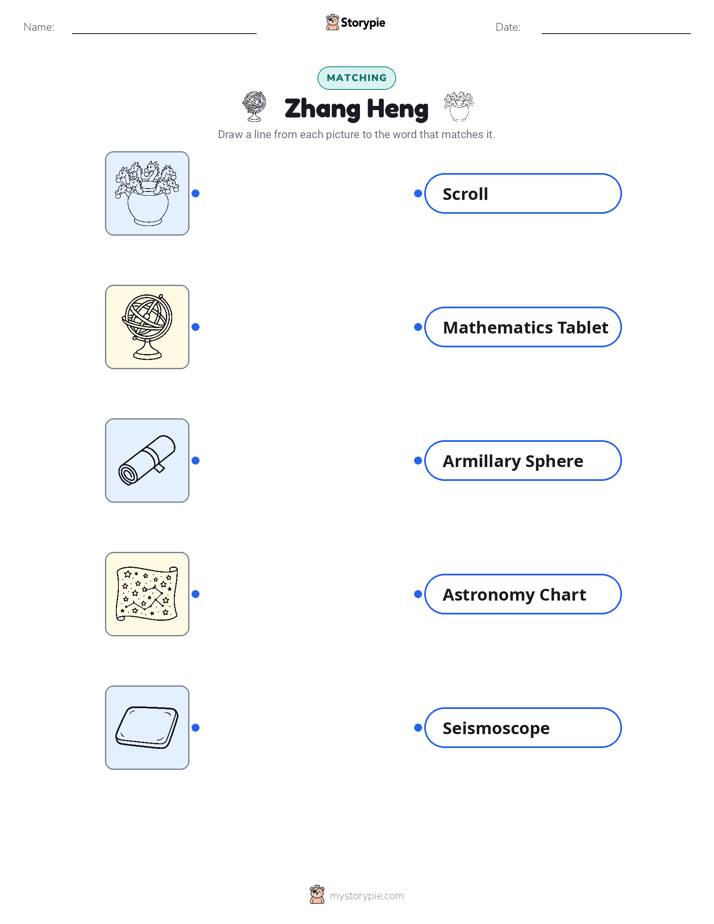
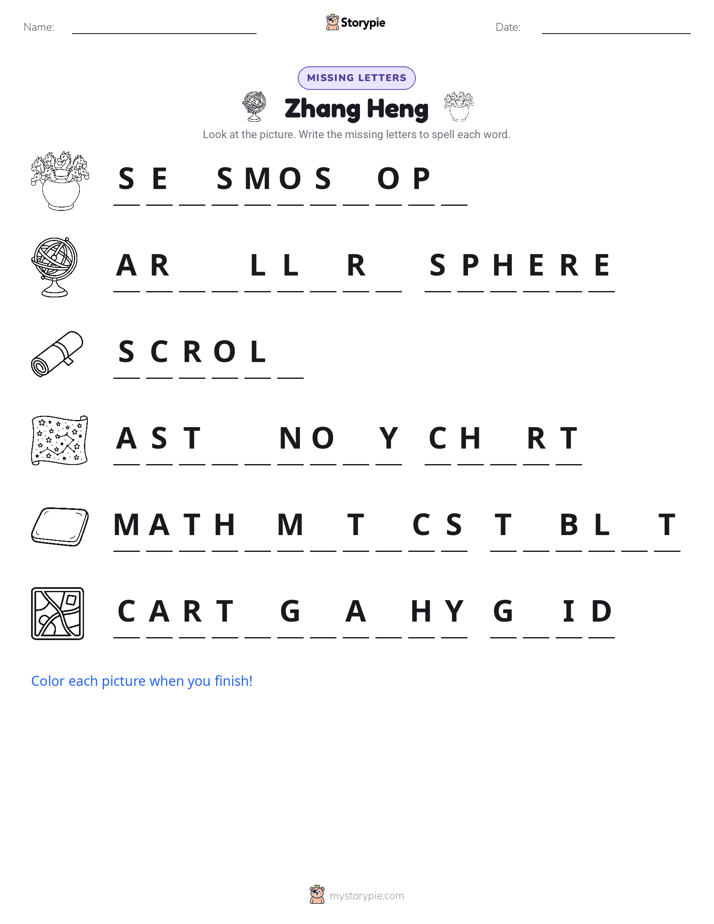
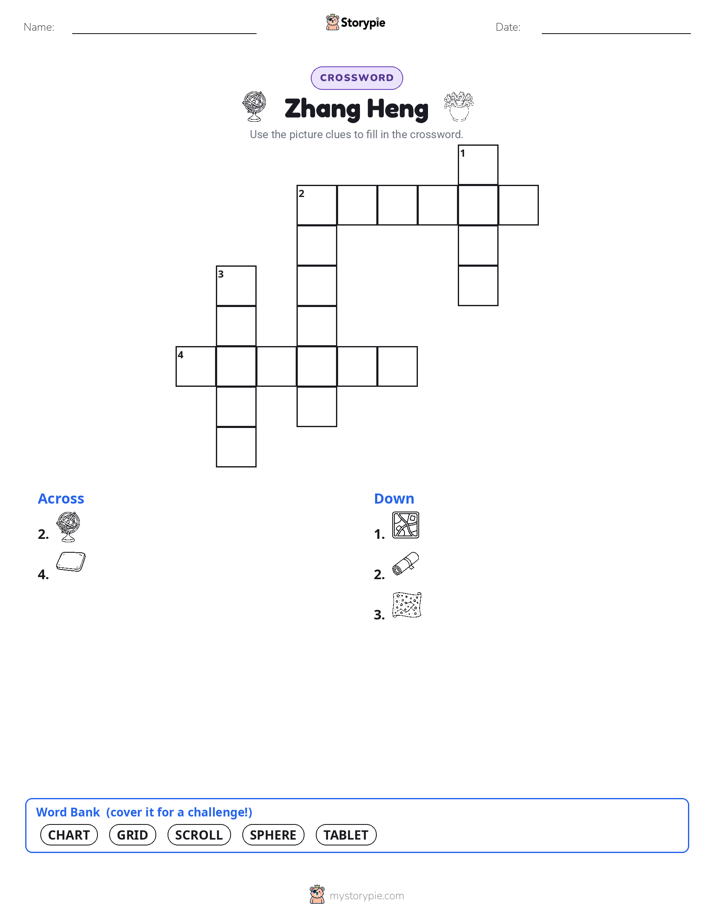
While serving the court, I dedicated myself to mapping both the heavens and the Earth with greater accuracy than ever before. Around the year 117 CE, I completed one of my proudest creations: a water-powered armillary sphere. This was a large, complex instrument that modeled the sky. As water flowed through it, the sphere would slowly rotate, showing the movement of the stars, sun, and moon across the sky. I also developed new ideas about the universe itself. I proposed that the universe was shaped like an egg, with the Earth as the yolk in the center. I was also one of the first to correctly explain that a lunar eclipse happens when the Moon passes through the Earth's shadow. My work wasn't limited to the stars; I also made contributions to mathematics, calculating a more precise value for pi. In cartography, I created a new standard for map-making by introducing a grid system, which allowed for much greater precision in locating places.
Zhang Heng: Stargazer, Scientist, and Inventor of Ancient China
Hello, my name is Zhang Heng, and I was a thinker, an inventor, and an astronomer in ancient China. I was born in the year 78 CE in a town called Nanyang. This was during the time of the great Han Dynasty, a period of incredible progress and discovery. From a young age, I was filled with curiosity. I spent my days reading the classics and my nights staring up at the vast, star-filled sky. I was always asking questions about how the world worked. This deep hunger for knowledge led me to leave my home when I was sixteen, around the year 95 CE. I traveled to the grand capitals of Chang'an and Luoyang, determined to study and learn everything I possibly could about the world around me.
My studies eventually led me to a life of service to the emperor. Around 115 CE, I began my career as a government official in the bustling capital city of Luoyang. I was given a very important position: Chief Astronomer. This was a job of great responsibility. I was tasked with carefully observing the heavens, tracking the movements of the stars and planets, and ensuring the official calendar was accurate. In the Han court, astronomy was not just a science; it was believed that events in the sky were connected to events on Earth. My observations helped the emperor understand the world and rule wisely. I reported on celestial events, like comets or eclipses, and helped maintain order and harmony between the heavens and the empire.
While serving the court, I dedicated myself to mapping both the heavens and the Earth with greater accuracy than ever before. Around the year 117 CE, I completed one of my proudest creations: a water-powered armillary sphere. This was a large, complex instrument that modeled the sky. As water flowed through it, the sphere would slowly rotate, showing the movement of the stars, sun, and moon across the sky. I also developed new ideas about the universe itself. I proposed that the universe was shaped like an egg, with the Earth as the yolk in the center. I was also one of the first to correctly explain that a lunar eclipse happens when the Moon passes through the Earth's shadow. My work wasn't limited to the stars; I also made contributions to mathematics, calculating a more precise value for pi. In cartography, I created a new standard for map-making by introducing a grid system, which allowed for much greater precision in locating places.
Perhaps my most famous invention was created to solve a serious problem in China: earthquakes. These tremors could cause terrible destruction, and often, news of a quake wouldn't reach the capital for weeks. I wanted to find a way to know when and where an earthquake had occurred, even from a great distance. In the year 132 CE, I unveiled my invention, the 'Houfeng Didong Yi,' which was the world's first seismoscope. It was a beautiful bronze jar, about six feet tall, with eight dragons arranged around the top, each holding a small bronze ball in its mouth. Below each dragon sat a bronze toad with its mouth open. Inside the jar was a carefully balanced pendulum. When a tremor shook the ground, the pendulum would swing and trigger a mechanism, causing one of the dragons to release its ball into the mouth of the toad below. The dragon that dropped the ball would point in the direction of the earthquake. For years, many at the imperial court were skeptical, but in 138 CE, my device proved its worth. A ball dropped, indicating an earthquake to the west. Days later, a messenger arrived from a western province, reporting that an earthquake had happened there on the very day my seismoscope had detected it.
Beyond my scientific work, I also found joy in writing poetry and in painting. I lived a full life of discovery and service to my country, and I lived to be 61 years old. I spent my final years in my hometown before passing away in 139 CE. My work was far ahead of its time. My seismoscope was a true marvel of engineering, and my advancements in astronomy and cartography set a new standard for science in China. Today, people remember me as one of the great scientific minds of ancient China. To honor my contributions to our understanding of the heavens, a crater on the Moon and an asteroid have been named after me, ensuring that my story continues to inspire new generations of explorers.
Wow facts
About
Zhang Heng was a Chinese polymath from the Han dynasty who excelled as an astronomer, mathematician, inventor, geographer, artist, and poet. He is best known for inventing the world's first seismoscope and a water-powered armillary sphere.
Take a Quiz
Question 1 of 5
What problem did Zhang Heng's seismoscope, the 'Houfeng Didong Yi,' solve?
Explore next






Want to do even more?
Go beyond exploring. Unlock tools that turn every story into real learning.

Storypie Plus for families
Full stories, quizzes, and printables. Nights and car rides, sorted.
- Unlimited audio stories
- Create Mode: your child stars in the story
- Offline downloads
- Printable worksheets & coloring pages

Why Storypie for Schools
Students engaged. Prep in seconds. Evenings back to you.
- Worksheets & Quizzes
- Classroom Management
- Formative Assessment
- Custom Curriculum & Lesson Plans
- 27 Languages

Why Storypie for Homeschool
Curriculum done. They'll ask for more. Hours back in your day.
- Worksheet Generator
- First-Person Audio Stories
- Built-in Comprehension Quizzes
- Custom Curriculum & Lesson Plans
- Print & Go Activities