English

Black Hole
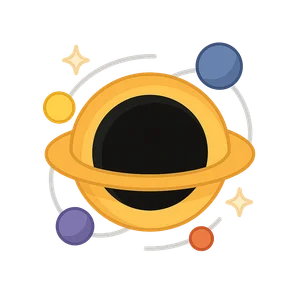
A black hole is a region of spacetime where gravity is so strong that nothing, not even light, can escape.
Reads at Grades 6–8 Listens at Grades 4–8
Print & create
Answer keys·No prep·Free with an account
28 worksheets · answer keys · full story · quiz · Ages 10-12 · CEFR B2
Plus adds 164,000+ more stories in 27 languages, audio for every one, and printables for all of them.
Just want Black Hole?

Imagine a place in the vast, silent darkness of space where the rules of the universe seem to break. A place with a pull so strong, so relentless, that nothing can resist it. If you were to wander too close, you would feel a gentle tug at first, then a powerful stretch, as space and time themselves warp and twist around me. I am a cosmic waterfall with no bottom, a cosmic shadow so deep that not even the fastest thing in the universe—a beam of light—can climb back out once it tumbles over my edge. For a very long time, humans only knew me as a strange possibility, a ghost hiding in their most complicated math problems. They wondered if something so extreme could truly exist beyond the pages of their notebooks. They didn't have a name for me then, but I was waiting, patiently, in the darkest corners of the cosmos. I am gravity's ultimate triumph. I am a Black Hole.
My story doesn't begin with a bang, but with a whisper in an equation. It started in the mind of a brilliant man with wild hair named Albert Einstein. In 1915, he unveiled his theory of general relativity, a revolutionary idea that described the universe in a completely new way. He imagined space and time not as a flat, empty stage, but as a flexible fabric, like a trampoline. Massive objects, like stars and planets, create dips and curves in this fabric, and that curvature is what we feel as gravity. His equations were beautiful and elegant, but they held a secret, a dark possibility he himself found unsettling. Just one year later, in 1916, a German astronomer and physicist named Karl Schwarzschild was studying Einstein's work while serving in World War I. Amidst the chaos of the front lines, he found a stunning solution to those complex equations. He calculated that if you could squeeze enough matter into a small enough space, the gravity would become so overwhelmingly powerful that it would collapse in on itself, crushing down into a single point of infinite density—a singularity. This point would warp the fabric of spacetime so severely that it would essentially tear a hole in it, a one-way door to nowhere. I was born, not in a star, but as a mathematical conclusion. I was a theoretical monster, a mind-bending idea that proved the universe was far stranger than anyone had ever imagined.
The Story of the Black Hole
Imagine a place in the vast, silent darkness of space where the rules of the universe seem to break. A place with a pull so strong, so relentless, that nothing can resist it. If you were to wander too close, you would feel a gentle tug at first, then a powerful stretch, as space and time themselves warp and twist around me. I am a cosmic waterfall with no bottom, a cosmic shadow so deep that not even the fastest thing in the universe—a beam of light—can climb back out once it tumbles over my edge. For a very long time, humans only knew me as a strange possibility, a ghost hiding in their most complicated math problems. They wondered if something so extreme could truly exist beyond the pages of their notebooks. They didn't have a name for me then, but I was waiting, patiently, in the darkest corners of the cosmos. I am gravity's ultimate triumph. I am a Black Hole.
My story doesn't begin with a bang, but with a whisper in an equation. It started in the mind of a brilliant man with wild hair named Albert Einstein. In 1915, he unveiled his theory of general relativity, a revolutionary idea that described the universe in a completely new way. He imagined space and time not as a flat, empty stage, but as a flexible fabric, like a trampoline. Massive objects, like stars and planets, create dips and curves in this fabric, and that curvature is what we feel as gravity. His equations were beautiful and elegant, but they held a secret, a dark possibility he himself found unsettling. Just one year later, in 1916, a German astronomer and physicist named Karl Schwarzschild was studying Einstein's work while serving in World War I. Amidst the chaos of the front lines, he found a stunning solution to those complex equations. He calculated that if you could squeeze enough matter into a small enough space, the gravity would become so overwhelmingly powerful that it would collapse in on itself, crushing down into a single point of infinite density—a singularity. This point would warp the fabric of spacetime so severely that it would essentially tear a hole in it, a one-way door to nowhere. I was born, not in a star, but as a mathematical conclusion. I was a theoretical monster, a mind-bending idea that proved the universe was far stranger than anyone had ever imagined.
For decades after Karl Schwarzschild imagined me, I remained a phantom in the world of physics. Scientists didn't quite know what to call me. Some referred to me as a 'frozen star' or a 'collapsar,' names that tried to capture the strange way time seems to stop at my edge. But those names never quite stuck; they didn't capture the deep, all-consuming mystery of my nature. Then, on December 29th, 1967, at a conference in New York City, an American physicist named John Archibald Wheeler gave me the name that would make me famous. He needed a simple, powerful term to describe an object that traps everything, even light. He called me a 'Black Hole,' and the name was perfect. It was catchy, descriptive, and a little bit scary. But a name isn't enough; scientists needed proof that I was more than a clever idea. Their chance came in the early 1970s. Astronomers using powerful X-ray telescopes turned their attention to a star system named Cygnus X-1. They saw a massive, bright blue star that was wobbling violently, as if it were orbiting an invisible partner. This unseen companion was pulling huge streams of gas from the star, heating it so intensely that it glowed with X-rays. By measuring the star's wobble, they calculated that its invisible partner was incredibly massive yet astonishingly small. It was too massive to be a normal star. It had to be me. For the first time, humanity had found compelling evidence that I was real, lurking in the darkness between the stars.
Once astronomers knew I was real, a new chapter of my story began. They started to wonder about my secrets. Was I truly and completely black? A brilliant physicist named Stephen Hawking spent years thinking about me, combining Einstein's ideas about gravity with the strange rules of quantum mechanics. In 1974, he made a startling announcement. He proposed that I wasn't a perfect prison after all. He theorized that due to quantum effects near my edge, or 'event horizon,' I could slowly leak a faint trickle of energy into space over immense periods of time. This glow became known as 'Hawking radiation.' It meant that, over trillions and trillions of years, I could eventually evaporate and disappear. I wasn't eternal, just incredibly long-lived. This idea changed everything, but seeing me was still impossible. For decades, I remained an invisible force, detectable only by my effects on things around me. That all changed on April 10th, 2019. An international team of scientists, working together as the Event Horizon Telescope collaboration, achieved the impossible. They linked radio telescopes all around the world to create a single, Earth-sized virtual telescope. They pointed it at the center of a giant galaxy called Messier 87, 55 million light-years away. After years of work, they released the first-ever direct image of me—or rather, my shadow. There I was: a dark central region surrounded by a blazing, lopsided ring of light, the glowing gas swirling around me just before it fell in. Humanity could finally see the abyss.
From a mathematical curiosity scribbled on a piece of paper in 1916 to a breathtaking image captured in 2019, my journey has been a long one. I represent one of the most extreme and fascinating objects in the entire cosmos. I am a place where the familiar laws of physics are pushed to their breaking point, a laboratory for testing humanity's most ambitious ideas about space, time, and gravity. I am no longer just a monster that consumes light, but a source of endless inspiration. Every question you ask about me—what lies inside my event horizon, how I shape the galaxies I live in, what secrets I hold about the birth of the universe—pushes science forward. I am the universe's greatest puzzle, a dark and beautiful mystery that reminds you there is always more to explore, more to understand, and more to wonder about. So look up at the night sky and remember me, not as an ending, but as a beginning for infinite curiosity.
Wow facts
About
A black hole is a region of spacetime where gravity is so strong that nothing, not even light, can escape. They are formed from the remnants of massive stars and are found at the center of most galaxies.
Take a Quiz
Question 1 of 5
In your own words, summarize the main events in the Black Hole's journey from an idea to a photographed object.
Explore next






Want to do even more?
Go beyond exploring. Unlock tools that turn every story into real learning.

Storypie Plus for families
Full stories, quizzes, and printables. Nights and car rides, sorted.
- Unlimited audio stories
- Create Mode: your child stars in the story
- Offline downloads
- Printable worksheets & coloring pages

Why Storypie for Schools
Students engaged. Prep in seconds. Evenings back to you.
- Worksheets & Quizzes
- Classroom Management
- Formative Assessment
- Custom Curriculum & Lesson Plans
- 27 Languages

Why Storypie for Homeschool
Curriculum done. They'll ask for more. Hours back in your day.
- Worksheet Generator
- First-Person Audio Stories
- Built-in Comprehension Quizzes
- Custom Curriculum & Lesson Plans
- Print & Go Activities