English

Checkers
Checkers, also known as Draughts…
Reads at Grades 6–8 Listens at Grades 4–8
Print & create
Answer keys·No prep·Free with an account
28 worksheets · answer keys · full story · quiz · Ages 10-12 · CEFR B2
Plus adds 244,000+ more stories in 27 languages, audio for every one, and printables for all of them.
Just want Checkers?
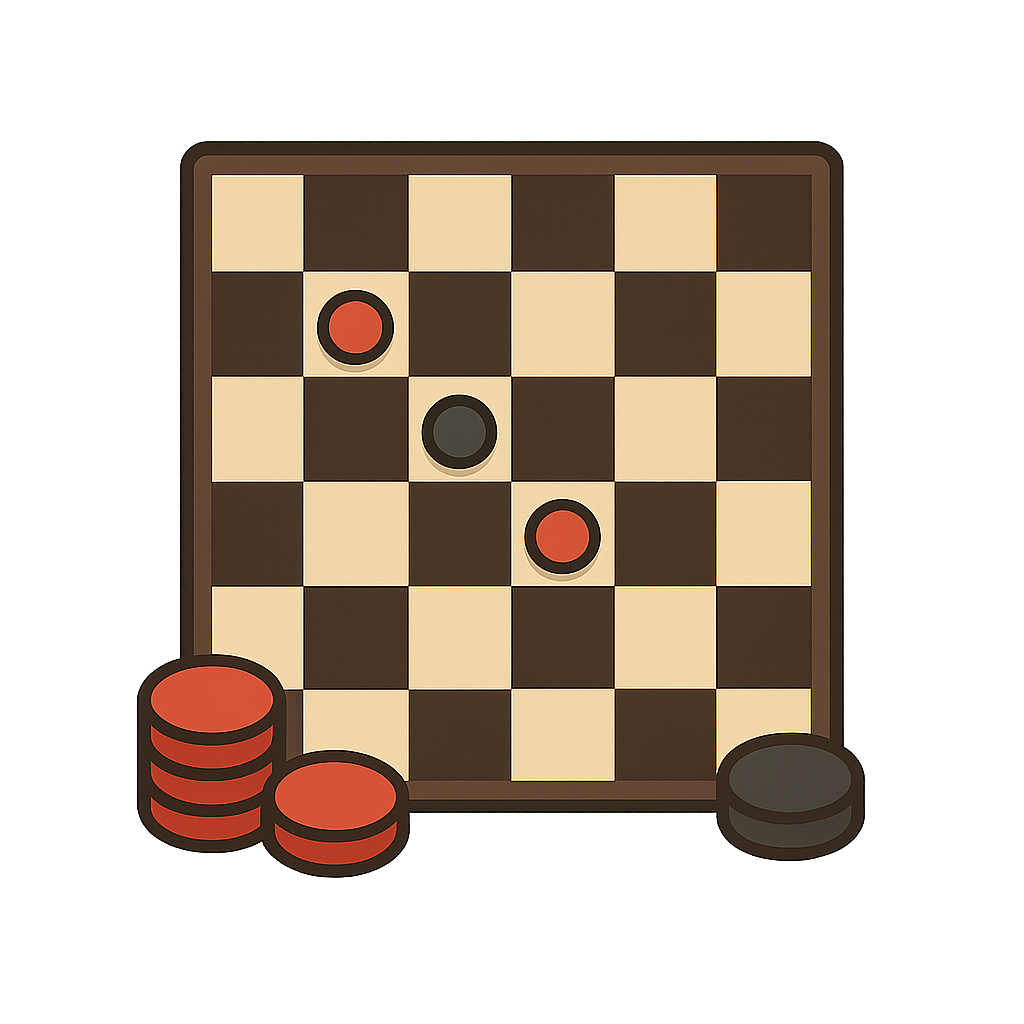
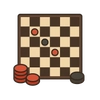
The room grows quiet except for the soft click and slide of pieces. Two minds are locked in a silent contest, their eyes scanning the sixty-four squares of alternating light and dark wood. I feel the slight weight of a hand, lifting one of my flat, round soldiers and moving it diagonally forward. A space opens up. A trap is set. The other player hesitates, their fingers drumming lightly on the table as they calculate the possibilities. This is where I come alive, not with a voice or a body, but in the space between thoughts, in the careful dance of advance and retreat. There is a satisfying clack as one piece hops over another, capturing it and setting it aside. The captured soldier has fallen, but the battle is far from over. There is a special kind of tension that builds as a lone piece bravely makes its way across the field, dodging and weaving through enemy territory. It gets closer and closer to the final row. Will it make it. The journey is perilous, a single mistake could lead to its capture. But the reward is great: a crown and the power to change the course of the entire game. This silent war, fought with patience and foresight, has been waged on my surface for centuries. You might not think of me as being alive, but I've been watching players think, plan, and smile for thousands of years. I am the game of Checkers, though some of my oldest friends call me Draughts.
My story did not begin on the familiar checkered board you see today. My roots stretch back into the deep soil of history, to the very cradle of civilization. If you could travel back in time, you would find some of my distant cousins in the ancient Mesopotamian city of Ur, nearly five thousand years ago, around 3000 BCE. Archaeologists there discovered a game board that, while different from me, shared my spirit of play and strategy. But my true, direct ancestor was born under the warm sun of ancient Egypt. Around 1400 BCE, a game called Alquerque was played by everyone from powerful pharaohs in their grand temples to farmers resting by the Nile. Imagine a board not of squares, but of intersecting lines, forming a web of points where the pieces could stand. The goal was the same thrilling challenge that players love about me today: to capture your opponent’s pieces by jumping over them. This was the heart of the game, the fundamental rule that has been passed down through my family for millennia. I'm very proud of this family trait. Alquerque was a test of skill, a way to sharpen the mind. It didn't need fancy equipment, just a marked surface, some stones or beads, and two people ready for a mental duel. This ancient game was my blueprint, the original idea from which I would one day evolve. It contained the spark of strategic capture that makes me so compelling.
The Game of Checkers: A Story of an Ancient Board Game
The room grows quiet except for the soft click and slide of pieces. Two minds are locked in a silent contest, their eyes scanning the sixty-four squares of alternating light and dark wood. I feel the slight weight of a hand, lifting one of my flat, round soldiers and moving it diagonally forward. A space opens up. A trap is set. The other player hesitates, their fingers drumming lightly on the table as they calculate the possibilities. This is where I come alive, not with a voice or a body, but in the space between thoughts, in the careful dance of advance and retreat. There is a satisfying clack as one piece hops over another, capturing it and setting it aside. The captured soldier has fallen, but the battle is far from over. There is a special kind of tension that builds as a lone piece bravely makes its way across the field, dodging and weaving through enemy territory. It gets closer and closer to the final row. Will it make it. The journey is perilous, a single mistake could lead to its capture. But the reward is great: a crown and the power to change the course of the entire game. This silent war, fought with patience and foresight, has been waged on my surface for centuries. You might not think of me as being alive, but I've been watching players think, plan, and smile for thousands of years. I am the game of Checkers, though some of my oldest friends call me Draughts.
My story did not begin on the familiar checkered board you see today. My roots stretch back into the deep soil of history, to the very cradle of civilization. If you could travel back in time, you would find some of my distant cousins in the ancient Mesopotamian city of Ur, nearly five thousand years ago, around 3000 BCE. Archaeologists there discovered a game board that, while different from me, shared my spirit of play and strategy. But my true, direct ancestor was born under the warm sun of ancient Egypt. Around 1400 BCE, a game called Alquerque was played by everyone from powerful pharaohs in their grand temples to farmers resting by the Nile. Imagine a board not of squares, but of intersecting lines, forming a web of points where the pieces could stand. The goal was the same thrilling challenge that players love about me today: to capture your opponent’s pieces by jumping over them. This was the heart of the game, the fundamental rule that has been passed down through my family for millennia. I'm very proud of this family trait. Alquerque was a test of skill, a way to sharpen the mind. It didn't need fancy equipment, just a marked surface, some stones or beads, and two people ready for a mental duel. This ancient game was my blueprint, the original idea from which I would one day evolve. It contained the spark of strategic capture that makes me so compelling.
For centuries, my ancestor Alquerque thrived in North Africa and the Middle East. Then, around the 10th century, a great change began. Carried in the minds of Moorish travelers and conquerors, Alquerque journeyed across the sea and into Spain. From there, it began to spread across Europe, passed from one player to another in marketplaces, castles, and quiet homes. But the most important moment of my life, the event that truly made me who I am, happened somewhere in the south of France during the 12th century. A group of clever and imaginative players had a revolutionary idea. They looked at a chessboard, with its neat grid of 64 alternating squares, and thought, "What if we played Alquerque on this board instead.". It was a stroke of genius. They discarded the old board of lines and embraced the checkered field. They gave each player twelve pieces and set them on the dark squares, ready for battle. In that moment, I was born. And they didn't stop there. They added the most exciting rule of all, the one that can turn a losing game into a stunning victory. They decided that when a simple piece, a 'man', bravely fought its way to the opponent's back row, it would be rewarded. It would receive a crown, another piece stacked on top, and become a mighty King. This new King was no longer restricted to moving forward; it could now move backward as well, becoming a powerful force on the board. I was so proud. In France, they called me 'Fierges', and my new life as a modern classic had begun.
After my transformation in France, I began to travel the world, and like any traveler, I picked up new customs and names along the way. For a very long time, people in different countries played me with slightly different rules. Some used a bigger board, others had different rules for capturing. It was a bit confusing, but everyone agreed on the fun of the game. Then, a pivotal moment arrived in 1756. An Englishman, a mathematician named William Payne, decided it was time to bring some order to my world. He wrote the very first book dedicated entirely to my strategy, titled "An Introduction to the Game of Draughts." His book helped create a standard set of rules that players in Great Britain could agree on, and that's when I formally got the name 'Draughts' there, a word related to the idea of drawing or moving a piece. When I sailed across the Atlantic Ocean with settlers heading to a new land, I found another new name. In America, they started calling me 'Checkers,' a simple and clear name inspired by my checkered board. Though I am ancient, my purpose has never changed. I still teach players the same valuable skills I always have: how to think ahead, how to plan a strategy, and how to be patient. I teach you how to see several moves into the future and how to adapt when your opponent makes an unexpected play. And perhaps most importantly, I teach how to win with grace and lose with a friendly handshake. I show that sometimes the simplest things, like a board and some pieces, are all you need to connect with another person and have a truly wonderful time.
Wow facts
About
Checkers, also known as Draughts, is a classic strategy board game for two players involving diagonal moves of uniform game pieces and mandatory captures by jumping over opponent pieces.
Take a Quiz
Question 1 of 5
What is the main idea of the section 'My Big Move and Makeover'?
Explore next



Want to do even more?
Go beyond exploring. Unlock tools that turn every story into real learning.

Storypie Plus for families
Full stories, quizzes, and printables. Nights and car rides, sorted.
- Unlimited audio stories
- Create Mode: your child stars in the story
- Offline downloads
- Printable worksheets & coloring pages

Why Storypie for Schools
Students engaged. Prep in seconds. Evenings back to you.
- Worksheets & Quizzes
- Classroom Management
- Formative Assessment
- Custom Curriculum & Lesson Plans
- 27 Languages

Why Storypie for Homeschool
Curriculum done. They'll ask for more. Hours back in your day.
- Worksheet Generator
- First-Person Audio Stories
- Built-in Comprehension Quizzes
- Custom Curriculum & Lesson Plans
- Print & Go Activities