English

Community Helpers: People Who Work
The concept that individuals within a society perform specialized jobs…
Reads at Grades 6–8 Listens at Grades 4–8
Print & create
Answer keys·No prep·Free with an account
28 worksheets · answer keys · full story · quiz · Ages 10-12 · CEFR B2
Plus adds 244,000+ more stories in 27 languages, audio for every one, and printables for all of them.
Just want Community Helpers: People Who Work?
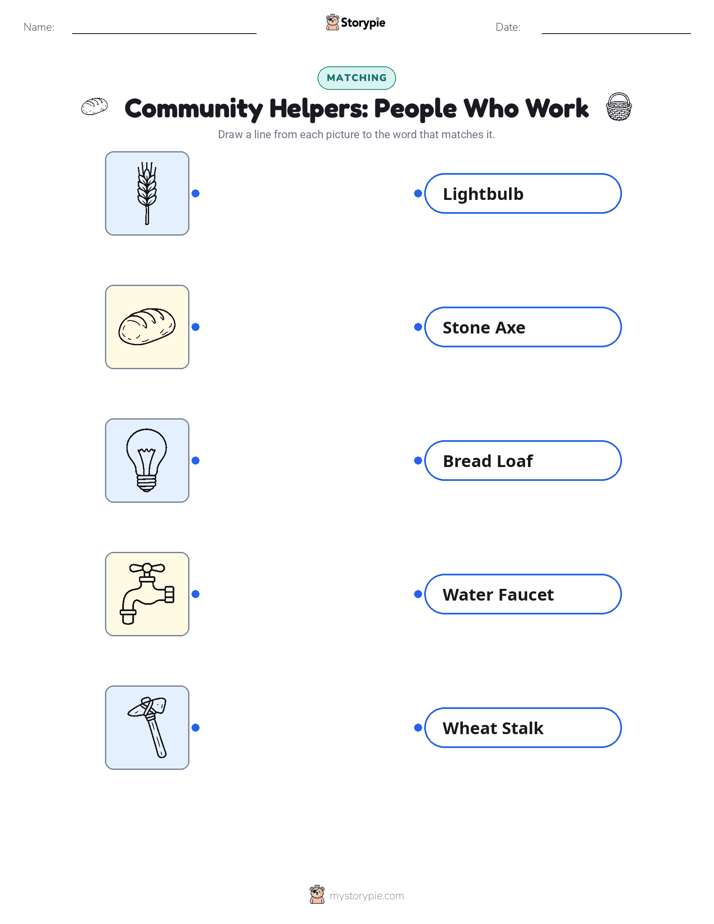
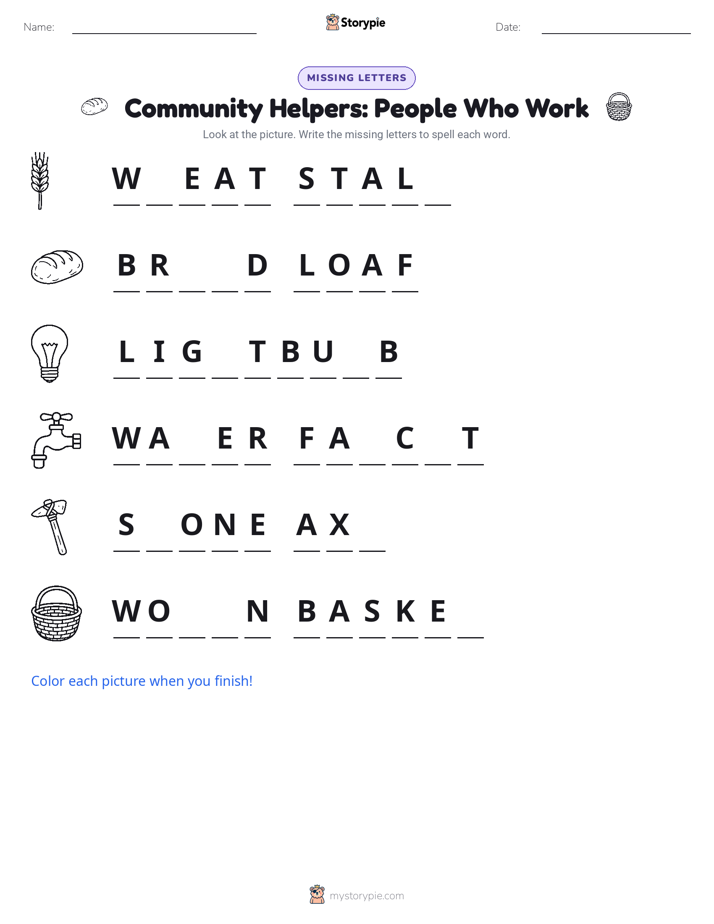
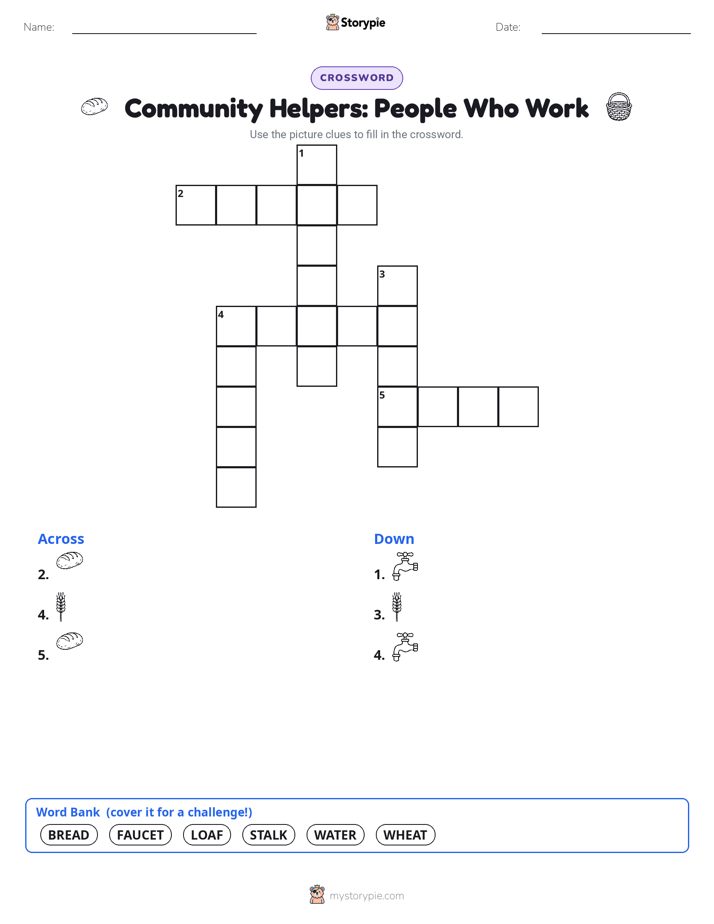
Think about your morning. Perhaps you had a piece of toast, flipped on a light switch, and poured a glass of cool, clean water from the faucet. Have you ever stopped to wonder how all those things came to be? A farmer far away woke up before dawn to grow the wheat for your bread. A baker mixed and kneaded the dough. Miles from your home, an engineer monitored a power plant to send electricity zipping through wires to your lightbulb, while a city worker ensured the water flowing to your tap was safe to drink. I am the invisible web that connects all of them to you. I am the quiet promise that when we work together, life becomes better for everyone. I am the fundamental idea that a community thrives when people share their unique talents and skills to help one another. You can call me Community Cooperation, but you might know me as the idea of Community Helpers.
My story began a very long time ago, born from the simple need for survival. During the Paleolithic Era, early humans lived in small, wandering groups. It didn't take them long to realize that it was more efficient if they divided the work. Some were naturally quick and strong, becoming skilled hunters who could track animals for miles. Others had a keen eye for nature's details, making them expert gatherers of edible plants, nuts, and berries. Still others had a knack for finding the safest caves or building the sturdiest temporary shelters. This was my simplest form, a partnership for survival. But my big growth spurt arrived with the Neolithic Revolution, which began around 10,000 BCE. When humans learned how to farm and domesticate animals, they could finally stop wandering and build permanent villages. For the first time, not everyone had to spend their entire day searching for food. This surplus of food was the key that unlocked my true potential. In early settlements like Çatalhöyük in modern-day Turkey, around 7500 BCE, you could see me flourishing. While farmers cultivated fields, others became expert potters, creating clay vessels to store grain and water. Some wove intricate cloth from flax and wool, and others became specialized builders, crafting durable mud-brick houses. This was the birth of specialized professions, and humanity was beginning to understand just how powerful I could be.
The Story of Community Helpers
Think about your morning. Perhaps you had a piece of toast, flipped on a light switch, and poured a glass of cool, clean water from the faucet. Have you ever stopped to wonder how all those things came to be? A farmer far away woke up before dawn to grow the wheat for your bread. A baker mixed and kneaded the dough. Miles from your home, an engineer monitored a power plant to send electricity zipping through wires to your lightbulb, while a city worker ensured the water flowing to your tap was safe to drink. I am the invisible web that connects all of them to you. I am the quiet promise that when we work together, life becomes better for everyone. I am the fundamental idea that a community thrives when people share their unique talents and skills to help one another. You can call me Community Cooperation, but you might know me as the idea of Community Helpers.
My story began a very long time ago, born from the simple need for survival. During the Paleolithic Era, early humans lived in small, wandering groups. It didn't take them long to realize that it was more efficient if they divided the work. Some were naturally quick and strong, becoming skilled hunters who could track animals for miles. Others had a keen eye for nature's details, making them expert gatherers of edible plants, nuts, and berries. Still others had a knack for finding the safest caves or building the sturdiest temporary shelters. This was my simplest form, a partnership for survival. But my big growth spurt arrived with the Neolithic Revolution, which began around 10,000 BCE. When humans learned how to farm and domesticate animals, they could finally stop wandering and build permanent villages. For the first time, not everyone had to spend their entire day searching for food. This surplus of food was the key that unlocked my true potential. In early settlements like Çatalhöyük in modern-day Turkey, around 7500 BCE, you could see me flourishing. While farmers cultivated fields, others became expert potters, creating clay vessels to store grain and water. Some wove intricate cloth from flax and wool, and others became specialized builders, crafting durable mud-brick houses. This was the birth of specialized professions, and humanity was beginning to understand just how powerful I could be.
With my help, those first villages grew into the world's first great cities and empires. In the sprawling cities of ancient Mesopotamia around 3500 BCE, I was the organizing force that allowed thousands of people to build towering ziggurats and manage complex irrigation systems that turned desert land into fertile fields. I created a diverse array of roles: scribes who kept records, merchants who traded goods, priests who led rituals, and soldiers who defended the city walls. My importance became so recognized that it was written into law. Around 1754 BCE, King Hammurabi of Babylon created a famous code of laws that included specific rules for doctors and builders, setting standards for their work and ensuring accountability. This showed that my jobs had become official and essential parts of the state. I leaped across continents and centuries to Ancient Rome, where I helped engineers design and construct incredible aqueducts that carried fresh water for miles and roads that connected a vast empire. To protect its one million residents, Rome needed organized services. So, I helped Emperor Augustus establish the Vigiles Urbani in 6 CE, the first city-wide corps of firefighters and watchmen. Even philosophers thought deeply about me. Around 375 BCE, the Greek thinker Plato argued in his book 'The Republic' that the perfect society was one where every citizen performed the job they were naturally best suited for, creating a harmonious and efficient whole.
As human society changed, so did I. The Industrial Revolution of the 18th and 19th centuries was a period of enormous transformation. Factories sprang up, and cities swelled with people moving in from the countryside to find work. These crowded, complex urban environments needed new kinds of helpers to function. I helped create some of the professions we see as essential today. To maintain order and safety, the first modern police force was founded in London on September 29th, 1829. With the rise of public education, being a teacher became a widespread and vital profession, shaping the minds of the next generation. I constantly adapted to new technologies, creating brand new jobs that would have been unimaginable just a century before. I was there when the first telephone operators connected calls across cities, when electricians lit up the world with a flick of a switch, and eventually, when computer programmers wrote the code that powers our digital age and web designers built the virtual spaces where we learn and connect. I am always changing, always growing alongside human ingenuity.
Today, I am all around you, working quietly in the background of your life. I am in the sanitation worker who keeps your city clean and healthy, the librarian who shares the magic of books and knowledge, the bus driver who gets you to school safely, and the scientist in a lab searching for cures to diseases. The global pandemic that began in 2020 served as a powerful reminder of just how much we depend on each other. Suddenly, everyone recognized the critical importance of my essential helpers, from the nurses and doctors on the front lines to the grocery clerks and delivery drivers who kept society running. I am the living proof that we are more resilient, more capable, and stronger together. My story is far from over; it is still being written every day. New challenges create new helpers, like drone operators who deliver medicine and renewable energy experts who are building a more sustainable future. I am the hopeful promise that whatever challenges lie ahead, we will face them, as we always have, together.
Wow facts
About
The concept that individuals within a society perform specialized jobs, all of which contribute to the functioning and well-being of the community as a whole.
Take a Quiz
Question 1 of 5
What problem did early humans in the Paleolithic Era face that led to the creation of Community Cooperation in its simplest form?
Explore next




Want to do even more?
Go beyond exploring. Unlock tools that turn every story into real learning.

Storypie Plus for families
Full stories, quizzes, and printables. Nights and car rides, sorted.
- Unlimited audio stories
- Create Mode: your child stars in the story
- Offline downloads
- Printable worksheets & coloring pages

Why Storypie for Schools
Students engaged. Prep in seconds. Evenings back to you.
- Worksheets & Quizzes
- Classroom Management
- Formative Assessment
- Custom Curriculum & Lesson Plans
- 27 Languages

Why Storypie for Homeschool
Curriculum done. They'll ask for more. Hours back in your day.
- Worksheet Generator
- First-Person Audio Stories
- Built-in Comprehension Quizzes
- Custom Curriculum & Lesson Plans
- Print & Go Activities