English

Drama and Plays (Theater)
Drama, or theater, is the art of storytelling through performance…
Reads at Grades 6–8 Listens at Grades 4–8
Print & create
Answer keys·No prep·Free with an account
28 worksheets · answer keys · full story · quiz · Ages 10-12 · CEFR B2
Plus adds 244,000+ more stories in 27 languages, audio for every one, and printables for all of them.
Just want Drama and Plays (Theater)?
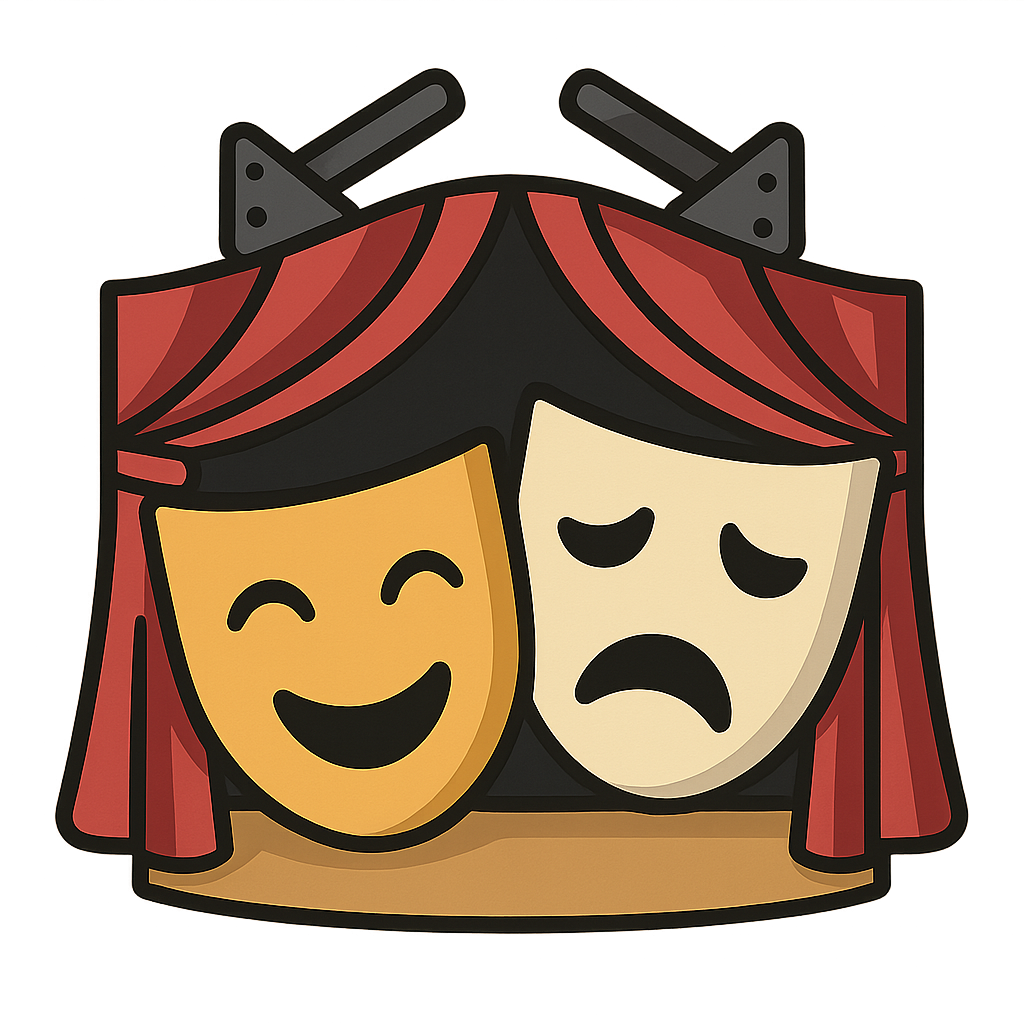
Imagine you are sitting in a vast, dark room, surrounded by the quiet breathing of hundreds of other people. A hush falls as the lights dim, and a single beam of light illuminates a space in front of you. In that moment, a collective anticipation hangs in the air, a shared feeling that you are all about to be transported somewhere else. I am that journey. I am a story that breathes, a world made of light, sound, and a few pieces of wood. I can be a king's castle one moment and a spaceship the next. I let you walk in someone else's shoes and feel their joy or sorrow, to gasp at a sudden twist or laugh at a clever joke, all while sitting next to a stranger who is feeling the exact same thing. Before movies, before screens you could hold in your hand, I was the original magic of seeing a story come to life right in front of you. I am Drama, and my home is the Theater.
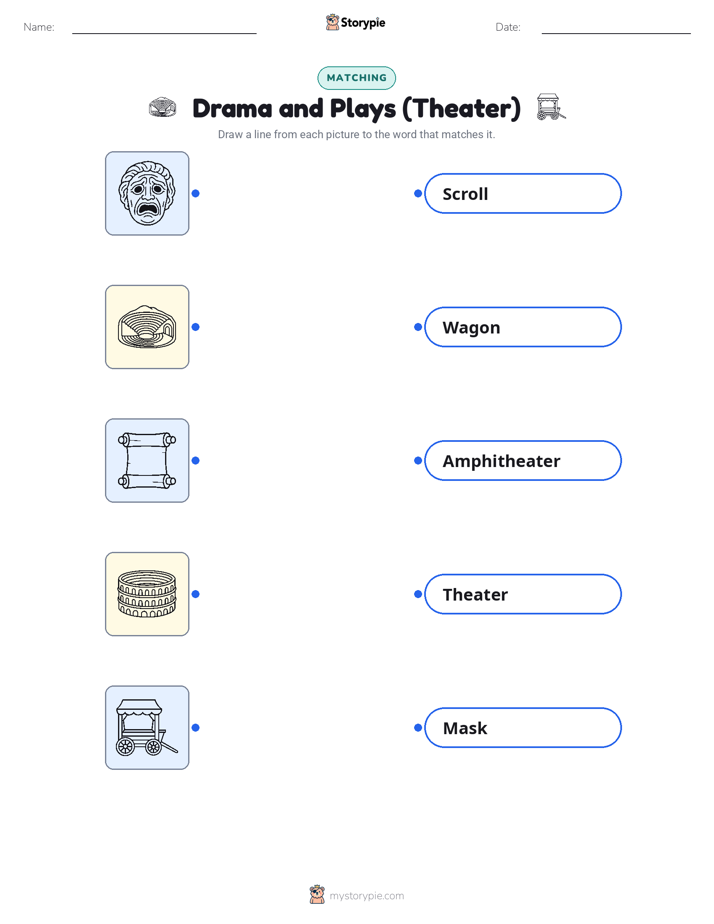
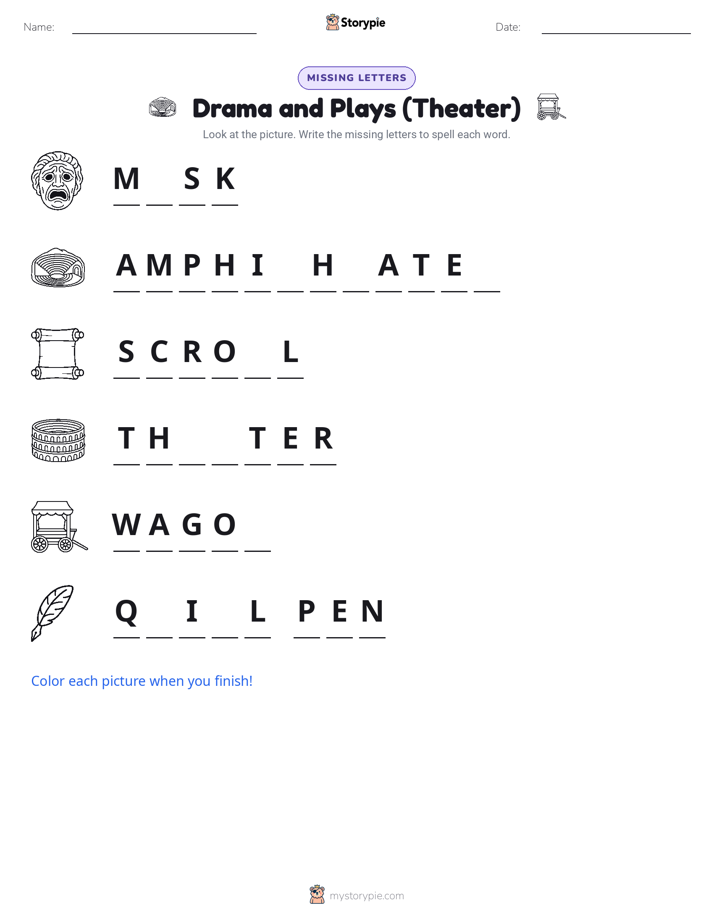
My story begins in the bright sunshine of Ancient Greece, over two and a half thousand years ago. I wasn't born all at once; I grew out of huge, joyful festivals held in Athens to honor Dionysus, the god of wine and celebration. At first, these festivals featured choruses of men who would sing and dance the epic stories of gods and heroes. It was beautiful, but it was more of a group recitation than a personal story. Then, during the 6th century BCE, a clever man named Thespis had a brilliant, revolutionary idea. Around the year 534 BCE, at the City Dionysia festival, he did something no one had ever done before. He stepped away from the chorus and began speaking not as a narrator, but as a character in the story. He became the very first actor, and suddenly, storytelling had a new, individual voice. It was a monumental shift. Building on this incredible innovation, great writers in the 5th century BCE, like Aeschylus, Sophocles, and Euripides, transformed me. Aeschylus added a second actor, allowing for conflict and dialogue. Then Sophocles added a third, making my stories far more complex and thrilling. People would gather by the thousands in enormous outdoor amphitheaters carved into hillsides to watch plays about heroes, gods, and the most difficult questions of life. The actors wore large, expressive masks to help show their emotions and project their voices to the very back rows.
I Am Drama: A Story of the Stage
Imagine you are sitting in a vast, dark room, surrounded by the quiet breathing of hundreds of other people. A hush falls as the lights dim, and a single beam of light illuminates a space in front of you. In that moment, a collective anticipation hangs in the air, a shared feeling that you are all about to be transported somewhere else. I am that journey. I am a story that breathes, a world made of light, sound, and a few pieces of wood. I can be a king's castle one moment and a spaceship the next. I let you walk in someone else's shoes and feel their joy or sorrow, to gasp at a sudden twist or laugh at a clever joke, all while sitting next to a stranger who is feeling the exact same thing. Before movies, before screens you could hold in your hand, I was the original magic of seeing a story come to life right in front of you. I am Drama, and my home is the Theater.
My story begins in the bright sunshine of Ancient Greece, over two and a half thousand years ago. I wasn't born all at once; I grew out of huge, joyful festivals held in Athens to honor Dionysus, the god of wine and celebration. At first, these festivals featured choruses of men who would sing and dance the epic stories of gods and heroes. It was beautiful, but it was more of a group recitation than a personal story. Then, during the 6th century BCE, a clever man named Thespis had a brilliant, revolutionary idea. Around the year 534 BCE, at the City Dionysia festival, he did something no one had ever done before. He stepped away from the chorus and began speaking not as a narrator, but as a character in the story. He became the very first actor, and suddenly, storytelling had a new, individual voice. It was a monumental shift. Building on this incredible innovation, great writers in the 5th century BCE, like Aeschylus, Sophocles, and Euripides, transformed me. Aeschylus added a second actor, allowing for conflict and dialogue. Then Sophocles added a third, making my stories far more complex and thrilling. People would gather by the thousands in enormous outdoor amphitheaters carved into hillsides to watch plays about heroes, gods, and the most difficult questions of life. The actors wore large, expressive masks to help show their emotions and project their voices to the very back rows.
From Greece, my journey took me to the powerful Roman Empire. Starting around 240 BCE, the Romans fell in love with my stories, but they added their own distinct flair. They were incredible engineers and built massive, freestanding stone theaters that didn't need a hillside for support. Their plays were often grander and more spectacular than my Greek originals. They adored comedies that made them roar with laughter, filled with witty servants and mistaken identities, but they also enjoyed thrilling tragedies. I flourished for centuries under Roman rule. However, as the Roman Empire began to crumble around the 5th century CE, my grand theaters fell silent. The formal, organized world that supported me faded away. For hundreds of years, I went into a kind of hibernation. The practice of writing and performing complex plays nearly vanished in Europe. But I didn't disappear completely. I lived on in a simpler form, carried by traveling minstrels, jugglers, and storytellers who kept the spirit of performance alive in bustling marketplaces and dusty village squares.
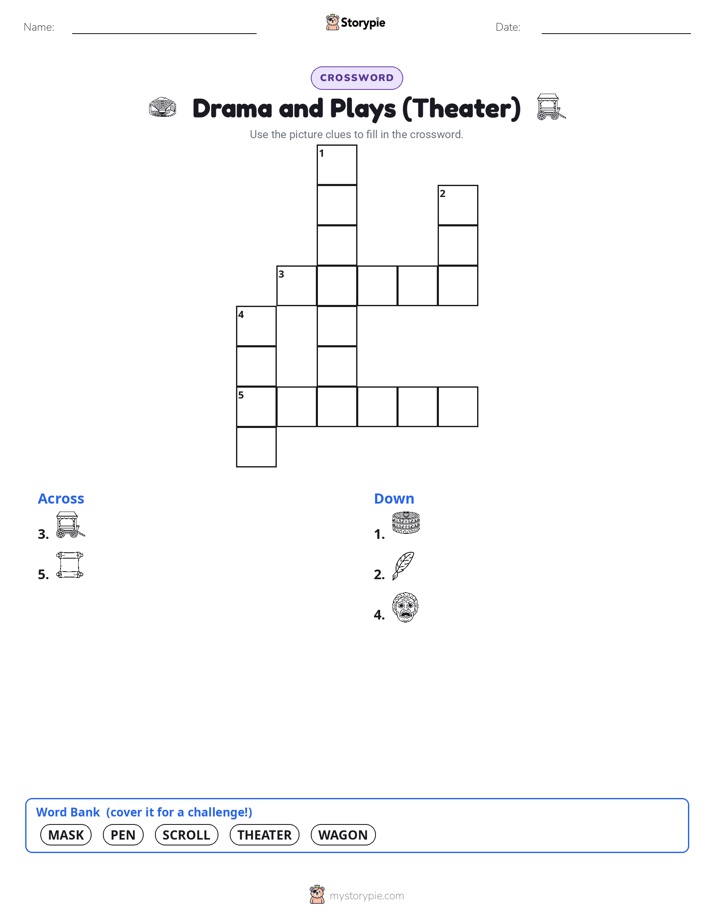
I awoke again during the Middle Ages, but this time in a very different place: the church. Around the 10th century CE, priests realized I could be a powerful teaching tool. To help people who couldn't read understand the Bible, they began using me to act out important stories during services. These short plays, called liturgical dramas, grew so popular that they eventually moved out of the churches and into the town squares for everyone to see. People built marvelous rolling stages called pageant wagons and performed 'Miracle' plays about the lives of saints and 'Morality' plays about the struggle between good and evil. Then came the Renaissance, a time of incredible creativity and a rediscovery of my ancient forms. In Italy, a hilarious, improvisational style called Commedia dell'arte became famous, with masked actors playing familiar stock characters. This excitement spread across Europe and reached England, where, for the first time, permanent public theaters were built just for me. A place called 'The Theatre' was built in London in 1576, and soon the city was buzzing with people from all walks of life—rich and poor—eager to see a play.
It was in this exciting time, during the late 16th and early 17th centuries, that I met one of my greatest friends and most brilliant collaborators: William Shakespeare. He was a master storyteller who understood the human heart better than almost anyone. In his famous theater, the Globe, he didn't need fancy special effects or elaborate sets. His powerful, poetic words alone could create raging storms at sea, bloody battles on a field, and magical forests enchanted by fairies, all inside the minds of the audience. The people who paid a penny to stand on the ground, called 'groundlings,' and the wealthy nobles sitting in the galleries were all equally captivated by his tragedies like 'Hamlet' and comedies like 'A Midsummer Night's Dream.' He showed the world that I could be used to explore the deepest, most complex feelings of love, jealousy, ambition, and loss, making my stories profoundly human and timeless.
Today, I am more alive than ever. You can find me in magnificent theaters on Broadway in New York City, in your own school auditorium, or at a small community playhouse in your town. I have changed with the times, embracing incredible lighting, sound, and technology to create worlds that my Greek and Roman ancestors could never have imagined. But my core purpose, my very heart, has never changed. I am a place for people to gather and share an experience. I am a mirror that helps you understand yourself and a window that helps you see into the lives of others. I am the magic of human connection, forged in a darkened room, and my stage is always open, waiting for the next story to be told. Perhaps it will be yours.
Wow facts
About
Drama, or theater, is the art of storytelling through performance, where actors portray characters and events for an audience, a practice originating in ancient Greece.
Take a Quiz
Question 1 of 5
What is the main idea of the story about how theater developed over time?
Explore next





Want to do even more?
Go beyond exploring. Unlock tools that turn every story into real learning.

Storypie Plus for families
Full stories, quizzes, and printables. Nights and car rides, sorted.
- Unlimited audio stories
- Create Mode: your child stars in the story
- Offline downloads
- Printable worksheets & coloring pages

Why Storypie for Schools
Students engaged. Prep in seconds. Evenings back to you.
- Worksheets & Quizzes
- Classroom Management
- Formative Assessment
- Custom Curriculum & Lesson Plans
- 27 Languages

Why Storypie for Homeschool
Curriculum done. They'll ask for more. Hours back in your day.
- Worksheet Generator
- First-Person Audio Stories
- Built-in Comprehension Quizzes
- Custom Curriculum & Lesson Plans
- Print & Go Activities