English

Earthquake
An earthquake is the shaking of the Earth's surface caused by a sudden release of energy in the planet's…
Reads at Grades 6–8 Listens at Grades 4–8
Print & create
Answer keys·No prep·Free with an account
28 worksheets · answer keys · full story · quiz · Ages 10-12 · CEFR B2
Plus adds 164,000+ more stories in 27 languages, audio for every one, and printables for all of them.
Just want Earthquake?
It begins as a deep, low hum you can feel more than hear, a vibration that seems to come from the very bones of the world. The feeling grows, and soon the floor beneath your feet begins to quiver, then sway. Windowpanes buzz in their frames, and books tumble from their shelves as the solid ground decides to dance a sudden, violent jig. You might grab onto a table to steady yourself, your heart pounding with a mix of fear and awe at the invisible force that can move a whole city. Have you ever felt that power. Have you ever felt the world itself shift beneath you. I am that deep, resonant shudder. I am the Earth’s powerful, rumbling voice. I am an Earthquake.
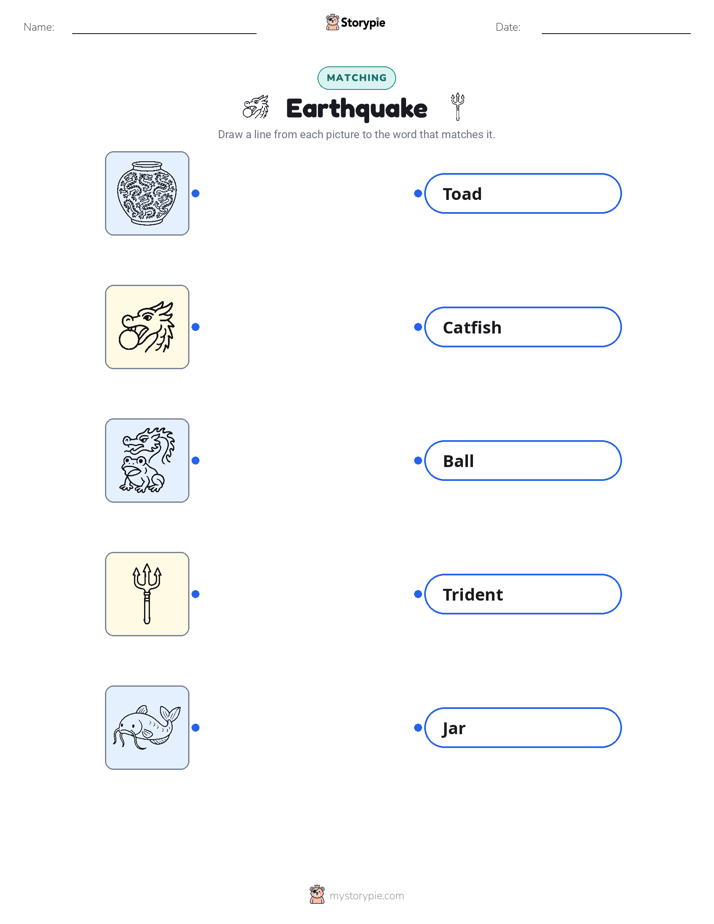
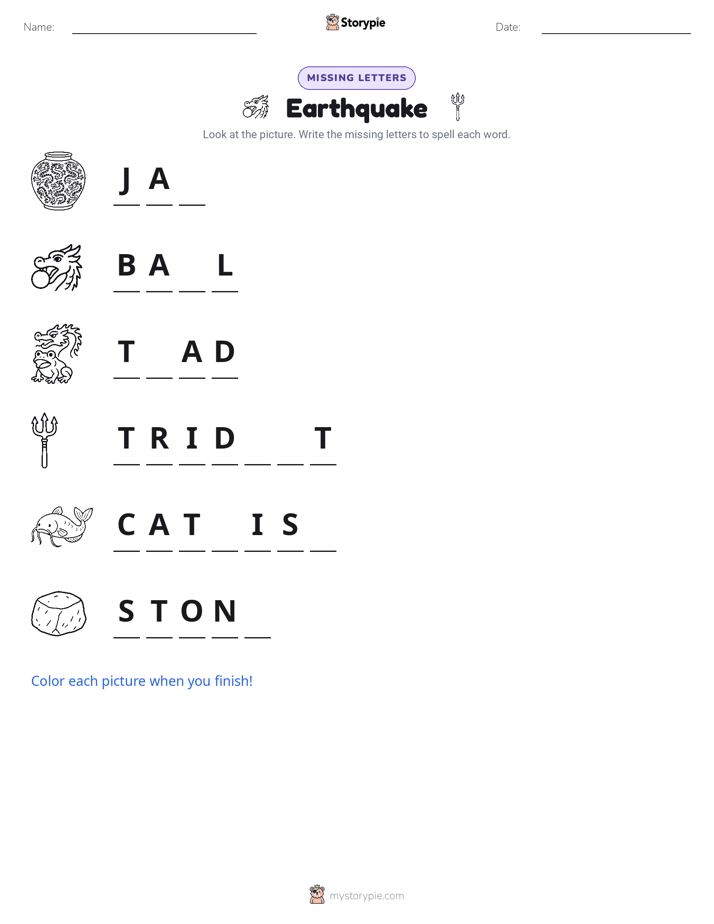
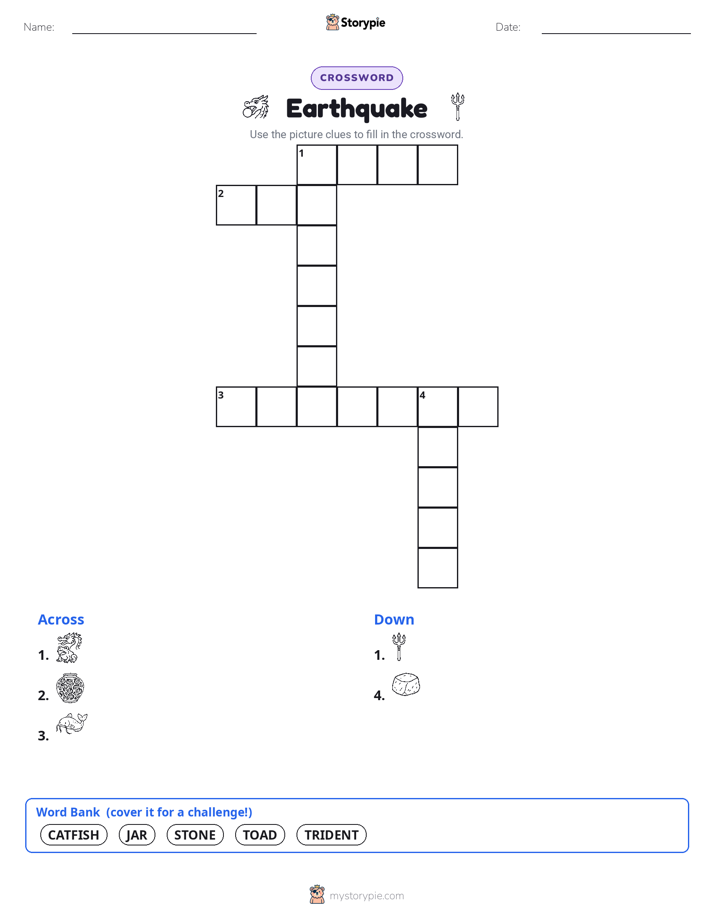
For most of human history, people had no way of knowing what I was. They only knew my incredible strength, and they tried to explain it with stories of gods and monsters. In ancient Greece, they believed I was the fury of the sea god, Poseidon, who they called the 'Earth-Shaker.' When he was angry, they said, he would strike the ground with his mighty trident, and I would answer with a roar. Far away in Japan, storytellers spoke of a giant catfish named Namazu who lived in the mud beneath the earth. A god named Kashima was supposed to keep him still with a heavy stone, but when Kashima let his guard down, Namazu would thrash his tail, and the islands would tremble. In the cold lands of the Norse, they whispered that I was the tortured shaking of the god Loki, bound deep underground as punishment for his misdeeds. These weren't just silly tales; they were humanity's first attempts to comprehend a power so immense it defied understanding. They were stories born of respect and a deep, instinctual fear.
I Am an Earthquake
It begins as a deep, low hum you can feel more than hear, a vibration that seems to come from the very bones of the world. The feeling grows, and soon the floor beneath your feet begins to quiver, then sway. Windowpanes buzz in their frames, and books tumble from their shelves as the solid ground decides to dance a sudden, violent jig. You might grab onto a table to steady yourself, your heart pounding with a mix of fear and awe at the invisible force that can move a whole city. Have you ever felt that power. Have you ever felt the world itself shift beneath you. I am that deep, resonant shudder. I am the Earth’s powerful, rumbling voice. I am an Earthquake.
For most of human history, people had no way of knowing what I was. They only knew my incredible strength, and they tried to explain it with stories of gods and monsters. In ancient Greece, they believed I was the fury of the sea god, Poseidon, who they called the 'Earth-Shaker.' When he was angry, they said, he would strike the ground with his mighty trident, and I would answer with a roar. Far away in Japan, storytellers spoke of a giant catfish named Namazu who lived in the mud beneath the earth. A god named Kashima was supposed to keep him still with a heavy stone, but when Kashima let his guard down, Namazu would thrash his tail, and the islands would tremble. In the cold lands of the Norse, they whispered that I was the tortured shaking of the god Loki, bound deep underground as punishment for his misdeeds. These weren't just silly tales; they were humanity's first attempts to comprehend a power so immense it defied understanding. They were stories born of respect and a deep, instinctual fear.
For centuries, myths were the only explanation. But then, a few brilliant minds began to look for clues, seeking a different kind of answer. One of the very first was a Chinese astronomer and inventor named Zhang Heng. In the year 132 CE, he created a magnificent device, the world’s first seismoscope. It was a large bronze jar, beautifully decorated with eight dragons, each holding a small bronze ball in its mouth. Below the dragons sat eight open-mouthed toads. When I rumbled, even from hundreds of miles away, a mechanism inside the jar would trigger, causing one of the dragons to drop its ball into a toad's mouth with a clang. The ball that fell showed the direction of my origin. It was an astonishing invention that moved beyond myth and toward measurement. Over sixteen hundred years later, on November 1st, 1755, I visited the city of Lisbon, Portugal, with devastating force. The tragedy was so profound that it forced thinkers across Europe to abandon supernatural explanations and begin asking serious scientific questions about what, not who, was causing me.
That tragic event sparked a new era of curiosity. Scientists were determined to understand my mechanics, to listen to the planet's heartbeat. An English scientist named John Milne, working in Japan during the 1880s, made a huge breakthrough. He invented the modern seismograph, a device with a weighted pendulum and a pen. When I moved the ground, the frame of the device moved with it, but the heavy weight stayed still, allowing the pen to draw a jagged line on a rotating drum of paper. For the first time, people had a written record of my vibrations, a signature of my passing. They could study my waves of energy. Then, in 1935, an American scientist named Charles F. Richter, along with his colleague Beno Gutenberg, created a way to measure my magnitude. They developed the Richter scale, a mathematical system that assigned a number to my strength based on the data from seismographs. Finally, humanity had a universal language to describe my power, allowing them to compare a small tremor in California to a massive quake in Chile.
With the tools to listen and measure, scientists were ready for the biggest discovery of all. The final piece of the puzzle wasn't about a single event but about the entire planet. As early as 1912, a German scientist named Alfred Wegener had proposed a radical idea he called 'continental drift,' suggesting that the continents were not fixed but were slowly moving. Most people dismissed his theory. But in the 1960s, scientists mapping the ocean floor found stunning evidence that he was right. They discovered that the Earth's crust isn't one solid piece but is broken into a jigsaw puzzle of enormous tectonic plates. These plates, carrying continents and oceans, are constantly floating, grinding, and crashing into each other on a sea of hot, molten rock. And me. I am what happens at their boundaries. When these colossal plates get stuck against each other, pressure builds and builds, until finally, they slip, releasing a staggering amount of energy in an instant. That energy is me.
Today, you understand that I am a natural, necessary part of a living planet. And while my power must be respected, it doesn't have to be feared in the same way it was in ancient times. Because you understand my cause, you can prepare. Engineers now design incredible buildings with foundations that can sway and absorb my energy. Cities in my active zones have early warning systems and emergency plans to keep people safe. I am no longer a monster or an angry god. I am a reminder that the Earth is not a static, unchanging rock. I am a force of creation. My movements over millions of years have raised the mightiest mountain ranges and carved the deepest ocean trenches. I am the evidence that the world is dynamic, alive, and forever reshaping itself.
Wow facts
About
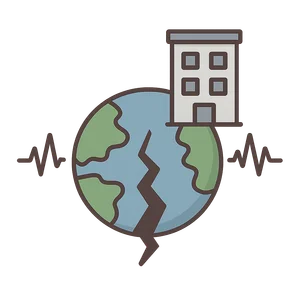
An earthquake is the shaking of the Earth's surface caused by a sudden release of energy in the planet's crust, primarily due to the movement of tectonic plates.
Take a Quiz
Question 1 of 5
What was the main difference between Zhang Heng's seismoscope and John Milne's seismograph?
Want to do even more?
Go beyond exploring. Unlock tools that turn every story into real learning.

Storypie Plus for families
Full stories, quizzes, and printables. Nights and car rides, sorted.
- Unlimited audio stories
- Create Mode: your child stars in the story
- Offline downloads
- Printable worksheets & coloring pages

Why Storypie for Schools
Students engaged. Prep in seconds. Evenings back to you.
- Worksheets & Quizzes
- Classroom Management
- Formative Assessment
- Custom Curriculum & Lesson Plans
- 27 Languages

Why Storypie for Homeschool
Curriculum done. They'll ask for more. Hours back in your day.
- Worksheet Generator
- First-Person Audio Stories
- Built-in Comprehension Quizzes
- Custom Curriculum & Lesson Plans
- Print & Go Activities