English


Negative Numbers (Integers)
Negative numbers are real numbers that are less than zero.
Reads at Grades 6–8 Listens at Grades 4–8
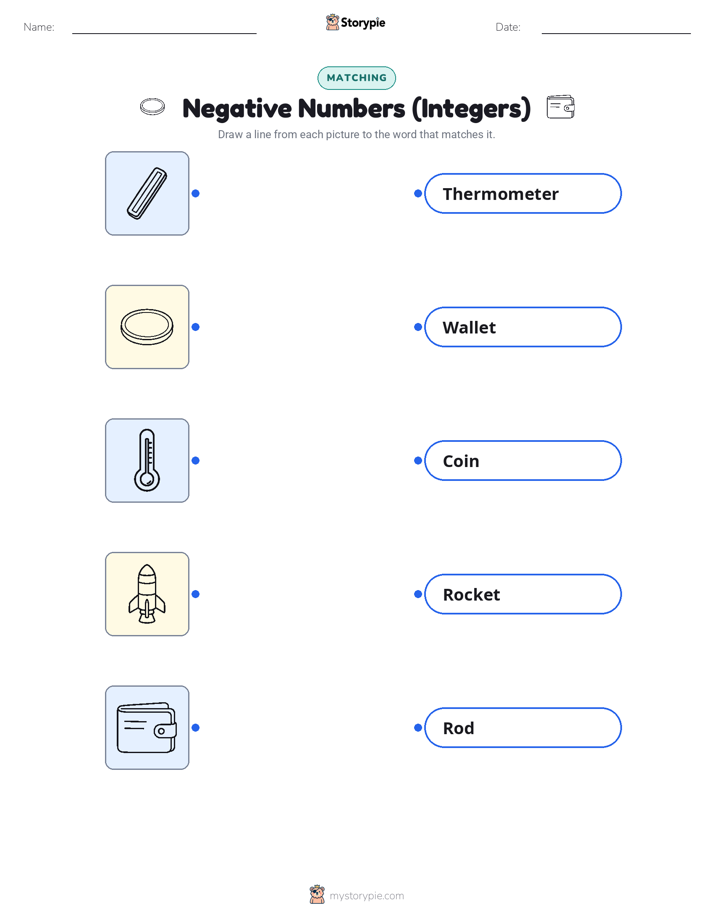
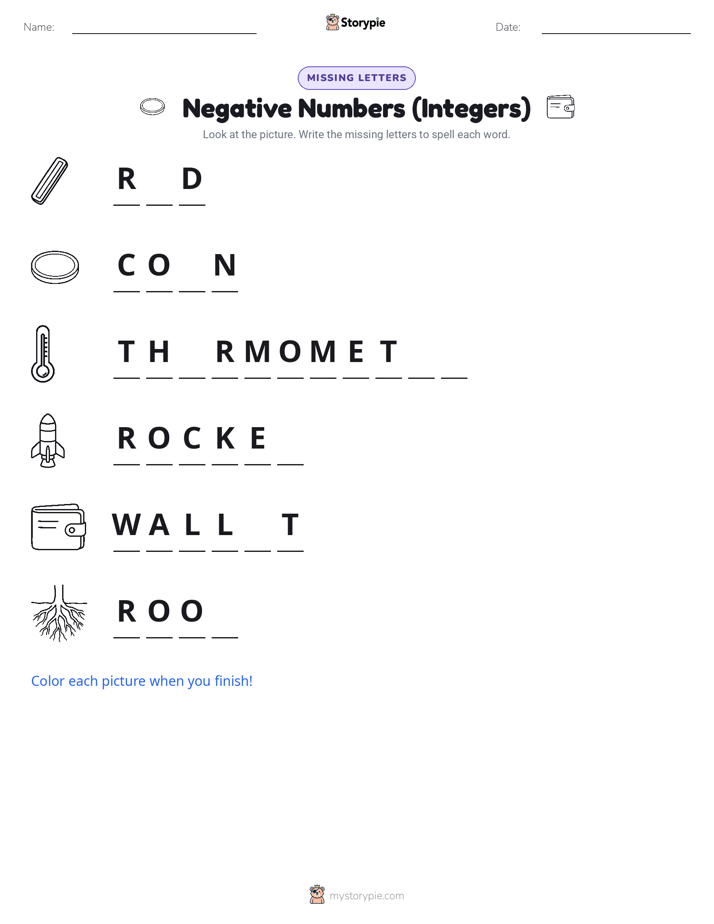
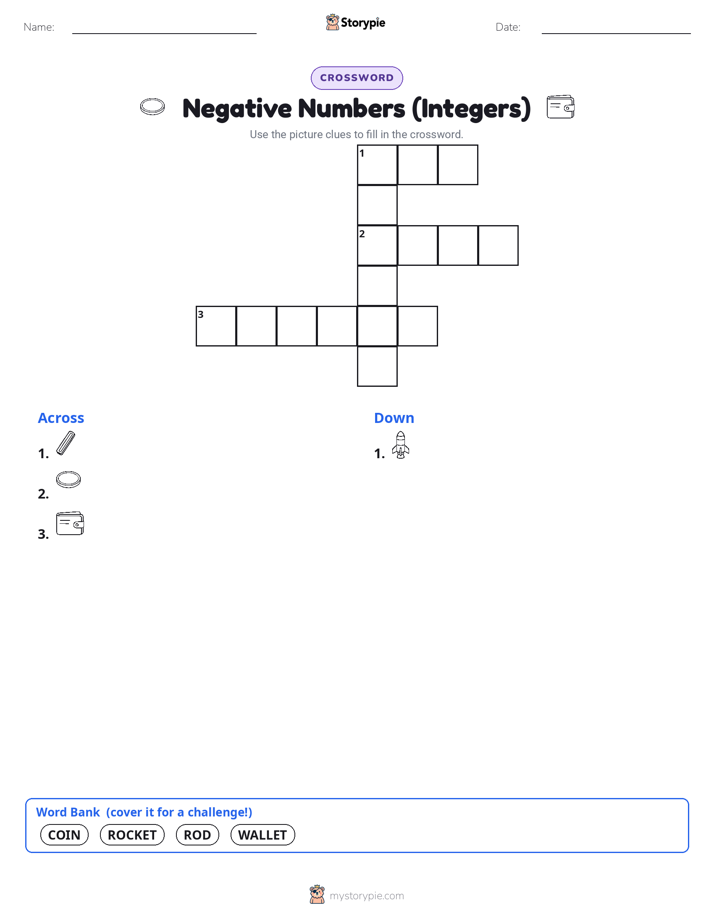
Print & create
Answer keys·No prep·Free with an account
28 worksheets · answer keys · full story · quiz · Ages 10-12 · CEFR B2
Plus adds 244,000+ more stories in 27 languages, audio for every one, and printables for all of them.
Just want Negative Numbers (Integers)?

Have you ever owed a friend some money? In that moment, your wallet doesn't just have zero, it has less than zero. Have you ever shivered on a winter day and seen the thermometer dip below that big, bold line for 0°? Or maybe you've watched a rocket launch, hearing the countdown echo, 'T-minus three, two, one…' In each of those moments, you’ve met me. I am that feeling of being in debt, that biting cold, that pause before the great blastoff. For a long time, people thought I was impossible, a puzzle that couldn't be solved. How can you have less than nothing? I am the space below the ground where roots grow deep, the crushing pressure in the darkest part of the ocean, and the quiet shadow on the other side of my famous cousin, Zero. I am the mirror image, the opposite direction, the other side of the story. Hello. My name is Negative Number, and I’m here to tell you how an idea that once seemed absurd came to change the world.
My journey to being understood was long and filled with doubters. For centuries, brilliant thinkers, especially in places like ancient Greece, simply dismissed me. They loved numbers they could see and measure, like the length of a side of a triangle or the number of coins in a pile. The idea of a number that represented a lack, something less than emptiness, just didn't make sense to them, so they ignored me. My first real welcome came from far away, in China, during the Han Dynasty between 202 BCE and 220 CE. There, clever mathematicians were writing a book called 'The Nine Chapters on the Mathematical Art'. They used different colored rods for their calculations: red rods for the things they had and black rods for the things they owed. Those black rods, representing debt, were my first real job. I wasn't a strange ghost of a number; I was a practical tool. My big breakthrough, however, happened in India. Around the year 628 CE, a genius mathematician named Brahmagupta decided it was time to give me a proper identity. In his writings, he laid out the rules for my entire family. He explained how to add and subtract with me, and he even solved the riddle that confused so many: what happens when you multiply a negative by a negative? He declared that the result is a positive, giving me a predictable and logical place in mathematics. But my travels to Europe were met with suspicion. For hundreds of years, I was called an outcast. In the 16th century, a German mathematician named Michael Stifel called me 'numeri absurdi,' or absurd numbers. He and others thought I was a meaningless fiction. But slowly, people started to see my value. In the early 13th century, a well-traveled Italian merchant and mathematician named Leonardo of Pisa, whom you probably know as Fibonacci, began using me in his book 'Liber Abaci' to solve problems about profit and loss. If a business deal went wrong, I was the perfect way to show it. It wasn't until the 17th century that I finally found my permanent home. A French philosopher and mathematician named René Descartes created his famous coordinate system. He drew a long horizontal line, placed Zero in the middle, and arranged all the positive numbers in a neat row to the right. Then, he looked to the empty space on the left and realized it was my home. He and another mathematician, John Wallis, helped everyone visualize me there, a perfect mirror of my positive siblings. I was no longer just a strange idea about debt; I was a location, a direction, and a necessary part of the complete world of numbers.
The Story of the Negative Number
Have you ever owed a friend some money? In that moment, your wallet doesn't just have zero, it has less than zero. Have you ever shivered on a winter day and seen the thermometer dip below that big, bold line for 0°? Or maybe you've watched a rocket launch, hearing the countdown echo, 'T-minus three, two, one…' In each of those moments, you’ve met me. I am that feeling of being in debt, that biting cold, that pause before the great blastoff. For a long time, people thought I was impossible, a puzzle that couldn't be solved. How can you have less than nothing? I am the space below the ground where roots grow deep, the crushing pressure in the darkest part of the ocean, and the quiet shadow on the other side of my famous cousin, Zero. I am the mirror image, the opposite direction, the other side of the story. Hello. My name is Negative Number, and I’m here to tell you how an idea that once seemed absurd came to change the world.
My journey to being understood was long and filled with doubters. For centuries, brilliant thinkers, especially in places like ancient Greece, simply dismissed me. They loved numbers they could see and measure, like the length of a side of a triangle or the number of coins in a pile. The idea of a number that represented a lack, something less than emptiness, just didn't make sense to them, so they ignored me. My first real welcome came from far away, in China, during the Han Dynasty between 202 BCE and 220 CE. There, clever mathematicians were writing a book called 'The Nine Chapters on the Mathematical Art'. They used different colored rods for their calculations: red rods for the things they had and black rods for the things they owed. Those black rods, representing debt, were my first real job. I wasn't a strange ghost of a number; I was a practical tool. My big breakthrough, however, happened in India. Around the year 628 CE, a genius mathematician named Brahmagupta decided it was time to give me a proper identity. In his writings, he laid out the rules for my entire family. He explained how to add and subtract with me, and he even solved the riddle that confused so many: what happens when you multiply a negative by a negative? He declared that the result is a positive, giving me a predictable and logical place in mathematics. But my travels to Europe were met with suspicion. For hundreds of years, I was called an outcast. In the 16th century, a German mathematician named Michael Stifel called me 'numeri absurdi,' or absurd numbers. He and others thought I was a meaningless fiction. But slowly, people started to see my value. In the early 13th century, a well-traveled Italian merchant and mathematician named Leonardo of Pisa, whom you probably know as Fibonacci, began using me in his book 'Liber Abaci' to solve problems about profit and loss. If a business deal went wrong, I was the perfect way to show it. It wasn't until the 17th century that I finally found my permanent home. A French philosopher and mathematician named René Descartes created his famous coordinate system. He drew a long horizontal line, placed Zero in the middle, and arranged all the positive numbers in a neat row to the right. Then, he looked to the empty space on the left and realized it was my home. He and another mathematician, John Wallis, helped everyone visualize me there, a perfect mirror of my positive siblings. I was no longer just a strange idea about debt; I was a location, a direction, and a necessary part of the complete world of numbers.
So why does my complicated history matter to you today? Because without me, your world would be very different. Every time you check a bank account online, I am there, showing debits and credits, keeping everything in balance. When a scientist measures the temperature in the freezing Antarctic or the charge of a tiny electron, they use me. Engineers rely on me to calculate opposing forces to build sturdy bridges and soaring skyscrapers. In the world of computer programming, I help create the logic that runs your favorite games and apps. I am the difference between forward and backward, up and down, a gain and a loss. My story proves that ideas that seem strange or even 'absurd' at first can be revolutionary. I taught the world that 'less than nothing' isn't an end, but simply a different direction. I am the balance, the opposite, the other side of the equation that makes the whole thing work. So the next time you see my little dash, the minus sign, remember the centuries of curiosity, debate, and breakthrough it took for me to find my place, and remember that sometimes the most puzzling ideas are the ones that end up making the most sense of all.
Wow facts
About
Negative numbers are real numbers that are less than zero. They represent opposites, debts, or quantities that are removed or decreased.
Take a Quiz
Question 1 of 5
In your own words, describe the journey of the Negative Number from its early use in China to its formal acceptance in Europe.
Explore next






Want to do even more?
Go beyond exploring. Unlock tools that turn every story into real learning.

Storypie Plus for families
Full stories, quizzes, and printables. Nights and car rides, sorted.
- Unlimited audio stories
- Create Mode: your child stars in the story
- Offline downloads
- Printable worksheets & coloring pages

Why Storypie for Schools
Students engaged. Prep in seconds. Evenings back to you.
- Worksheets & Quizzes
- Classroom Management
- Formative Assessment
- Custom Curriculum & Lesson Plans
- 27 Languages

Why Storypie for Homeschool
Curriculum done. They'll ask for more. Hours back in your day.
- Worksheet Generator
- First-Person Audio Stories
- Built-in Comprehension Quizzes
- Custom Curriculum & Lesson Plans
- Print & Go Activities