English

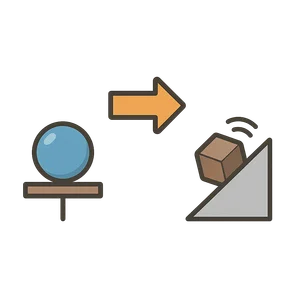
Newton's Laws of Motion
A set of fundamental laws of classical physics that describe the relationship between the motion of an object…
Reads at Grades 6–8 Listens at Grades 4–8
Print & create
Answer keys·No prep·Free with an account
28 worksheets · answer keys · full story · quiz · Ages 10-12 · CEFR B2
Plus adds 208,000+ more stories in 27 languages, audio for every one, and printables for all of them.
Just want Newton's Laws of Motion?

Have you ever wondered about the invisible push you feel when a car suddenly speeds up, pressing you back into your seat? Or the satisfying pull when you kick a soccer ball just right, sending it soaring toward the goal? Think about a book resting perfectly still on a table. It won't move an inch until you give it a nudge. Why does it take a mighty shove to move a heavy box of toys, but only a tiny tap to send a marble rolling across the floor? These aren't random happenings. They are all part of a grand, cosmic dance, and I am the choreographer. I am the set of secret rules that governs every single movement in the universe, from the gentle drift of a feather to the majestic orbit of a planet around its sun. Without me, everything would be a jumble of unpredictable chaos. A tossed ball might fly off into space, or a spinning top might never fall. But I bring order to it all. I am the reason things make sense. I am the Laws of Motion, and I keep the universe from being a chaotic mess.
For thousands of years, people tried to figure me out. Brilliant thinkers like the ancient Greek philosopher Aristotle had some clever ideas. He thought that objects needed a constant push or pull to keep moving, which seemed to make sense. After all, a cart stops when the horse stops pulling. But his understanding was incomplete; he didn't see the whole picture. It took a very special mind to finally piece together my true nature. That mind belonged to a man named Sir Isaac Newton. He lived in England during the 17th century, a time of great scientific curiosity. Newton wasn't just smart; he was relentlessly curious. He would watch an apple fall from a tree and wonder not just that it fell, but *why* it fell straight down. He spent decades observing the world, conducting experiments, and using the powerful language of mathematics to describe what he saw. He filled notebooks with calculations and ideas, trying to unlock the secrets of the cosmos. Finally, on July 5th, 1687, he introduced me to the world in a groundbreaking book called *Philosophiæ Naturalis Principia Mathematica*, which people often just call the *Principia*. In its pages, he didn't just guess; he proved my existence with logic and math. He laid out my three fundamental rules, a clear and elegant explanation for how and why everything moves.
The Universe's Secret Rules
Have you ever wondered about the invisible push you feel when a car suddenly speeds up, pressing you back into your seat? Or the satisfying pull when you kick a soccer ball just right, sending it soaring toward the goal? Think about a book resting perfectly still on a table. It won't move an inch until you give it a nudge. Why does it take a mighty shove to move a heavy box of toys, but only a tiny tap to send a marble rolling across the floor? These aren't random happenings. They are all part of a grand, cosmic dance, and I am the choreographer. I am the set of secret rules that governs every single movement in the universe, from the gentle drift of a feather to the majestic orbit of a planet around its sun. Without me, everything would be a jumble of unpredictable chaos. A tossed ball might fly off into space, or a spinning top might never fall. But I bring order to it all. I am the reason things make sense. I am the Laws of Motion, and I keep the universe from being a chaotic mess.
For thousands of years, people tried to figure me out. Brilliant thinkers like the ancient Greek philosopher Aristotle had some clever ideas. He thought that objects needed a constant push or pull to keep moving, which seemed to make sense. After all, a cart stops when the horse stops pulling. But his understanding was incomplete; he didn't see the whole picture. It took a very special mind to finally piece together my true nature. That mind belonged to a man named Sir Isaac Newton. He lived in England during the 17th century, a time of great scientific curiosity. Newton wasn't just smart; he was relentlessly curious. He would watch an apple fall from a tree and wonder not just that it fell, but why it fell straight down. He spent decades observing the world, conducting experiments, and using the powerful language of mathematics to describe what he saw. He filled notebooks with calculations and ideas, trying to unlock the secrets of the cosmos. Finally, on July 5th, 1687, he introduced me to the world in a groundbreaking book called Philosophiæ Naturalis Principia Mathematica, which people often just call the Principia. In its pages, he didn't just guess; he proved my existence with logic and math. He laid out my three fundamental rules, a clear and elegant explanation for how and why everything moves.
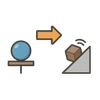
My three big ideas are the foundation of how the universe works on a grand scale. My first rule is a bit lazy. It says that things like to keep doing whatever they’re already doing. An object at rest, like that book on the table, wants to stay at rest. An object in motion wants to stay in motion, moving in a straight line at a constant speed. This tendency to resist changes in motion is called inertia. You've felt it yourself. When you're a passenger in a bus that suddenly stops, your body lurches forward because it wants to keep moving at the speed the bus was going. That’s my first law in action. My second rule is all about oomph. It connects force, mass, and acceleration. It says that to make an object speed up, or accelerate, you need to apply a force. The more force you apply, the faster it accelerates. Think about baseball. A gentle tap from a bat will only bunt the ball, but a powerful swing sends it flying. Mass matters, too. It’s a measure of how much 'stuff' is in an object. It’s much harder to change the motion of something with a lot of mass. If you swung that same bat with the same force at a heavy bowling ball, it would barely move. My third rule is about partnership. It’s very simple but very profound: for every action, there is an equal and opposite reaction. When you push on a wall, the wall pushes back on you with the exact same force. You don't see the wall move because it has so much mass and is fixed to the ground, but the force is there. A rocket works because of this rule. It pushes hot gas down with tremendous force (the action), and the gas pushes the rocket up with an equal force (the reaction), launching it into space. Even when you jump, you are pushing down on the Earth, and the Earth is pushing up on you.
Once Newton revealed my secrets, humanity saw the universe in a whole new light. I am the bedrock of a field of science called classical mechanics. My rules are not just dusty ideas in an old book; they are at work all around you, every single day. Engineers use my first law, inertia, to design life-saving features in cars. Seatbelts and airbags are there to safely counteract your body's tendency to keep moving forward during a sudden stop. Scientists use my third law, action-reaction, to calculate the precise amount of thrust needed to launch satellites into orbit and send robotic explorers to Mars and beyond. My principles even help athletes perfect their game, from figuring out the best angle to throw a football to the physics behind a perfect dive. Understanding me gave humans a powerful tool to predict and control the physical world. It allowed them to build bridges, invent machines, and explore the solar system in ways they could only have dreamed of before the 17th century. I am still at work every time you play, every time you travel, and every time you look up at the stars in wonder.
Wow facts
About
A set of fundamental laws of classical physics that describe the relationship between the motion of an object and the forces acting upon it, including Newton's three laws of motion, the laws of thermodynamics, and electromagnetism.
Take a Quiz
Question 1 of 5
In your own words, explain the problem Sir Isaac Newton was trying to solve when he developed the Laws of Motion.
Explore next





Want to do even more?
Go beyond exploring. Unlock tools that turn every story into real learning.

Storypie Plus for families
Full stories, quizzes, and printables. Nights and car rides, sorted.
- Unlimited audio stories
- Create Mode: your child stars in the story
- Offline downloads
- Printable worksheets & coloring pages

Why Storypie for Schools
Students engaged. Prep in seconds. Evenings back to you.
- Worksheets & Quizzes
- Classroom Management
- Formative Assessment
- Custom Curriculum & Lesson Plans
- 27 Languages

Why Storypie for Homeschool
Curriculum done. They'll ask for more. Hours back in your day.
- Worksheet Generator
- First-Person Audio Stories
- Built-in Comprehension Quizzes
- Custom Curriculum & Lesson Plans
- Print & Go Activities