English

Numbers and Numerals 0-10
Numbers are abstract concepts of quantity, while numerals are the symbols used to represent them.
Reads at Grades 3–5 Listens at Grades 1–5
Print & create
Answer keys·No prep·Free with an account
28 worksheets · answer keys · full story · quiz · Ages 8-10 · CEFR B1
Plus adds 244,000+ more stories in 27 languages, audio for every one, and printables for all of them.
Just want Numbers and Numerals 0-10?
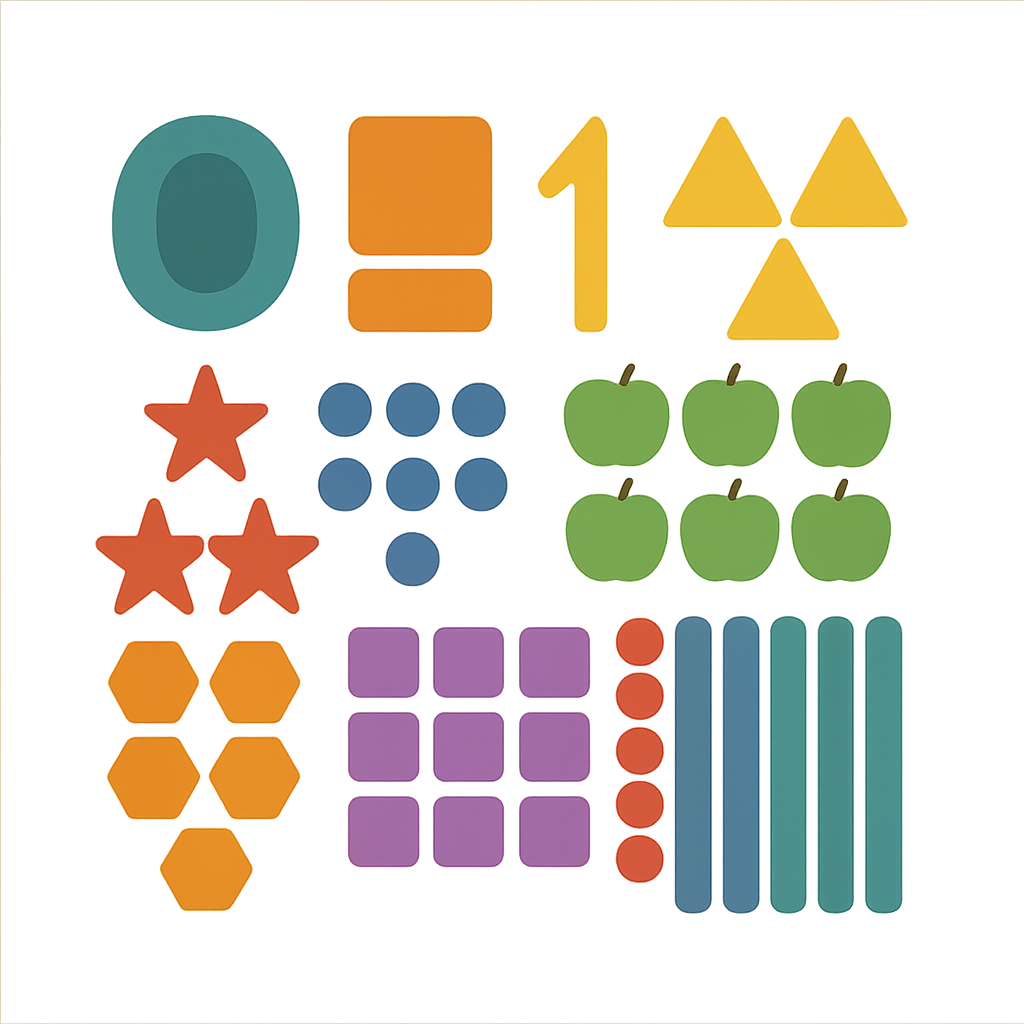
Do you know me. I am the feeling you get when you count your birthday candles. I am the number of stars you can see in the sky, the pages in your favorite book, and the friends you invite to your party. I am in the beat of a drum and the slices of a pizza. You have known me your whole life, even before you could say my name. Can you guess who I am. I am everywhere you look, helping you make sense of the world. That’s right. I am Numbers.
My story began a very, very long time ago, before there were cities or schools. Imagine a chilly evening over 20,000 years ago. Someone wanted to remember how many sunrises had passed since the last big hunt. So, they picked up a sharp stone and carved a single line into a piece of bone. The next day, they carved another. Those were my very first scribbles. They were called tally marks, and they were the first way people gave me a shape. Thousands of years later, in a warm land called Mesopotamia around 4000 BCE, clever people called the Sumerians had a new idea. To count their sheep or jars of olive oil, they used little clay tokens in different shapes. A small clay cone might mean one, and a round clay ball might mean ten. They were turning the idea of me into something they could actually hold in their hands. It was my first real job, and I was excited to help people organize their world.
For a long, long time, I wore many different outfits depending on where I was in the world. In ancient Egypt, I was a set of beautiful pictures, or hieroglyphs. A single stroke was one, a drawing of a heel bone meant ten, and a coiled rope stood for one hundred. It was like a secret code. Then, around 500 BCE, the powerful Romans gave me a new look using letters from their own alphabet. You have probably seen me dressed this way on clocks or in book chapters: I for one, V for five, and X for ten. But my most amazing transformation happened in India, sometime between the 1st and 4th centuries CE. Brilliant thinkers there created the simple, graceful shapes you use in math class today: 1, 2, 3, and all my other friends. And they gave me the greatest gift of all: my superhero partner, Zero. Around the 5th century CE, Zero showed up as a simple dot or a circle. He stood for 'nothing,' but he was the most important something I could have asked for. With Zero, telling the difference between 2, 20, and 200 became incredibly easy.
The Story of Me, Numbers
Do you know me. I am the feeling you get when you count your birthday candles. I am the number of stars you can see in the sky, the pages in your favorite book, and the friends you invite to your party. I am in the beat of a drum and the slices of a pizza. You have known me your whole life, even before you could say my name. Can you guess who I am. I am everywhere you look, helping you make sense of the world. That’s right. I am Numbers.
My story began a very, very long time ago, before there were cities or schools. Imagine a chilly evening over 20,000 years ago. Someone wanted to remember how many sunrises had passed since the last big hunt. So, they picked up a sharp stone and carved a single line into a piece of bone. The next day, they carved another. Those were my very first scribbles. They were called tally marks, and they were the first way people gave me a shape. Thousands of years later, in a warm land called Mesopotamia around 4000 BCE, clever people called the Sumerians had a new idea. To count their sheep or jars of olive oil, they used little clay tokens in different shapes. A small clay cone might mean one, and a round clay ball might mean ten. They were turning the idea of me into something they could actually hold in their hands. It was my first real job, and I was excited to help people organize their world.
For a long, long time, I wore many different outfits depending on where I was in the world. In ancient Egypt, I was a set of beautiful pictures, or hieroglyphs. A single stroke was one, a drawing of a heel bone meant ten, and a coiled rope stood for one hundred. It was like a secret code. Then, around 500 BCE, the powerful Romans gave me a new look using letters from their own alphabet. You have probably seen me dressed this way on clocks or in book chapters: I for one, V for five, and X for ten. But my most amazing transformation happened in India, sometime between the 1st and 4th centuries CE. Brilliant thinkers there created the simple, graceful shapes you use in math class today: 1, 2, 3, and all my other friends. And they gave me the greatest gift of all: my superhero partner, Zero. Around the 5th century CE, Zero showed up as a simple dot or a circle. He stood for 'nothing,' but he was the most important something I could have asked for. With Zero, telling the difference between 2, 20, and 200 became incredibly easy.
Once I had my new look and my fantastic friend Zero, I was ready to travel the globe. My journey took me from India to the Middle East, where I was welcomed by amazing Arab scholars and mathematicians. A very wise man named Al-Khwarizmi, who lived in the 9th century CE, thought I was wonderful. He wrote famous books about me, showing everyone how simple and powerful I was for solving problems. From there, I traveled with merchants on camels and sailors on ships, following busy trade routes all the way to Europe. At first, people in Europe were used to their old Roman letters, but a clever Italian man named Fibonacci helped change their minds. In his book, written in the year 1202, he showed everyone how much easier I was for counting money and trading goods. Slowly but surely, the whole world started to adopt my new, easy-to-use system.
Today, I am so proud to be a part of your life every single day. I am in the clock on the wall that tells you when it is time to play. I am in the recipe that helps you measure the perfect amount of sugar for delicious cookies. I am the secret language inside computers, tablets, and phones that allows you to play games and talk to friends far away. From building the tallest skyscrapers to launching rockets into space, people use me to understand their world and create amazing things. I am a language that everyone, everywhere, can understand. So the next time you count your toys or check the score of a game, give me a little wave. I am Numbers, and you can always count on me.
Wow facts
About
Numbers are abstract concepts of quantity, while numerals are the symbols used to represent them. The modern Hindu-Arabic numeral system, including zero, originated in India and spread globally, becoming widely adopted in mathematics.
Take a Quiz
Question 1 of 5
In the story, I said I got a 'transformation' in India. What does the word 'transformation' mean here?
Explore next





Want to do even more?
Go beyond exploring. Unlock tools that turn every story into real learning.

Storypie Plus for families
Full stories, quizzes, and printables. Nights and car rides, sorted.
- Unlimited audio stories
- Create Mode: your child stars in the story
- Offline downloads
- Printable worksheets & coloring pages

Why Storypie for Schools
Students engaged. Prep in seconds. Evenings back to you.
- Worksheets & Quizzes
- Classroom Management
- Formative Assessment
- Custom Curriculum & Lesson Plans
- 27 Languages

Why Storypie for Homeschool
Curriculum done. They'll ask for more. Hours back in your day.
- Worksheet Generator
- First-Person Audio Stories
- Built-in Comprehension Quizzes
- Custom Curriculum & Lesson Plans
- Print & Go Activities