English


Plasma
Often called the fourth state of matter, plasma is a super-heated…
Reads at Grades 6–8 Listens at Grades 4–8
Print & create
Answer keys·No prep·Free with an account
28 worksheets · answer keys · full story · quiz · Ages 10-12 · CEFR B2
Plus adds 164,000+ more stories in 27 languages, audio for every one, and printables for all of them.
Just want Plasma?

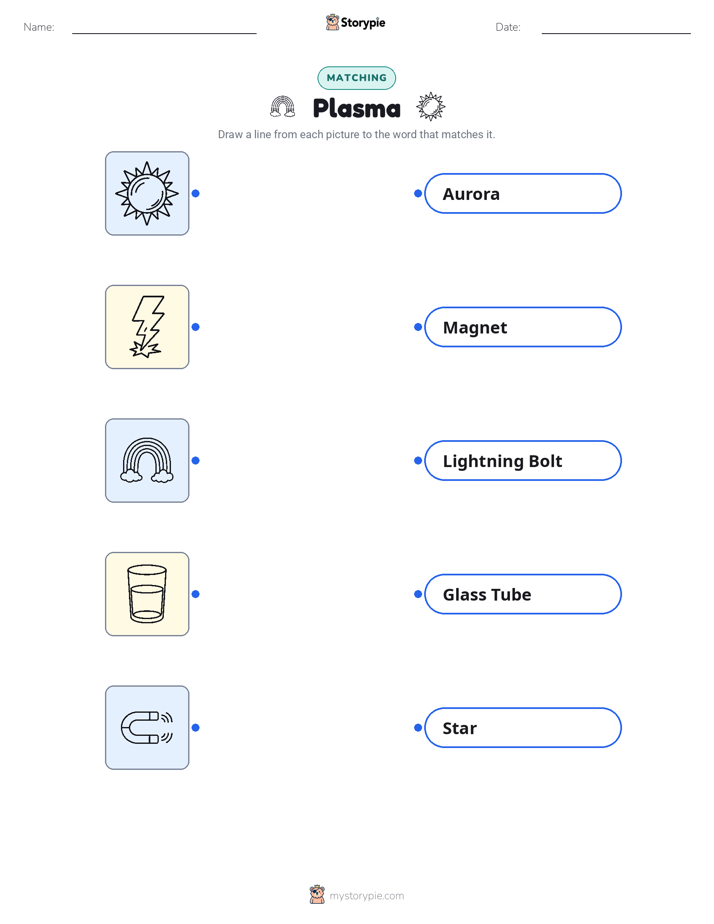
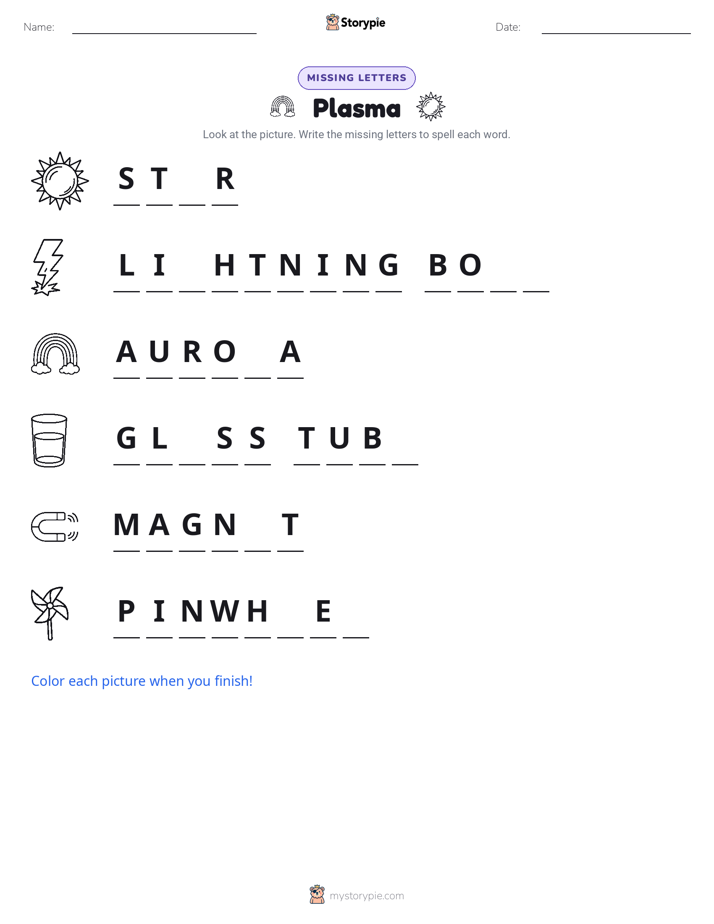
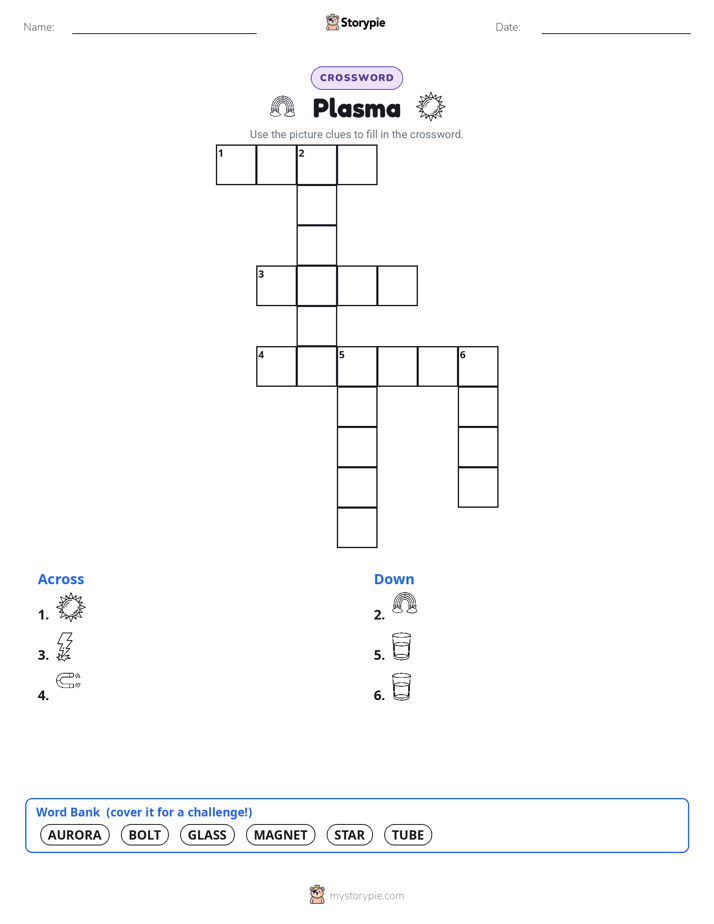
Before you knew my name, you saw my work everywhere. I am the blistering heart of every star, including your own Sun. I am the jagged, brilliant flash of lightning that splits the sky during a storm and the soft, dancing curtains of light you call the aurora borealis. I am the most common state of matter in the entire visible universe, making up more than ninety-nine percent of it. Yet for most of human history, I was a secret hiding in plain sight. You knew about solids, liquids, and gases, but you didn't have a word for me. I am not like them. I am a superheated, electrically charged gas, a swirling soup of particles buzzing with immense energy. I am what happens when matter gets so hot that its atoms break apart. I am Plasma, the fourth state of matter.
For centuries, humans watched me paint the heavens and ignite the skies, but they didn't understand what they were seeing. My story as a known concept began in a quiet laboratory in London, England. It was the year 1879, and a curious scientist named Sir William Crookes was experimenting with electricity. He worked with a special piece of equipment, a sealed glass tube with almost all the air pumped out, which became known as a Crookes tube. He wanted to see what would happen if he passed a high-voltage electrical current through the near-vacuum inside. When he flipped the switch, I came alive. A beam of light streamed through the tube, a beautiful, ethereal glow. Sir William Crookes was fascinated. He knew this wasn't a normal gas or solid. He observed how I could be bent by magnets and how I could make a tiny pinwheel inside the tube spin. He realized he was looking at something entirely new, a fourth state of matter which he called 'radiant matter'. He didn't know my exact composition, but he knew I was fundamentally different. A few years later, on April 30th, 1897, another brilliant scientist named J.J. Thomson used a similar tube to discover the electron. His discovery was a crucial piece of my puzzle. It helped future scientists understand that my glowing 'radiant matter' was actually a sea of those tiny, negatively charged electrons that had been stripped from their atoms, leaving behind positively charged ions.
The Voice of the Stars
Before you knew my name, you saw my work everywhere. I am the blistering heart of every star, including your own Sun. I am the jagged, brilliant flash of lightning that splits the sky during a storm and the soft, dancing curtains of light you call the aurora borealis. I am the most common state of matter in the entire visible universe, making up more than ninety-nine percent of it. Yet for most of human history, I was a secret hiding in plain sight. You knew about solids, liquids, and gases, but you didn't have a word for me. I am not like them. I am a superheated, electrically charged gas, a swirling soup of particles buzzing with immense energy. I am what happens when matter gets so hot that its atoms break apart. I am Plasma, the fourth state of matter.
For centuries, humans watched me paint the heavens and ignite the skies, but they didn't understand what they were seeing. My story as a known concept began in a quiet laboratory in London, England. It was the year 1879, and a curious scientist named Sir William Crookes was experimenting with electricity. He worked with a special piece of equipment, a sealed glass tube with almost all the air pumped out, which became known as a Crookes tube. He wanted to see what would happen if he passed a high-voltage electrical current through the near-vacuum inside. When he flipped the switch, I came alive. A beam of light streamed through the tube, a beautiful, ethereal glow. Sir William Crookes was fascinated. He knew this wasn't a normal gas or solid. He observed how I could be bent by magnets and how I could make a tiny pinwheel inside the tube spin. He realized he was looking at something entirely new, a fourth state of matter which he called 'radiant matter'. He didn't know my exact composition, but he knew I was fundamentally different. A few years later, on April 30th, 1897, another brilliant scientist named J.J. Thomson used a similar tube to discover the electron. His discovery was a crucial piece of my puzzle. It helped future scientists understand that my glowing 'radiant matter' was actually a sea of those tiny, negatively charged electrons that had been stripped from their atoms, leaving behind positively charged ions.
'Radiant matter' was a poetic and fitting description, but science requires precision, and I was waiting for my true name. That name came from an American chemist and physicist named Irving Langmuir. In the 1920s, Langmuir was working at the General Electric research laboratory, deeply investigating my properties. He studied the way I behaved, how my collection of free-moving electrons and ions conducted electricity and responded to magnetic fields. As he watched me, he was struck by an interesting similarity. He thought about blood, and how the liquid part, the blood plasma, carries around red cells, white cells, and platelets. In a similar way, he saw how I, this electrified gas, carried around ions and electrons. The analogy was perfect. In a scientific paper in 1928, he formally proposed the name 'plasma'. The scientific community agreed, and the name stuck. Finally, I had an official identity. I was no longer just a mysterious glow in a tube; I was plasma, a fundamental state of matter with a name and a growing field of study dedicated to unlocking my secrets.
For a long time, you might have thought I only existed in distant stars or in specialized laboratories. But I have slowly made my way into your world, into your very homes. If you've ever seen the bright, vibrant colors of a neon sign, you were looking at me. Different gases are put into glass tubes, and when electricity is passed through them, they become me, glowing in their own unique colors. For a while, I was even the star of your living rooms, creating the crisp, bright images on plasma screen televisions. In factories, I am harnessed in plasma torches, creating jets of me so hot they can slice through thick steel with incredible precision. But my most important job for humanity is just beginning. Scientists are working tirelessly to build machines that can recreate the conditions inside the Sun. They use powerful magnetic fields to contain me at millions of degrees Celsius, hoping to achieve nuclear fusion. This is the process that powers the stars, and if we can harness it on Earth, it would provide a nearly limitless supply of clean, safe energy. I am the energy of the stars, a cosmic power now being used to light up your world and, hopefully, to power a brighter, cleaner future for everyone.
Wow facts
About
Often called the fourth state of matter, plasma is a super-heated, ionized gas that makes up stars and lightning and is used in technologies like TVs and fusion energy research.
Take a Quiz
Question 1 of 5
What is the main idea of this story?
Explore next






Want to do even more?
Go beyond exploring. Unlock tools that turn every story into real learning.

Storypie Plus for families
Full stories, quizzes, and printables. Nights and car rides, sorted.
- Unlimited audio stories
- Create Mode: your child stars in the story
- Offline downloads
- Printable worksheets & coloring pages

Why Storypie for Schools
Students engaged. Prep in seconds. Evenings back to you.
- Worksheets & Quizzes
- Classroom Management
- Formative Assessment
- Custom Curriculum & Lesson Plans
- 27 Languages

Why Storypie for Homeschool
Curriculum done. They'll ask for more. Hours back in your day.
- Worksheet Generator
- First-Person Audio Stories
- Built-in Comprehension Quizzes
- Custom Curriculum & Lesson Plans
- Print & Go Activities