English


Projectile Motion
Motion is the phenomenon in which an object changes its position with respect to time.
Reads at Grades 6–8 Listens at Grades 4–8
Print & create
Answer keys·No prep·Free with an account
28 worksheets · answer keys · full story · quiz · Ages 10-12 · CEFR B2
Plus adds 244,000+ more stories in 27 languages, audio for every one, and printables for all of them.
Just want Projectile Motion?
I am the whisper that rustles the leaves on an autumn afternoon and the silent, unstoppable glide of a glacier carving a valley. I am the frantic buzz of a hummingbird's wings, beating so fast they become a blur, and the slow, patient crawl of a snail leaving a silvery trail. You can see me in the grand, cosmic waltz of planets spinning around a star and in the unnoticed drift of a single dust mote dancing in a sunbeam. I am everywhere, in everything. I am the energy that animates the universe, the invisible force that turns stillness into action. From the tiniest atom vibrating in place to the colossal expansion of a galaxy rushing away from its neighbors, I am the constant, the one thing that is always happening. For millennia, humans saw my effects but couldn't name my cause. They felt me as a push when they moved a heavy stone and as a pull when they stretched a bowstring. They knew that something had to happen to begin a journey, to throw a spear, or to send a boat across the water. This secret energy, this fundamental principle of change, has a name. I am Motion.
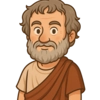
For thousands of years, humans have tried to understand my secrets. One of the first great thinkers to try and pin me down was a man in ancient Greece named Aristotle. He was clever, and his ideas were so compelling that they were believed for centuries. He thought that everything in the world had a 'natural place' it wanted to be. A rock, being made of earth, wanted to go down to the earth, so it fell. Smoke, being airy, wanted to go up to the sky. He also declared, with great certainty, that heavier objects must fall faster than lighter ones. It just seemed to make sense, didn't it? If you dropped a boulder and a feather, of course the boulder would win the race to the ground. For a very long time, almost no one questioned this. People just accepted it. Then, nearly two thousand years later, a curious and defiant man in Italy named Galileo Galilei started asking questions. He wasn't satisfied with just thinking about how I should work; he wanted to see it for himself. He believed that the universe had rules, and those rules could be discovered through observation and experiments. The most famous story about him involves a very famous building: the Leaning Tower of Pisa. As the legend goes, Galileo climbed to the top of the tilting tower, carrying two cannonballs of different weights. While a crowd of scholars and students watched from below, he held them out over the edge and let them go at the exact same moment. They plummeted downward, and to everyone's astonishment, they struck the ground together. *Clang!* One sound, not two. With that one dramatic experiment, Galileo showed the world that Aristotle was wrong. My pull on a heavy object and a light object is the same. He proved that to truly understand me, you couldn't just sit and think. You had to get up, test, measure, and challenge old ideas.
I Am Motion
I am the whisper that rustles the leaves on an autumn afternoon and the silent, unstoppable glide of a glacier carving a valley. I am the frantic buzz of a hummingbird's wings, beating so fast they become a blur, and the slow, patient crawl of a snail leaving a silvery trail. You can see me in the grand, cosmic waltz of planets spinning around a star and in the unnoticed drift of a single dust mote dancing in a sunbeam. I am everywhere, in everything. I am the energy that animates the universe, the invisible force that turns stillness into action. From the tiniest atom vibrating in place to the colossal expansion of a galaxy rushing away from its neighbors, I am the constant, the one thing that is always happening. For millennia, humans saw my effects but couldn't name my cause. They felt me as a push when they moved a heavy stone and as a pull when they stretched a bowstring. They knew that something had to happen to begin a journey, to throw a spear, or to send a boat across the water. This secret energy, this fundamental principle of change, has a name. I am Motion.
For thousands of years, humans have tried to understand my secrets. One of the first great thinkers to try and pin me down was a man in ancient Greece named Aristotle. He was clever, and his ideas were so compelling that they were believed for centuries. He thought that everything in the world had a 'natural place' it wanted to be. A rock, being made of earth, wanted to go down to the earth, so it fell. Smoke, being airy, wanted to go up to the sky. He also declared, with great certainty, that heavier objects must fall faster than lighter ones. It just seemed to make sense, didn't it? If you dropped a boulder and a feather, of course the boulder would win the race to the ground. For a very long time, almost no one questioned this. People just accepted it. Then, nearly two thousand years later, a curious and defiant man in Italy named Galileo Galilei started asking questions. He wasn't satisfied with just thinking about how I should work; he wanted to see it for himself. He believed that the universe had rules, and those rules could be discovered through observation and experiments. The most famous story about him involves a very famous building: the Leaning Tower of Pisa. As the legend goes, Galileo climbed to the top of the tilting tower, carrying two cannonballs of different weights. While a crowd of scholars and students watched from below, he held them out over the edge and let them go at the exact same moment. They plummeted downward, and to everyone's astonishment, they struck the ground together. Clang! One sound, not two. With that one dramatic experiment, Galileo showed the world that Aristotle was wrong. My pull on a heavy object and a light object is the same. He proved that to truly understand me, you couldn't just sit and think. You had to get up, test, measure, and challenge old ideas.
Galileo opened the door, but the person who truly wrote down my rulebook was an Englishman named Sir Isaac Newton. He was a quiet, intensely brilliant man who saw the universe as a grand puzzle. The story goes that his biggest clue came from a very ordinary event: watching an apple fall from a tree in his garden. He wondered, if a force pulls an apple to the ground, could that same force reach all the way up to the Moon and keep it in orbit? This single question led him to uncover my three most important laws, the rules I live by everywhere in the universe. First, he realized that I have a stubborn streak, which he called inertia. This is my First Law. It means I like to keep doing whatever I'm already doing. An object at rest, like a soccer ball on the grass, will stay at rest until someone kicks it. An object in motion, like a satellite coasting through empty space, will stay in motion in a straight line at a constant speed forever, unless another force acts on it. My natural state is to resist change. Next, Newton figured out exactly how you can change me. His Second Law explains that to change my speed or direction—to accelerate me—you need a force, a push or a pull. And the amount of force you need depends on the object's mass. Think about it: it's easy to push a toy car and make it go fast, but it would take a tremendous push to get a real car moving at the same speed. The more massive something is, the more force it takes to change its motion. Finally, Newton revealed my most elegant secret, the Third Law. He stated that for every action, there is an equal and opposite reaction. I never happen in just one direction. When a rocket blasts off, it pushes hot gas downward with incredible force. That's the action. In return, the gas pushes the rocket upward with the exact same amount of force. That's the reaction, and it's what lifts the ship into the sky. When you jump, your feet push down on the Earth, and the Earth pushes you up into the air. Every push has a push back. It's the universe's perfect balancing act.
Once you understand Newton's rules, you can see me at work everywhere. Those three laws are why a bicycle glides smoothly down the street, why a car can speed up and slow down, and why a pitcher can throw a curveball. Understanding my principles is what allowed humanity to build bridges, design airplanes, and even send spaceships to explore the planets. My story, however, didn't end with Newton. A century ago, another brilliant mind, Albert Einstein, came along and showed that I have even more secrets, especially when things move close to the speed of light. My story is always unfolding. Now it's your turn. Every time you run, jump, or throw a ball, you are conducting your own experiment with my laws. I am the spirit of discovery, the energy of creation, and the power of change. I am in every step you take, and with every question you ask, you can help write my next chapter.
Wow facts
About
Motion is the phenomenon in which an object changes its position with respect to time. It is a fundamental concept in physics, described by principles discovered by thinkers like Aristotle, Galileo Galilei, and Sir Isaac Newton.
Take a Quiz
Question 1 of 5
What was the main difference between how Aristotle tried to understand motion and how Galileo did? Use evidence from the story.
Explore next



Want to do even more?
Go beyond exploring. Unlock tools that turn every story into real learning.

Storypie Plus for families
Full stories, quizzes, and printables. Nights and car rides, sorted.
- Unlimited audio stories
- Create Mode: your child stars in the story
- Offline downloads
- Printable worksheets & coloring pages

Why Storypie for Schools
Students engaged. Prep in seconds. Evenings back to you.
- Worksheets & Quizzes
- Classroom Management
- Formative Assessment
- Custom Curriculum & Lesson Plans
- 27 Languages

Why Storypie for Homeschool
Curriculum done. They'll ask for more. Hours back in your day.
- Worksheet Generator
- First-Person Audio Stories
- Built-in Comprehension Quizzes
- Custom Curriculum & Lesson Plans
- Print & Go Activities