English


Roman Numerals
Roman numerals are a numeral system that originated in ancient Rome and remained the usual way of writing…
Reads at Grades 3–5 Listens at Grades 1–5
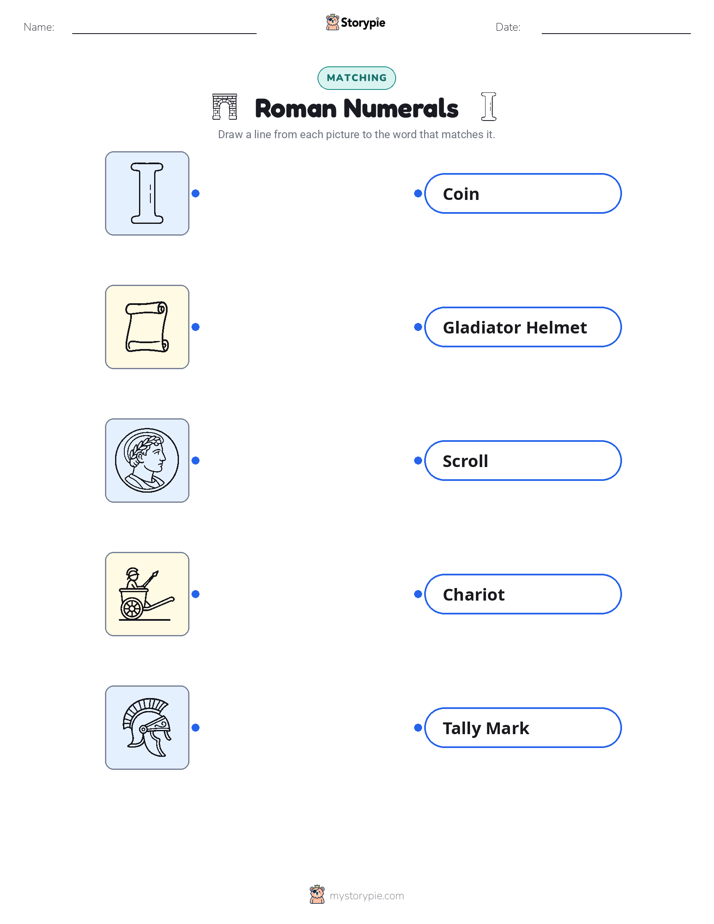
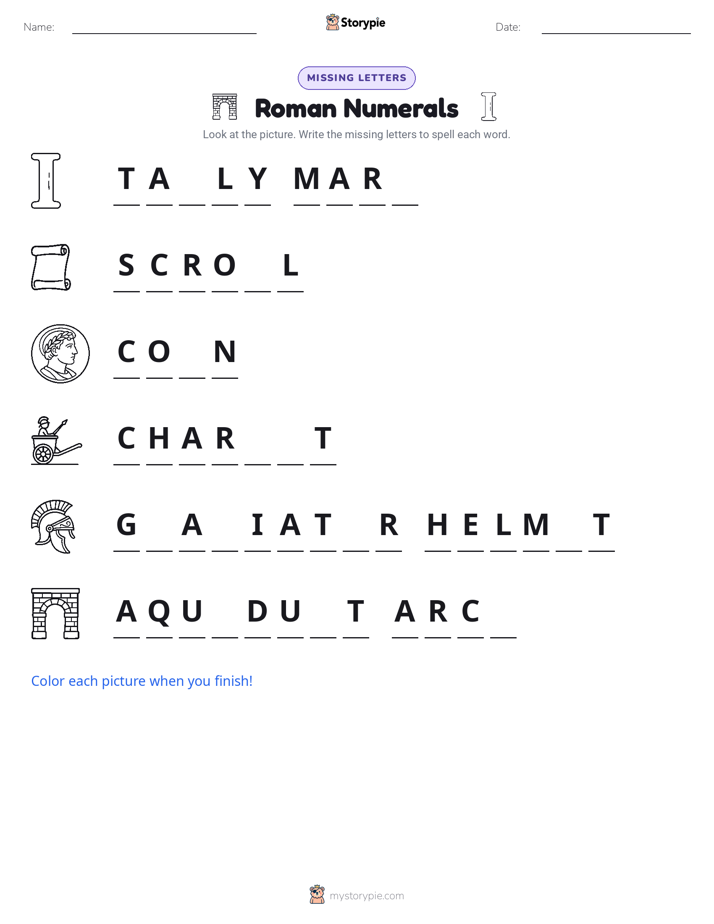
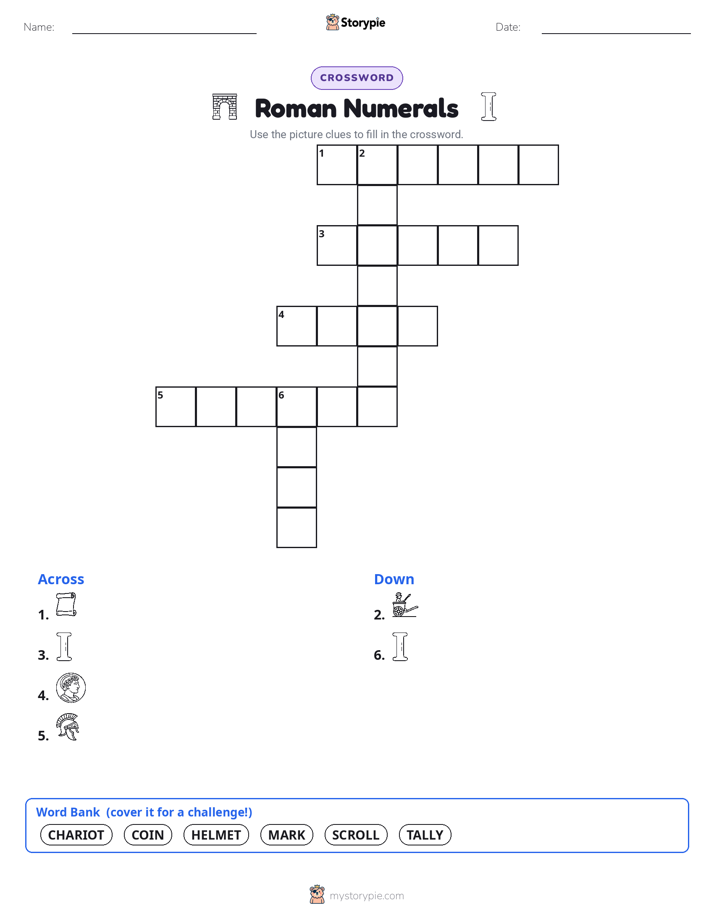
Print & create
Answer keys·No prep·Free with an account
28 worksheets · answer keys · full story · quiz · Ages 8-10 · CEFR B1
Plus adds 116,000+ more stories in 27 languages, audio for every one, and printables for all of them.
Just want Roman Numerals?

Have you ever looked at a very old, grand clock and noticed something strange. Instead of the numbers you know, you saw letters. Maybe a big I, a V, and an X marking the hours. Or have you ever watched the huge football game at the end of the season and seen a bunch of letters, like LVIII, and wondered what they meant. You might see me numbering the chapters in a fancy book or carved into the stone of an important building. It can feel like you’ve found a secret code, hiding in plain sight. I use letters, but I’m not spelling any words. I’m telling you ‘how many’. Have you figured out my secret identity yet. I am Roman Numerals, and I'm one of the oldest ways to count.
My story begins a very, very long time ago, in a place called ancient Rome, way back around the year 500 BCE. Before I came along, counting could be a real chore. Can you imagine trying to write the number fifty just by making little tally marks. You would have to draw fifty little lines. The Romans were smart people. They built amazing roads and cities, and they knew they needed a smarter way to write their numbers. They looked at the letters they used for writing every day and had a brilliant idea. They decided to use some of them for counting. It was so much simpler. They used the letter 'I' for the number one, which makes sense because it looks just like a single tally mark. For five, they chose 'V', which some people think looks like an open hand showing five fingers. And for ten, they used 'X', which looks like two 'V's' put together, one on top of the other, like two hands. My rules are like a fun puzzle. When you see a smaller letter after a bigger one, you just add them together. So, VI is V plus I, or 5 plus 1, which equals 6. But here is my clever trick. if the smaller letter comes *before* the bigger one, you subtract it. So, IV is not six. it is V minus I, or 5 minus 1, which equals 4. Once the Romans figured me out, they used me for everything. Builders carved me into incredible buildings to show the date they were finished. Roman generals used me to count their thousands of soldiers and organize their legions. As the mighty Roman Empire grew and spread across Europe, I traveled with them. For more than one thousand years, I was the main way people wrote down numbers, all the way from Italy to Britain.
The Secret Code of Rome
Have you ever looked at a very old, grand clock and noticed something strange. Instead of the numbers you know, you saw letters. Maybe a big I, a V, and an X marking the hours. Or have you ever watched the huge football game at the end of the season and seen a bunch of letters, like LVIII, and wondered what they meant. You might see me numbering the chapters in a fancy book or carved into the stone of an important building. It can feel like you’ve found a secret code, hiding in plain sight. I use letters, but I’m not spelling any words. I’m telling you ‘how many’. Have you figured out my secret identity yet. I am Roman Numerals, and I'm one of the oldest ways to count.
My story begins a very, very long time ago, in a place called ancient Rome, way back around the year 500 BCE. Before I came along, counting could be a real chore. Can you imagine trying to write the number fifty just by making little tally marks. You would have to draw fifty little lines. The Romans were smart people. They built amazing roads and cities, and they knew they needed a smarter way to write their numbers. They looked at the letters they used for writing every day and had a brilliant idea. They decided to use some of them for counting. It was so much simpler. They used the letter 'I' for the number one, which makes sense because it looks just like a single tally mark. For five, they chose 'V', which some people think looks like an open hand showing five fingers. And for ten, they used 'X', which looks like two 'V's' put together, one on top of the other, like two hands. My rules are like a fun puzzle. When you see a smaller letter after a bigger one, you just add them together. So, VI is V plus I, or 5 plus 1, which equals 6. But here is my clever trick. if the smaller letter comes before the bigger one, you subtract it. So, IV is not six. it is V minus I, or 5 minus 1, which equals 4. Once the Romans figured me out, they used me for everything. Builders carved me into incredible buildings to show the date they were finished. Roman generals used me to count their thousands of soldiers and organize their legions. As the mighty Roman Empire grew and spread across Europe, I traveled with them. For more than one thousand years, I was the main way people wrote down numbers, all the way from Italy to Britain.
Today, the great Roman Empire is only found in history books, but guess what. I am still here, working and counting every day. Even though you have easier numbers to use for your math homework, people still use me for special occasions to make things look important and timeless. You can still find me on the faces of beautiful grandfather clocks, ticking away the hours with my letters. If you watch a movie all the way to the end credits, you might see me telling you the year it was made, like MCMLXXXVIII. That’s my way of writing 1988. I am also used to give names to kings and queens, like Queen Elizabeth II of England, to show that she was the second Queen Elizabeth. And every single year, I get to be a big part of the Super Bowl, the most famous football game in America. Seeing me is like finding a little piece of history that is still alive. I am a reminder that a really good idea can last for thousands of years. So the next time you spot me on a clock, in a book, or on your screen, you can know my secret. I am a piece of living history, and I am still counting right along with you.
Wow facts
About
Roman numerals are a numeral system that originated in ancient Rome and remained the usual way of writing numbers throughout Europe well into the Late Middle Ages.
Take a Quiz
Question 1 of 5
Why did the ancient Romans stop using simple tally marks for counting?
Explore next




Want to do even more?
Go beyond exploring. Unlock tools that turn every story into real learning.

Storypie Plus for families
Full stories, quizzes, and printables. Nights and car rides, sorted.
- Unlimited audio stories
- Create Mode: your child stars in the story
- Offline downloads
- Printable worksheets & coloring pages

Why Storypie for Schools
Students engaged. Prep in seconds. Evenings back to you.
- Worksheets & Quizzes
- Classroom Management
- Formative Assessment
- Custom Curriculum & Lesson Plans
- 27 Languages

Why Storypie for Homeschool
Curriculum done. They'll ask for more. Hours back in your day.
- Worksheet Generator
- First-Person Audio Stories
- Built-in Comprehension Quizzes
- Custom Curriculum & Lesson Plans
- Print & Go Activities