

 English

I Am American Gothic
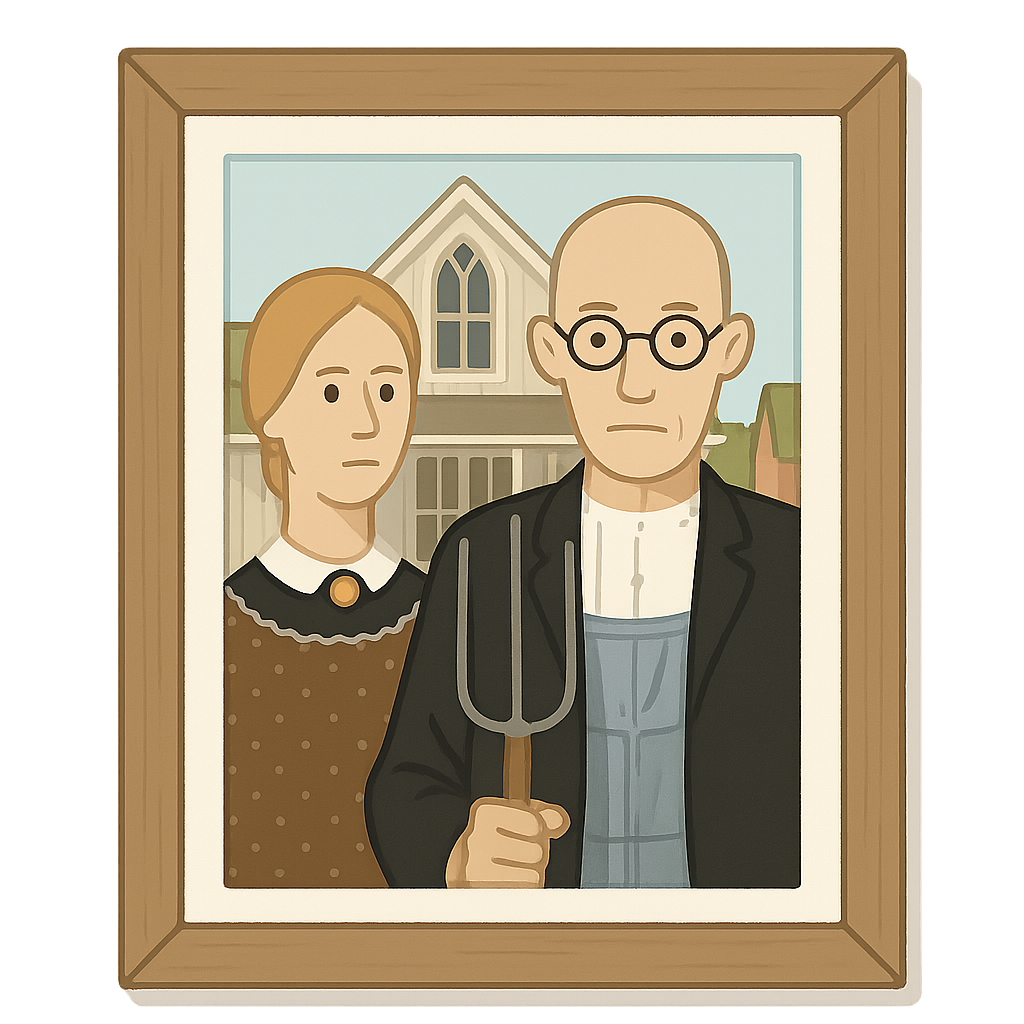
I hang here in the quiet, holding a single moment still forever. Through my frame, you can see a man and a woman standing before their home. The man's face is long and serious, his gaze direct from behind thin, round spectacles. His hand, weathered by work, grips a three-pronged pitchfork, and he holds it not like a simple farm tool, but with the stern authority of a king holding a staff. Beside him, a woman stands with her blonde hair pulled back tightly, except for one soft curl that has escaped to brush against her cheek. Her eyes look just past you, her expression unreadable, as if she has spotted something important in the far distance. Behind them is our house, a simple home of white wood, but it is crowned with a grand, pointed window. It is an ambitious window, the kind you might expect to see on a church in some old European city, not on a farmhouse in the American heartland. Look closer at the world I hold. Can you see the careful stitching on the man’s denim overalls? Or the tiny floral pattern on the woman’s brooch, which pins her collar neatly closed? Notice the delicate, clean curtains hanging perfectly in that fancy window. Every detail is a piece of a story, a clue to who these people might be. I am a portrait of a place, a feeling, and a history. I am American Gothic.
My story began not with a flash of lightning, but with a quiet observation on a summer day in 1930. My creator was an artist named Grant Wood, a man who carried the love of his home state, Iowa, in his heart and in his hands. He saw a profound beauty in its rolling hills, sturdy barns, and the determined people who worked the land. One afternoon, while visiting the small town of Eldon, Iowa, his artist's eye was caught by a little white wooden house. It was a modest cottage, but it had that one spectacular feature: the tall, arching window in its gable, a style known as Carpenter Gothic. Grant was immediately captivated. He sketched the house right then and there, his mind already beginning to paint a picture. He said later that he didn't want to paint the actual people who lived inside. Instead, he wanted to imagine the exact kind of people he felt should live in a house like that. He envisioned them as embodying the pioneer spirit: hardworking, serious, and deeply rooted in their land. To bring this vision to life, he needed faces that could tell this story. He found them close to home. The man with the stern jaw and the powerful pitchfork was modeled by his own dentist, Dr. Byron McKeeby. The woman with the watchful eyes was none other than his own sister, Nan Wood Graham. A fascinating secret about me is that they never even posed together. Grant painted the house first, then his sister, then the dentist, all separately in his studio. He carefully composed the scene bit by bit, like a director setting a stage. His style was precise and meticulous. He wanted every line to be clean, every texture to feel real. You can almost feel the smooth, worn handle of the pitchfork, the weathered grain of the house’s wooden siding, and the crisp, starched fabric of the apron Nan wore. He wasn't just painting a picture; he was building a world.
Once I was complete, in the autumn of 1930, Grant sent me on a journey. He entered me into a major competition at the prestigious Art Institute of Chicago. When the judges saw me, they were intrigued. They looked past the stern faces and saw the incredible detail and the powerful story I told. I was awarded a bronze medal and a prize of three hundred dollars. More importantly, the museum’s curators decided to purchase me for their permanent collection. I have lived within these halls ever since, my quiet scene observed by millions. At first, however, my reception was mixed. Some people back in Iowa were offended. They thought Grant was making fun of them, portraying them as grim and old-fashioned. They wrote angry letters to the newspapers. But Grant patiently explained his true intentions. He said, “I had to go to France to appreciate Iowa.” He meant that seeing the world had helped him see the unique character and strength of his home. He wasn't mocking Midwesterners; he was honoring their resilience and deep-seated values. My fame truly solidified during a very difficult era in American history known as the Great Depression. In the 1930s, when many people lost their jobs and their homes, they looked at the two figures I hold and saw something familiar: determination. They saw people who were not smiling, but who were also not defeated. I became a national symbol of American endurance—a reminder that ordinary people could face immense hardship with strength, dignity, and an unshakeable spirit. I was no longer just a painting of two people and a house; I was a portrait of a nation’s character.
For nearly a century, I have watched the world change from my place on the museum wall. My fame has grown in ways Grant Wood could never have imagined. I have become one of the most recognizable paintings in the world, so famous that people have made me a part of their own stories. My image has been borrowed, copied, and changed thousands of times. You might have seen me recreated with cartoon characters, superheroes, famous celebrities, and even household pets standing solemnly with a pitchfork in front of my Gothic window. These new versions are called parodies, and they don't hurt my feelings at all. In fact, I find it wonderful. It means that my story is not stuck in 1930. Each time someone reimagines me, they are starting a new conversation, asking new questions about what it means to be American, what family looks like, or simply what is serious and what is funny. I am more than just oil paint on a beaverboard panel. I am a question that invites you to wonder. Who are these people? What are they thinking? What will happen just after this moment ends? I am a quiet reminder that you don't have to look to grand palaces or epic battles to find a powerful story. You just have to look closely at the world around you, and you will find beauty, strength, and entire worlds of meaning waiting to be discovered in the simple, ordinary moments of everyday life.
Activities
Take a Quiz
Test what you learned with a fun quiz!
Get creative with colors!
Print a coloring book page of this topic.














 Free for Educators