English

American Gothic
A 1930 painting by Grant Wood…
Reads at Grades 3–5 Listens at Grades 1–5
Print & create
Answer keys·No prep·Free with an account
28 worksheets · answer keys · full story · quiz · Ages 8-10 · CEFR B1
Plus adds 280,000+ more stories in 27 languages, audio for every one, and printables for all of them.
Just want American Gothic?
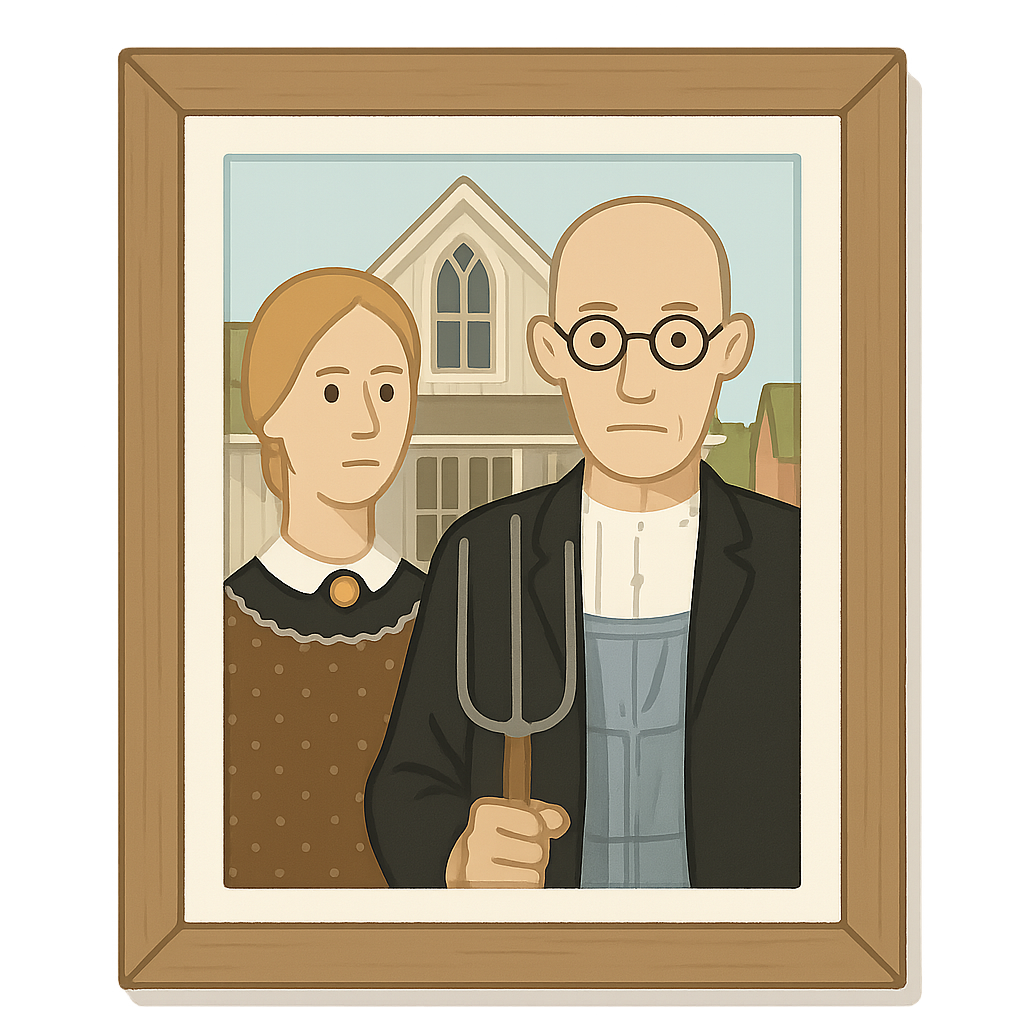
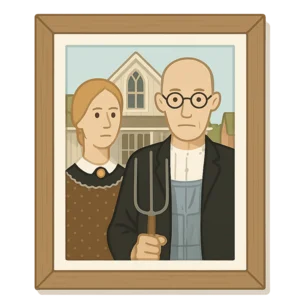
I am a quiet moment, captured in paint. Through my window, you can see a tall, serious man with round glasses holding a three-pronged pitchfork. He looks straight at you, his face long and his mouth set in a firm line. Beside him stands a woman with golden hair pulled back in a neat bun. She isn't looking at you, though. Her eyes are turned to the side, as if she’s a little worried or perhaps just noticed something interesting down the road. Behind them is a simple white house, but it has a very special, pointed window right in the middle of its roof, like a church window on a farmhouse. Everything about me is still and sharp, from the perfect stitching on the man’s overalls to the delicate pattern on the woman’s apron. The colors are calm, and the air feels like it's holding its breath, waiting for a story to be told. I am a painting about a place, a time, and the people who belong to it. I am the famous painting called American Gothic.
My story really begins with an artist named Grant Wood. It was the year 1930, and Grant was driving through a small town in Iowa called Eldon. As he drove, his eyes landed on the little white house with its fancy, arched window. He thought it was both charming and a little bit funny. Can you imagine seeing a window like that on such a plain, hardworking house? It sparked a question in his mind: “What kind of people would live in a house like this?” He knew he had to paint them. But he didn't find a real farm couple living there. Instead, he used his imagination. He asked his own sister, Nan, to be the model for the woman. For the stern-looking man, he asked his family dentist, Dr. Byron McKeeby, to pose. Grant didn't even have them stand together in front of the house. He painted each of them separately in his studio. He carefully chose their clothes to tell a story—an old-fashioned apron for Nan and sturdy denim overalls for the doctor—to make them look like hardworking American pioneers. He added the pitchfork to show the man was a farmer, connected to the land. On the porch behind them, he painted a few potted plants to show a touch of home and care.
American Gothic
I am a quiet moment, captured in paint. Through my window, you can see a tall, serious man with round glasses holding a three-pronged pitchfork. He looks straight at you, his face long and his mouth set in a firm line. Beside him stands a woman with golden hair pulled back in a neat bun. She isn't looking at you, though. Her eyes are turned to the side, as if she’s a little worried or perhaps just noticed something interesting down the road. Behind them is a simple white house, but it has a very special, pointed window right in the middle of its roof, like a church window on a farmhouse. Everything about me is still and sharp, from the perfect stitching on the man’s overalls to the delicate pattern on the woman’s apron. The colors are calm, and the air feels like it's holding its breath, waiting for a story to be told. I am a painting about a place, a time, and the people who belong to it. I am the famous painting called American Gothic.
My story really begins with an artist named Grant Wood. It was the year 1930, and Grant was driving through a small town in Iowa called Eldon. As he drove, his eyes landed on the little white house with its fancy, arched window. He thought it was both charming and a little bit funny. Can you imagine seeing a window like that on such a plain, hardworking house? It sparked a question in his mind: “What kind of people would live in a house like this?” He knew he had to paint them. But he didn't find a real farm couple living there. Instead, he used his imagination. He asked his own sister, Nan, to be the model for the woman. For the stern-looking man, he asked his family dentist, Dr. Byron McKeeby, to pose. Grant didn't even have them stand together in front of the house. He painted each of them separately in his studio. He carefully chose their clothes to tell a story—an old-fashioned apron for Nan and sturdy denim overalls for the doctor—to make them look like hardworking American pioneers. He added the pitchfork to show the man was a farmer, connected to the land. On the porch behind them, he painted a few potted plants to show a touch of home and care.
When Grant Wood finished painting me in 1930, he sent me to a big art competition at the Art Institute of Chicago. And guess what? I won a prize! At first, some people back in Iowa were a little upset. They thought I made farmers look too serious and old-fashioned. But soon, people all over America started to see me differently. It was a very difficult time called the Great Depression, when many families had very little money and life was hard. When they looked at the faces of my people, they didn't see sadness; they saw strength and determination. I became a symbol of the American spirit—the idea of working hard and never giving up. For over 90 years, I have hung in that very same museum, and millions of visitors have come to look at me. I’ve been copied and parodied in cartoons, movies, and advertisements countless times. People still argue and wonder about my story: Are the people in the painting husband and wife, or are they a father and his unmarried daughter? I never tell. By keeping that secret, I let you decide, connecting your imagination to mine and reminding everyone that a single picture can tell a thousand different stories.
Wow facts
About
A 1930 painting by Grant Wood, depicting a farmer standing beside a woman in front of a house with a Gothic-style window. It is one of the most famous and parodied images in American art.
Take a Quiz
Question 1 of 5
In the story, the painting says the artist found the house 'charming.' What does the word 'charming' mean in this sentence?
Explore next






Want to do even more?
Go beyond exploring. Unlock tools that turn every story into real learning.

Storypie Plus for families
Full stories, quizzes, and printables. Nights and car rides, sorted.
- Unlimited audio stories
- Create Mode: your child stars in the story
- Offline downloads
- Printable worksheets & coloring pages

Why Storypie for Schools
Students engaged. Prep in seconds. Evenings back to you.
- Worksheets & Quizzes
- Classroom Management
- Formative Assessment
- Custom Curriculum & Lesson Plans
- 27 Languages

Why Storypie for Homeschool
Curriculum done. They'll ask for more. Hours back in your day.
- Worksheet Generator
- First-Person Audio Stories
- Built-in Comprehension Quizzes
- Custom Curriculum & Lesson Plans
- Print & Go Activities