English

The Night Watch
A famous 1642 oil painting by Rembrandt van Rijn, renowned for its large scale…
Reads at Grades 6–8 Listens at Grades 4–8
Print & create
Answer keys·No prep·Free with an account
28 worksheets · answer keys · full story · quiz · Ages 10-12 · CEFR B2
Plus adds 164,000+ more stories in 27 languages, audio for every one, and printables for all of them.
Just want The Night Watch?
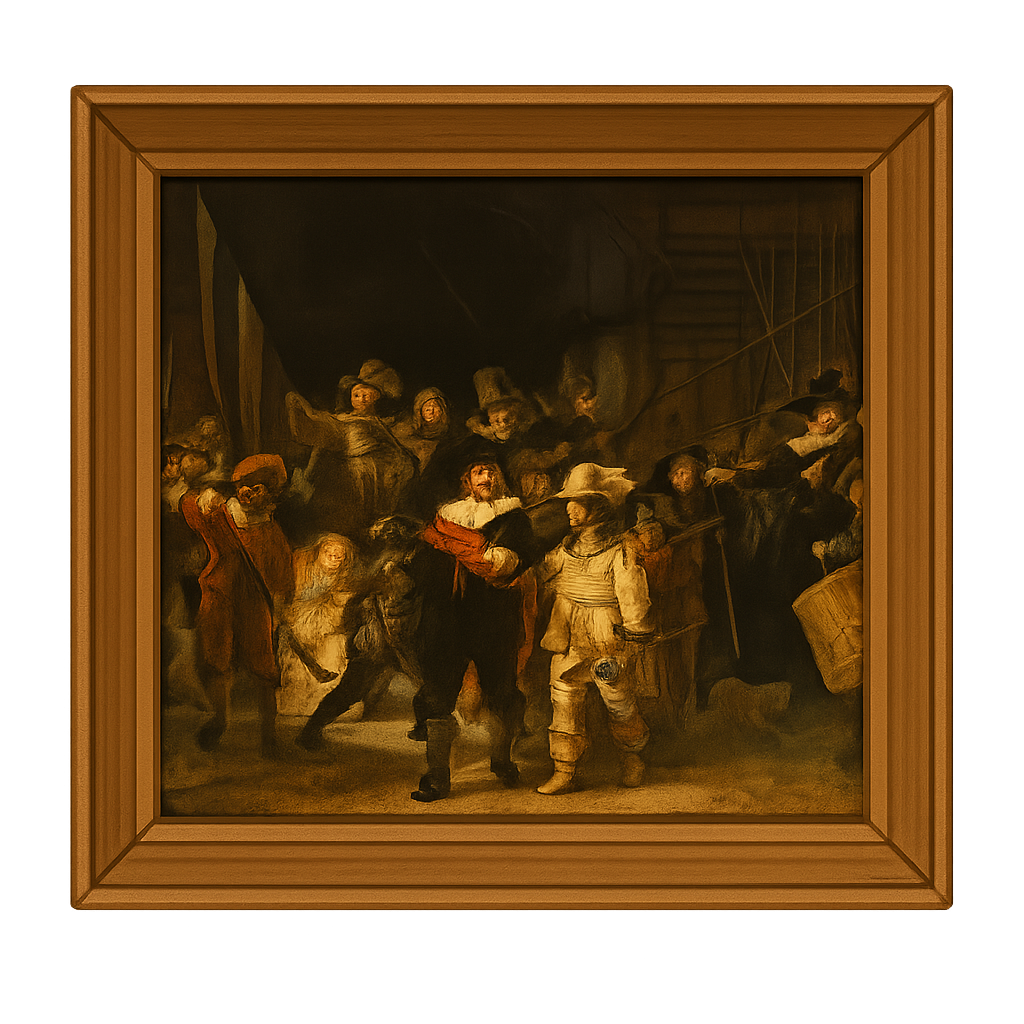
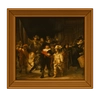
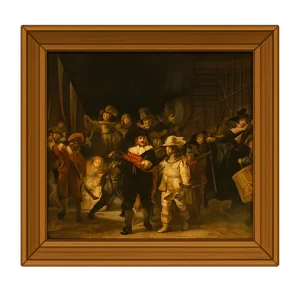
I hang in the quiet, grand hall of a museum, feeling hundreds of eyes on me every single day. They see a vast world of golden light and deep, dramatic shadows, a scene bursting with the energy of a moment frozen in time. Within my giant frame, dozens of soldiers bustle about, a drummer prepares to strike his instrument, and a mysterious young girl glows with an inner light, her presence a puzzle to many. People call me 'The Night Watch,' a name that suggests a scene of darkness and secrecy. But that name is a mistake born from the slow passage of time. My story actually began in the bright sunshine of a bustling city almost four hundred years ago, a testament to a master's daring vision. I am a painting, yes, but I am also a doorway into the past, a story of civic pride, and a revolution on canvas. My true name is much longer and more formal, but my journey has earned me the title the world knows me by today.
My story starts in Amsterdam, in the Netherlands, around the year 1639. The city was flourishing, a center of trade and art during what is called the Dutch Golden Age. A brilliant and famous artist named Rembrandt van Rijn was given a major commission. He was asked to paint a group portrait of a company of city guards, the Kloveniers, led by their captain, Frans Banninck Cocq. In those days, group portraits were common, but they were often stiff and formal, with everyone lined up neatly, looking straight ahead. But Rembrandt was not an ordinary artist. He had a revolutionary idea. He didn't want to paint them standing still in a boring line like statues. He envisioned capturing them in the middle of action, bursting with life and individual personality, as if they were about to march right out of the canvas and into the room. For three years, until I was finally completed in 1642, he worked tirelessly on a colossal canvas. He mixed rich, earthy colors and played with light and shadow—a technique called chiaroscuro—as if it were magic. He painted Captain Cocq dressed in black, giving orders, his hand seeming to reach right out of the painting toward the viewer. Rembrandt wasn't just painting faces; he was telling a story of duty, community, and the dynamic spirit of Amsterdam.
The Story of The Night Watch
I hang in the quiet, grand hall of a museum, feeling hundreds of eyes on me every single day. They see a vast world of golden light and deep, dramatic shadows, a scene bursting with the energy of a moment frozen in time. Within my giant frame, dozens of soldiers bustle about, a drummer prepares to strike his instrument, and a mysterious young girl glows with an inner light, her presence a puzzle to many. People call me 'The Night Watch,' a name that suggests a scene of darkness and secrecy. But that name is a mistake born from the slow passage of time. My story actually began in the bright sunshine of a bustling city almost four hundred years ago, a testament to a master's daring vision. I am a painting, yes, but I am also a doorway into the past, a story of civic pride, and a revolution on canvas. My true name is much longer and more formal, but my journey has earned me the title the world knows me by today.
My story starts in Amsterdam, in the Netherlands, around the year 1639. The city was flourishing, a center of trade and art during what is called the Dutch Golden Age. A brilliant and famous artist named Rembrandt van Rijn was given a major commission. He was asked to paint a group portrait of a company of city guards, the Kloveniers, led by their captain, Frans Banninck Cocq. In those days, group portraits were common, but they were often stiff and formal, with everyone lined up neatly, looking straight ahead. But Rembrandt was not an ordinary artist. He had a revolutionary idea. He didn't want to paint them standing still in a boring line like statues. He envisioned capturing them in the middle of action, bursting with life and individual personality, as if they were about to march right out of the canvas and into the room. For three years, until I was finally completed in 1642, he worked tirelessly on a colossal canvas. He mixed rich, earthy colors and played with light and shadow—a technique called chiaroscuro—as if it were magic. He painted Captain Cocq dressed in black, giving orders, his hand seeming to reach right out of the painting toward the viewer. Rembrandt wasn't just painting faces; he was telling a story of duty, community, and the dynamic spirit of Amsterdam.
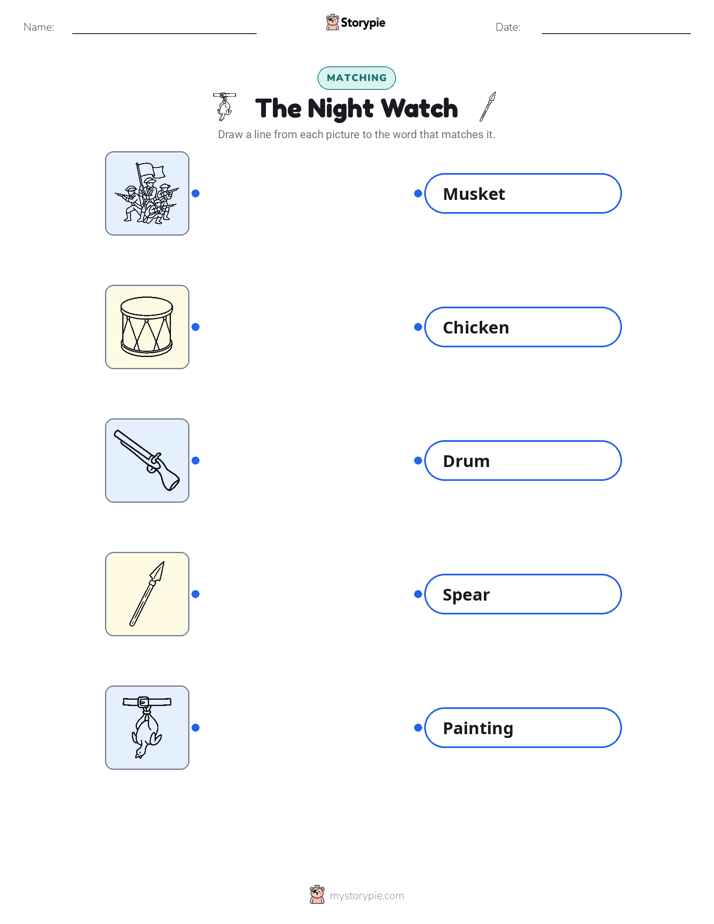
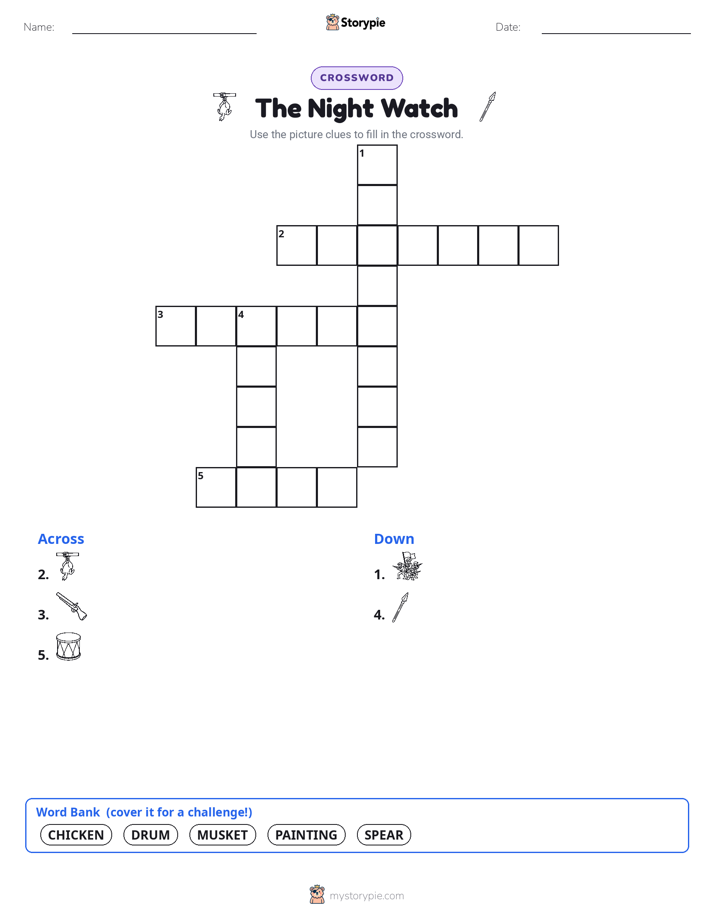
When you look closer into my world, you see that it’s filled with more than just soldiers preparing to march. Every corner holds a detail, a small story. There is the captain’s lieutenant, Willem van Ruytenburch, who shines in his magnificent yellow uniform, catching the brightest light. To the side, a dog barks at the drummer, who is about to strike his drum, his cheeks puffed with air. Men are cleaning their muskets, others are carrying ornate spears and banners, and some faces are half-hidden in the shadows, adding to the feeling of a real, chaotic moment. And then, of course, there is the girl in the golden dress. She is not a soldier, but a mascot, a symbolic figure representing the entire company. If you look closely at her belt, you will see a chicken hanging from it. The chicken’s claws, or 'klauwen' in Dutch, were a clever visual pun, a symbol for the Kloveniers themselves. For centuries, my surface gathered dust and layers of dark, discolored varnish, which made people believe I was a night scene. It was this darkness that gave me my famous nickname. But after a careful cleaning in the 1940s, my true, sunlit colors were finally revealed, proving that Rembrandt had captured a moment of bright, glorious day.
My long life has been a true adventure, filled with both honor and peril. In 1715, I was moved from the Kloveniers' hall to Amsterdam’s Town Hall. But there was a problem: I was too big for the wall they had chosen for me. In a decision that art lovers still mourn today, pieces were trimmed from all four of my sides to make me fit. An entire strip on my left side was cut off, and with it, two of my characters were lost forever. It was a sad day, but the heart of my story, the dynamic action at my center, remained intact. I have survived dangers my creator never could have imagined. During World War II, as enemy forces occupied the Netherlands, I became a national treasure in need of protection. To keep me safe from bombs and theft, I was carefully removed from my frame, rolled up like a giant scroll, and taken to a secret location. For several years, I was hidden deep underground in a special vault inside the St. Pietersberg caves. I waited there in the cool, silent dark until the war finally ended in 1945, when I could be brought out into the light and returned home to a joyful nation.
Today, I live in a place of great honor, in my own dedicated gallery at the Rijksmuseum in Amsterdam. People from all over the world make a pilgrimage to visit me. I am considered one of the greatest treasures of the Netherlands and a supreme masterpiece of the Dutch Golden Age. I am more than just a historical artifact; I am a testament to what is possible when a brilliant artist dares to break the rules and reimagine what a painting can be. I show people that a portrait can be full of action, drama, and emotion. I am a reminder that every person, every moment, has a story worth telling. So when you look at me, don't see me as just a silent painting on a wall. See me as a conversation across centuries, inviting you to step into my light and imagine a world as it once was, full of action, courage, and a touch of golden mystery.
Wow facts
About
A famous 1642 oil painting by Rembrandt van Rijn, renowned for its large scale, dramatic use of light and shadow (chiaroscuro), and its depiction of motion in what was traditionally a static group portrait.
Take a Quiz
Question 1 of 5
Which sentence best summarizes the main idea of my story?
Explore next






Want to do even more?
Go beyond exploring. Unlock tools that turn every story into real learning.

Storypie Plus for families
Full stories, quizzes, and printables. Nights and car rides, sorted.
- Unlimited audio stories
- Create Mode: your child stars in the story
- Offline downloads
- Printable worksheets & coloring pages

Why Storypie for Schools
Students engaged. Prep in seconds. Evenings back to you.
- Worksheets & Quizzes
- Classroom Management
- Formative Assessment
- Custom Curriculum & Lesson Plans
- 27 Languages

Why Storypie for Homeschool
Curriculum done. They'll ask for more. Hours back in your day.
- Worksheet Generator
- First-Person Audio Stories
- Built-in Comprehension Quizzes
- Custom Curriculum & Lesson Plans
- Print & Go Activities