

 English


The Thinker's Tale
I sit here, silent and still. The sun warms my dark, smooth skin, but deep inside, I am always cool. I am made of bronze, a strong metal that gleams when the light hits it just right. Rain can wash over me, and wind can whistle past, but I do not move. I am frozen in a single, powerful moment. My back is curved, and all my muscles are tight, as if I am about to spring into action. But I never do. My elbow rests on my knee, and my chin rests upon my hand. Can you feel the weight of my head? It is full of thoughts, so many thoughts that I must hold it up. People walk by and whisper. They look up at me and wonder, “What is he thinking about?”. They see a man lost in a deep, silent puzzle. They are right to wonder. My mind is a swirling storm of questions and ideas, of stories and secrets. I am The Thinker, and my thoughts are as heavy as the bronze I am made of.
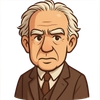
My story began a long, long time ago with a wonderful artist from France named Auguste Rodin. He had a magnificent beard and hands that could turn a lump of clay into something that looked alive. Around the year 1880, he was given a very important job: to create a pair of giant bronze doors for a new museum. He called this project “The Gates of Hell,” which sounds a bit scary, but it was inspired by a very old and famous poem written by a man named Dante Alighieri. Can you imagine creating doors taller than a school bus, covered in hundreds of figures, each telling a part of a story? That was Auguste’s grand idea. My first job was to be the most important figure of all. Auguste planned for me to sit right at the very top of the doors, looking down at everyone else. He first called me “The Poet.” I was meant to be Dante himself, the writer of the poem, thinking about the incredible, twisting story he had created. Auguste worked on me for a long time, shaping my muscles and carving the serious look on my face. But as he worked, he started to see something different in me. He realized I was not just one person, one poet thinking about his story. He saw in my pose the struggle and strength of every person who has ever had a big, important, world-changing thought. I was starting to represent something much bigger than just one story. I was becoming a symbol for all of humanity.
Auguste Rodin decided I was too special to just sit on top of a door. He believed my silent message needed to be seen up close, where everyone could feel its power. So, he made me again, but this time, he made me much bigger—a true giant of bronze. On April 21st, 1906, this new, larger version of me was placed in a very famous spot in Paris, right in front of a building called the Panthéon, for the whole world to see. People would stop their busy days to just stand and look at me. They would grow quiet, and sometimes, I would see them copy my pose, resting their own chins on their hands as if trying to solve my puzzle. What could I possibly be pondering? The truth is, I am thinking about whatever you are thinking about. Today, many copies of me exist in museums and gardens all across the globe, from Philadelphia to Tokyo. My silent thought has been shared everywhere. I am here to remind you that your thoughts have power. Every great invention, every beautiful poem, and every kind idea starts with a quiet moment of thinking, just like mine.
Activities
Take a Quiz
Test what you learned with a fun quiz!
Get creative with colors!
Print a coloring book page of this topic.















 Free for Educators