English


The Thinker - Rodin
A famous bronze sculpture by Auguste Rodin depicting a nude male figure sitting on a rock with his chin on…
Reads at Grades 6–8 Listens at Grades 4–8
Print & create
Answer keys·No prep·Free with an account
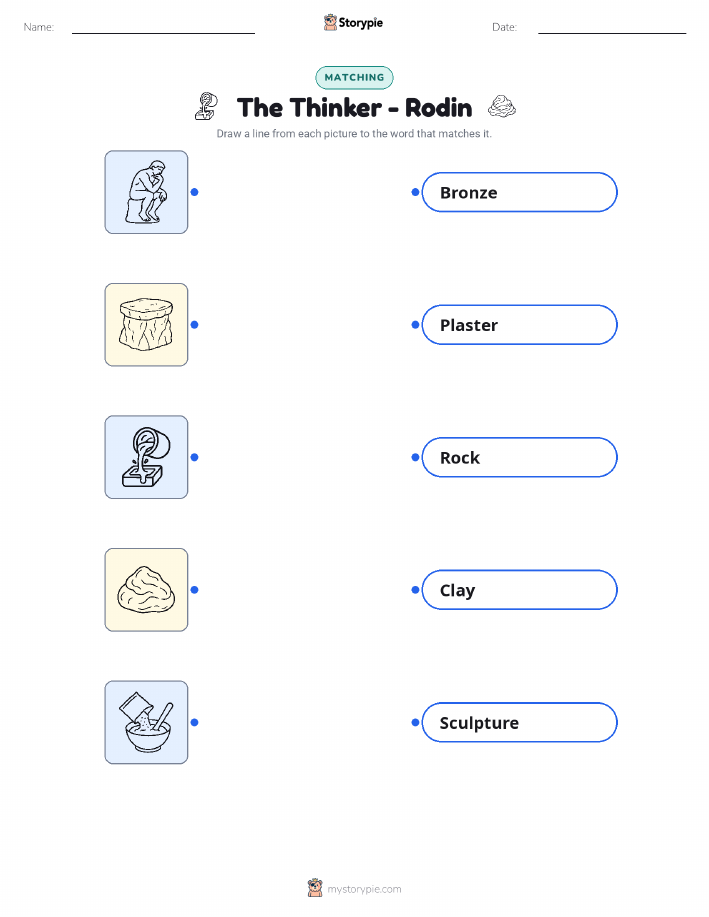
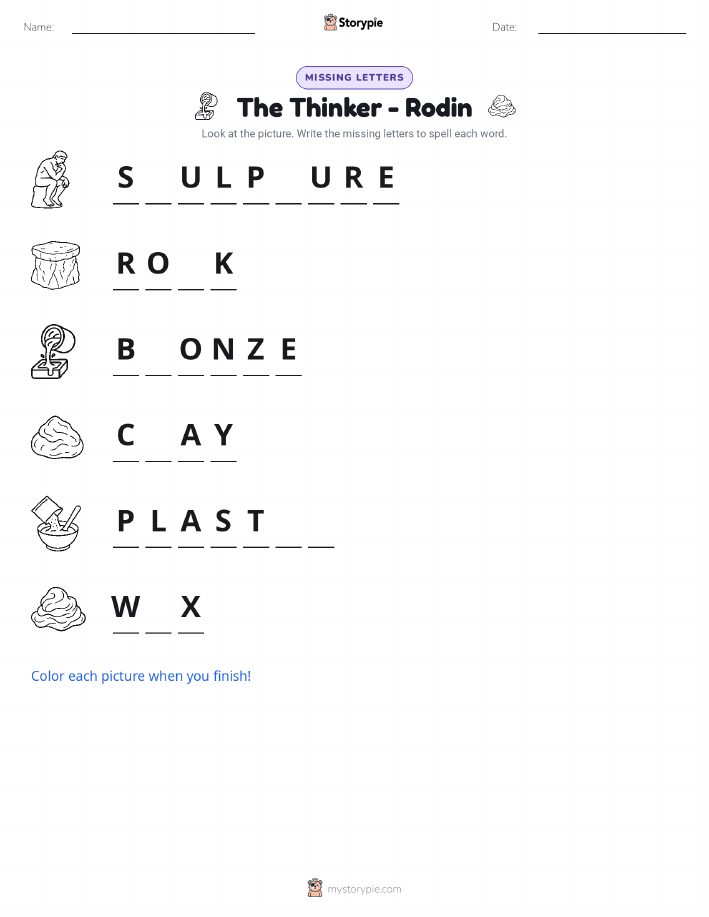
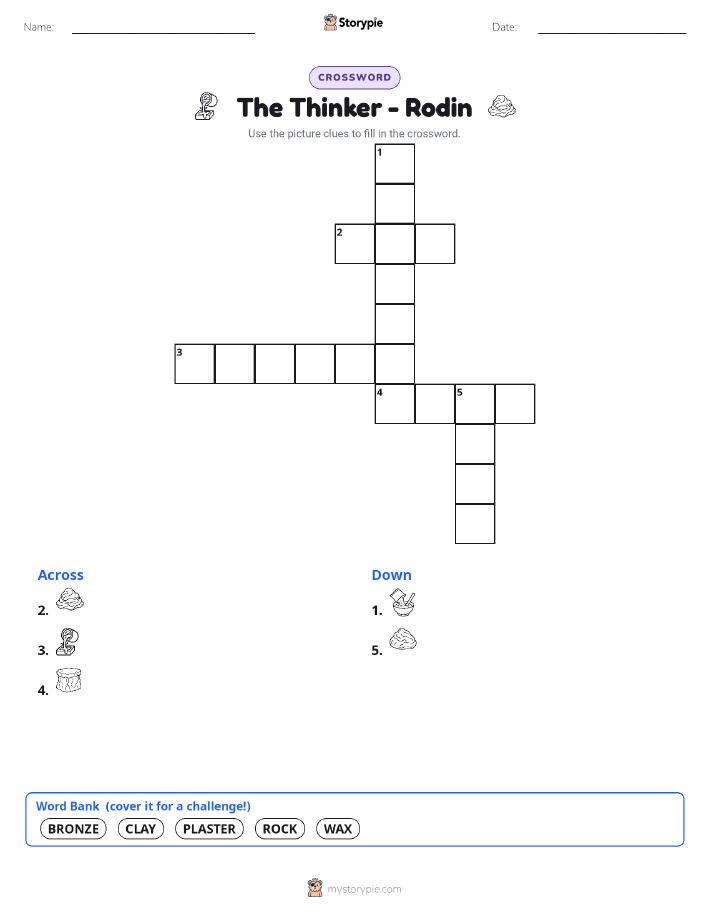
28 worksheets · answer keys · full story · quiz · Ages 10-12 · CEFR B2
Plus adds 280,000+ more stories in 27 languages, audio for every one, and printables for all of them.
Just want The Thinker - Rodin?
A Bronze Body, A Mind of Stone
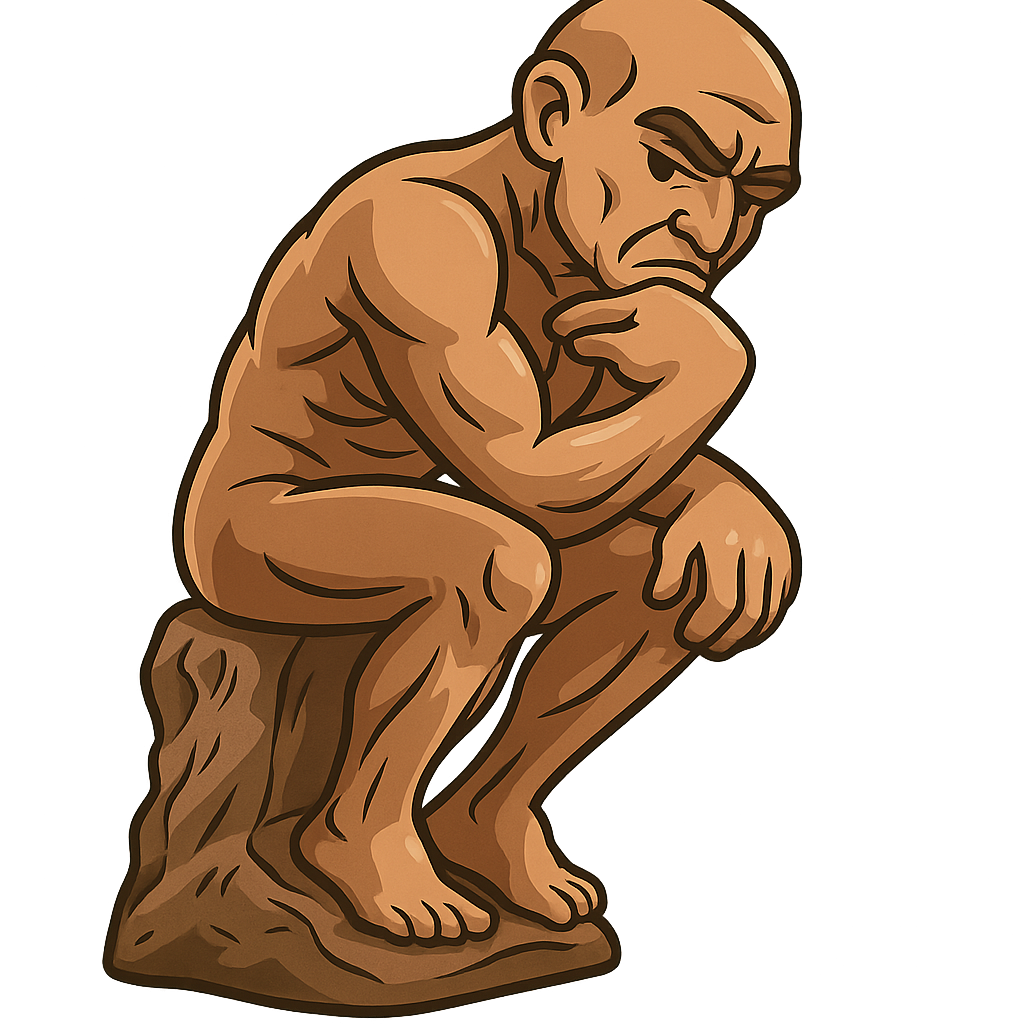
The sun warms my metal back, and the rain trickles down my furrowed brow in cool streams. I feel it all, yet I do not move. I have sat this way for over a century, perched on a rock, lost in a thought so deep that the world of bustling cars and chattering people seems to fade into a distant hum. I am a body of bronze, but my mind is a universe of stone-solid concentration. My powerful muscles are coiled with effort, not for lifting or fighting, but for the immense labor of thinking. My back is curved, my brow is heavy, and my chin rests upon the back of my hand, my lips pressed together by the sheer force of my focus. My gaze is fixed downward, not in sadness, but in profound introspection. I see everything and nothing at all. Children run past me in parks, scholars study my form in quiet museums, and still, I remain locked in this eternal moment of contemplation. From the tension in my toes to the deliberate placement of my arm upon my knee, my entire being is dedicated to a single, silent task. I am an idea given form, a question cast in metal. I am Le Penseur. In your language, I am The Thinker.
In the Hands of a Master
My story begins not on a pedestal, but in the mind of a man with hands as strong as his vision. His name was Auguste Rodin, and around the year 1880, his studio in Paris was a chaotic wonderland of creation. The air was thick with the scent of wet clay and drying plaster. Tools lay scattered about, and all around were the silent, white forms of figures waiting to be brought to life. Rodin was not creating me to sit alone. He first imagined me as a key figure for a colossal project, a magnificent bronze doorway commissioned for a new museum. He called it 'The Gates of Hell.' This epic undertaking was inspired by a famous and terrifying poem, 'The Inferno,' written centuries earlier by the Italian poet Dante Alighieri. The poem describes a journey through the many layers of the underworld. Rodin’s original idea was for me to be Dante himself, the poet, sitting above the swirling chaos of the doors, looking down upon the world of suffering and struggle that he had created with his words. I was to be the creator contemplating his creation. My own creation was a long and arduous journey. First, Rodin sculpted me as a small model from soft clay, his thumbs pressing into the material to form my muscles and thoughtful expression. From there, I was scaled up into a larger plaster form, every detail meticulously refined. But plaster is fragile. To become eternal, I had to pass through fire. The final process was called bronze casting. A wax version of me was made and then encased in a ceramic mold. The mold was heated until the wax melted away, leaving a hollow space in my exact shape. Then came the dramatic moment when molten bronze, glowing like liquid sun, was poured into the empty mold. After it cooled, the mold was broken away, and there I was, transformed from a delicate model into a permanent, powerful being of metal, ready to think forever.
The Thinker
A Bronze Body, A Mind of Stone
The sun warms my metal back, and the rain trickles down my furrowed brow in cool streams. I feel it all, yet I do not move. I have sat this way for over a century, perched on a rock, lost in a thought so deep that the world of bustling cars and chattering people seems to fade into a distant hum. I am a body of bronze, but my mind is a universe of stone-solid concentration. My powerful muscles are coiled with effort, not for lifting or fighting, but for the immense labor of thinking. My back is curved, my brow is heavy, and my chin rests upon the back of my hand, my lips pressed together by the sheer force of my focus. My gaze is fixed downward, not in sadness, but in profound introspection. I see everything and nothing at all. Children run past me in parks, scholars study my form in quiet museums, and still, I remain locked in this eternal moment of contemplation. From the tension in my toes to the deliberate placement of my arm upon my knee, my entire being is dedicated to a single, silent task. I am an idea given form, a question cast in metal. I am Le Penseur. In your language, I am The Thinker.
In the Hands of a Master
My story begins not on a pedestal, but in the mind of a man with hands as strong as his vision. His name was Auguste Rodin, and around the year 1880, his studio in Paris was a chaotic wonderland of creation. The air was thick with the scent of wet clay and drying plaster. Tools lay scattered about, and all around were the silent, white forms of figures waiting to be brought to life. Rodin was not creating me to sit alone. He first imagined me as a key figure for a colossal project, a magnificent bronze doorway commissioned for a new museum. He called it 'The Gates of Hell.' This epic undertaking was inspired by a famous and terrifying poem, 'The Inferno,' written centuries earlier by the Italian poet Dante Alighieri. The poem describes a journey through the many layers of the underworld. Rodin’s original idea was for me to be Dante himself, the poet, sitting above the swirling chaos of the doors, looking down upon the world of suffering and struggle that he had created with his words. I was to be the creator contemplating his creation. My own creation was a long and arduous journey. First, Rodin sculpted me as a small model from soft clay, his thumbs pressing into the material to form my muscles and thoughtful expression. From there, I was scaled up into a larger plaster form, every detail meticulously refined. But plaster is fragile. To become eternal, I had to pass through fire. The final process was called bronze casting. A wax version of me was made and then encased in a ceramic mold. The mold was heated until the wax melted away, leaving a hollow space in my exact shape. Then came the dramatic moment when molten bronze, glowing like liquid sun, was poured into the empty mold. After it cooled, the mold was broken away, and there I was, transformed from a delicate model into a permanent, powerful being of metal, ready to think forever.
A Thought for the World
As the years passed and Rodin continued to work on his 'Gates of Hell,' something remarkable happened. He began to see me as more than just the poet Dante. He saw in my coiled form a universal symbol—the timeless image of a human being using the power of the mind to create, to solve, to dream. He decided that my thought was too big to be confined to a doorway. I needed to stand on my own. So, he chose to enlarge me into a monumental, freestanding statue. This decision changed my destiny. I was no longer just a character in a story; I was the story itself. In 1904, I was exhibited for the first time as a large-scale bronze sculpture, and people were captivated. They saw in me their own struggles and their own capacity for deep thought. The culmination of this new life came on April 21st, 1906. On that day, I was placed in a place of great honor in Paris, right in front of the Panthéon, a grand building where many of France's most brilliant minds are laid to rest. By placing me there, a monument to a thinker among the tombs of great thinkers, a powerful statement was made: the act of creation and contemplation is one of humanity’s noblest pursuits. Crowds gathered to gaze up at me, and I became a symbol for the city. My form became so famous that Rodin authorized casts to be made and sent around the globe. Today, my bronze brothers sit in silent contemplation in cities from Philadelphia to Tokyo, each one a reminder that a powerful thought can resonate across the entire world.
The Never-Ending Question
People often stand before me and ask, 'What is he thinking about?'. They search my bronze face for an answer, but the secret I hold is that there is no single answer. I am thinking about everything and nothing. I am thinking about the poet's words, the scientist's equation, the artist's vision, and the philosopher's question. I represent the magnificent, difficult, and beautiful process of thinking itself. My purpose is not to provide you with an answer, but to inspire you to find your own. I am here to remind you that the ability to sit quietly, to focus your mind, and to wrestle with a big idea is a superpower. It is a power that every single person possesses. Every great invention, every moving story, and every act of progress began just like this: with one person, one moment, and one deep, unbroken thought. My silent vigil is a celebration of that power within you.
Wow facts
About
A famous bronze sculpture by Auguste Rodin depicting a nude male figure sitting on a rock with his chin on his hand, as if deep in thought.
Take a Quiz
Question 1 of 5
Retell the story of how The Thinker was created, from the initial idea to its final bronze form.
Explore next






Want to do even more?
Go beyond exploring. Unlock tools that turn every story into real learning.

Storypie Plus for families
Full stories, quizzes, and printables. Nights and car rides, sorted.
- Unlimited audio stories
- Create Mode: your child stars in the story
- Offline downloads
- Printable worksheets & coloring pages

Why Storypie for Schools
Students engaged. Prep in seconds. Evenings back to you.
- Worksheets & Quizzes
- Classroom Management
- Formative Assessment
- Custom Curriculum & Lesson Plans
- 27 Languages

Why Storypie for Homeschool
Curriculum done. They'll ask for more. Hours back in your day.
- Worksheet Generator
- First-Person Audio Stories
- Built-in Comprehension Quizzes
- Custom Curriculum & Lesson Plans
- Print & Go Activities