

 English

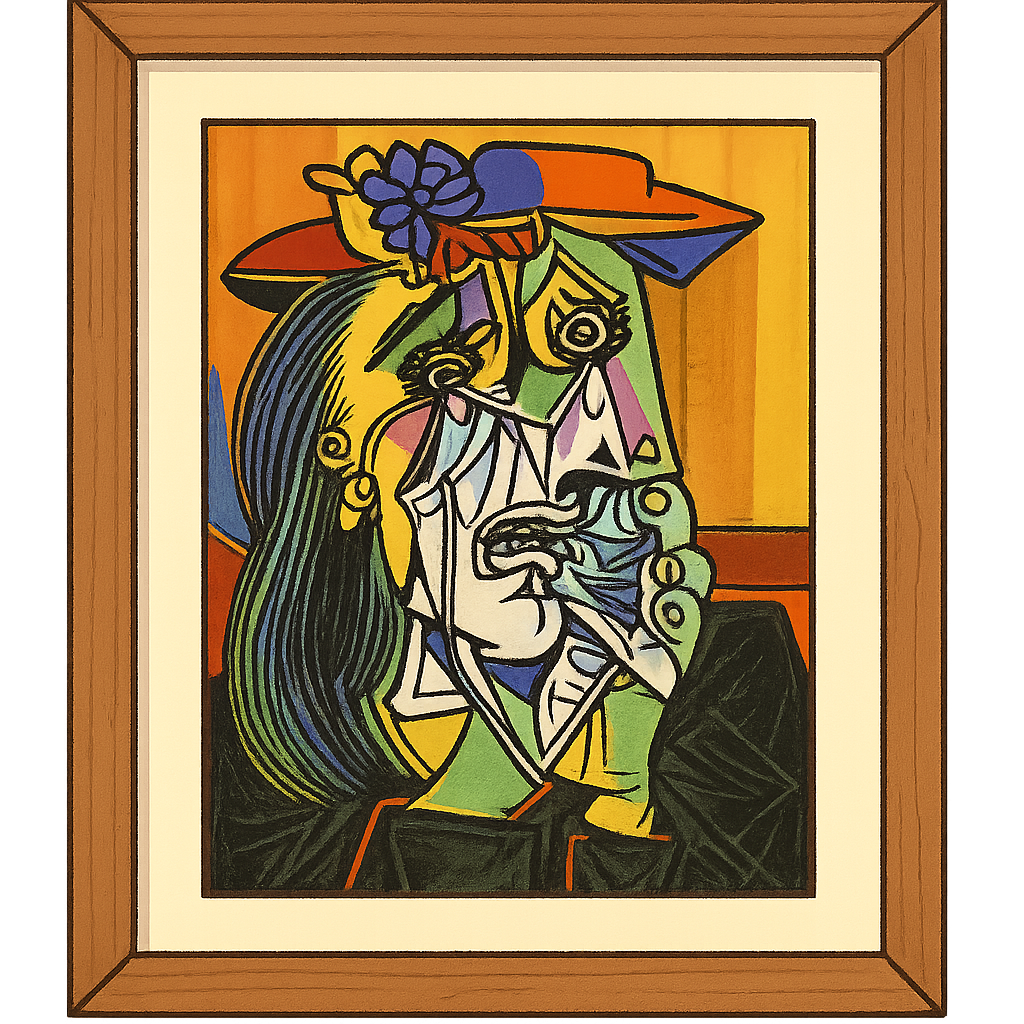
The Story of The Weeping Woman
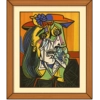
I feel like a storm trapped on a piece of canvas. My skin is a landscape of sharp angles and colliding colors, a puzzle of sickly green and deep, bruised purple. There are no soft curves on my face, only jagged lines that cut through the air. My eyes are not gentle pools of water; they are fractured, like two pieces of shattered glass that can never reflect the world clearly again. They are wide with a shock that never fades, and from them spill tears that look like sharp, glittering shards. My nose is a sharp triangle, my mouth a twisted, dark grimace holding back a scream that has been stuck in my throat for decades. Look at my hands. They are not graceful. They are like the claws of a desperate animal, digging into the crumpled handkerchief I clutch to my face, as if trying to tear the sorrow right out of my own skin. I am not a quiet, peaceful painting you can glance at and forget. I am a roar of emotion, a visible ache. Have you ever felt a sadness so enormous, so heavy, that it felt like it had sharp edges inside you? A sorrow that wasn't just a quiet river of tears, but a violent tempest that threatened to break you into a thousand pieces? That is the feeling I hold. That is what I am. I am The Weeping Woman, a portrait not just of a person, but of a feeling that every human, in every corner of the world, understands in their heart.
My creator was a man whose hands were as full of revolutionary ideas as they were of paint. His name was Pablo Picasso, and he brought me to life in his Paris studio in the year 1937. It was a time of great turmoil and fear in Europe, and Picasso was not just an artist living in a bubble; he felt the world’s pain deeply. He was from Spain, and though he lived in France, his heart was breaking for his homeland. In that year, Spain was torn apart by a terrible civil war. Picasso heard news that shocked him to his core: the German air force, supporting the nationalist side in the war, had bombed the small Basque town of Guernica on April 26, 1937. The attack was brutal, aimed at civilians, and it was one of the first times air power had been used to terrorize a population. Picasso was filled with rage and grief. He poured all of that fury into a gigantic, mural-sized painting he called "Guernica," a chaotic masterpiece of black, white, and grey that showed the horror of the bombing. But one huge painting wasn't enough to contain his sorrow. The suffering he imagined was too vast, too personal. So, he began to paint me. And not just me once, but a whole series of weeping women. He wanted to show the other side of the battle—not the soldiers and the bombs, but the aftermath. He wanted to give a face to the universal grief that war leaves behind. The woman whose face he borrowed for my features was his friend and fellow artist, the talented photographer Dora Maar. He often captured her vibrant, intelligent face, but during this time, he saw her as a reflection of the world's anguish. So while my lines may echo Dora's, I am not just one woman. I am every mother who has lost a child, every sister who has lost a brother, every person whose world has been shattered by conflict. I am the face of private grief made public, a symbol of the immense human cost of war.
For a time, I remained with Picasso, a constant, vivid reminder of the world’s sorrow. But a work of art is meant to be seen, to speak to people it has never met. After my creator’s time, my journey began. I traveled until I found my permanent home in a vast, modern museum in London called the Tate Modern. Here, I hang on a clean white wall, and thousands of people from all over the world come to see me every year. Their reactions are as varied as my own colors. Some people stand before me in silence, their faces reflecting my own painted grief. Others seem confused, their heads tilted as they try to make sense of my broken shapes and clashing hues. Children sometimes point, whispering about my strange, sharp face. But almost no one just walks past. I make them stop. I make them feel. Picasso’s style, known as Cubism, was revolutionary. He believed that a single viewpoint was not enough to capture the truth of a person or an object. He wanted to show you all sides at once—the front of my face, the side of my face, and most importantly, the feelings churning inside of me, all laid bare on the flat canvas. My purpose was never to be beautiful in the way a field of flowers is beautiful. My purpose is to be true. I am a window into a moment of unbearable pain. And yet, there is hope in my existence. By showing this deep sadness so openly, I become a symbol of resilience. I prove that art can give voice to emotions that are too powerful for words. I connect the heart of a Spanish artist in 1937 to the heart of a student visiting the museum today. I am a permanent reminder of the importance of empathy, of feeling for others, and of the desperate need for peace in our world. I show that a single painting, made of just canvas and pigment, can hold a universe of feeling and continue to speak for humanity for generations to come.
Activities
Take a Quiz
Test what you learned with a fun quiz!
Get creative with colors!
Print a coloring book page of this topic.












 Free for Educators