English


The First Animated Feature Film Released (1937)
The premiere of Walt Disney's 'Snow White and the Seven Dwarfs' on December 21st, 1937…
Reads at Grades 6–8 Listens at Grades 4–8
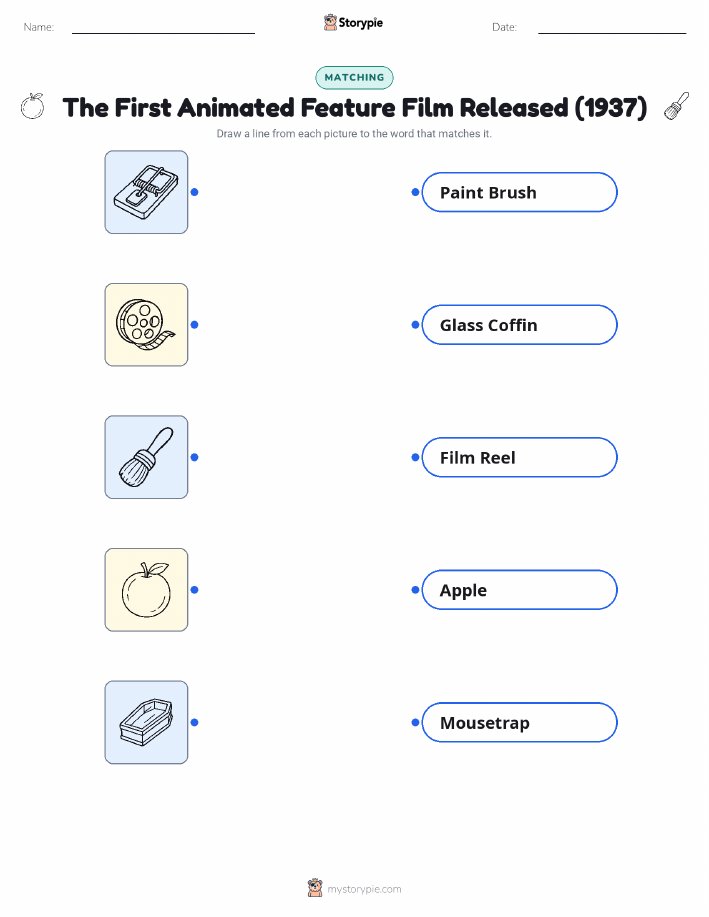
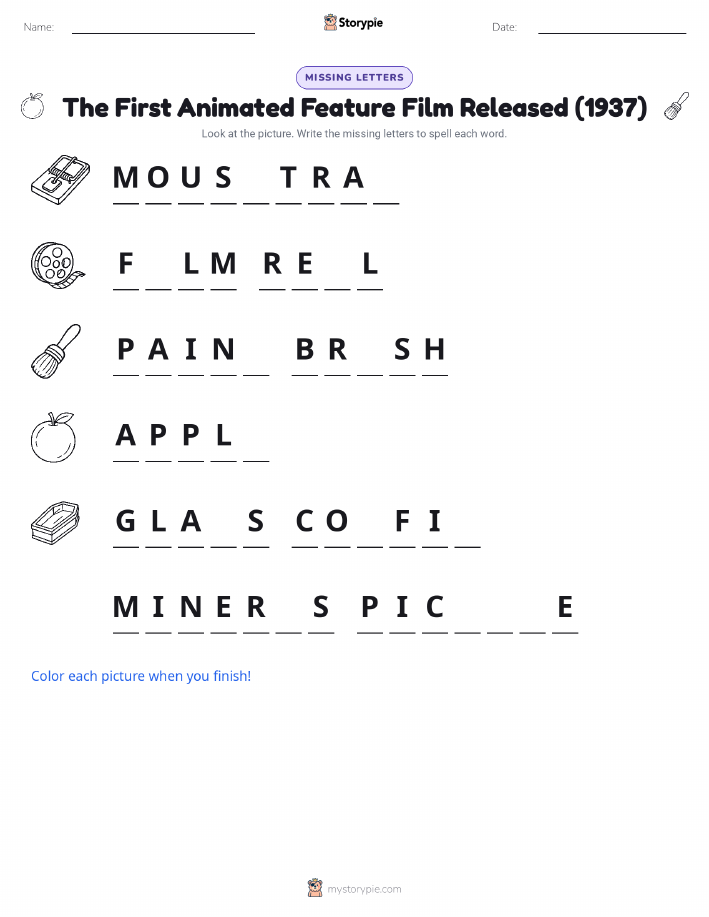
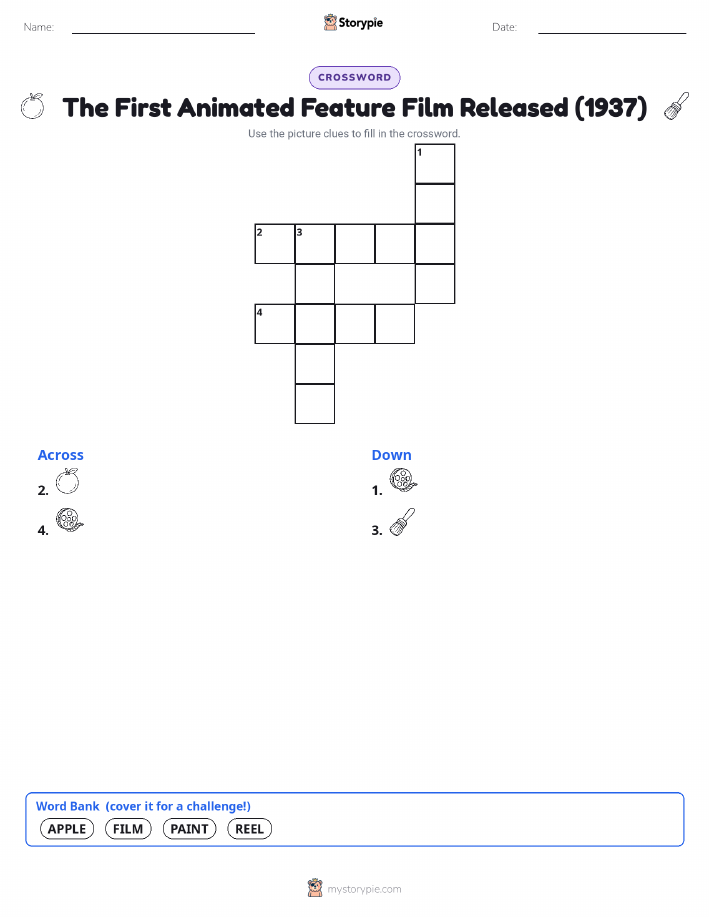
Print & create
Answer keys·No prep·Free with an account
28 worksheets · answer keys · full story · quiz · Ages 10-12 · CEFR B2
Plus adds 279,000+ more stories in 27 languages, audio for every one, and printables for all of them.
Just want The First Animated Feature Film Released (1937)?

A Dream Bigger Than a Mouse
You might know my name, Walt Disney, from the theme parks or the movies, but I want to take you back to a time long before all that. A time when my best friend was a cheerful little mouse named Mickey. Back in the 1930s, our animation studio was making a name for itself with short cartoons. Mickey Mouse, the Silly Symphonies—they made people laugh, and I was proud of that. But deep down, I had a bigger dream stirring in my heart. I didn’t just want to make people laugh for seven minutes; I wanted to make them feel a whole range of emotions—to make them cry, to make them cheer, to tell a story so grand and beautiful it would stay with them forever. I wanted to create the world's first full-length animated feature film. When I announced my idea, you would have thought I’d said I was going to build a rocket to the moon. People in Hollywood just stared at me. “A cartoon that long? Nobody will sit through it,” they said. “The bright colors will hurt their eyes.” Even my own brother and business partner, Roy, and my dear wife, Lillian, were worried. They begged me to reconsider. The newspapers and industry experts had a special name for my project. They called it “Disney’s Folly.” A folly is a foolish and expensive mistake. They were all convinced that my dream would be the end of our little studio. It was a huge risk, but it was a story I simply had to tell.
Bringing a Fairy Tale to Life
The story I chose was a classic fairy tale I’d loved since I was a boy: Snow White and the Seven Dwarfs. I knew it had everything—a beautiful princess, a terrifying villain, suspense, and true love. But turning that simple story into an 83-minute film was a challenge unlike any we had ever faced. Production officially began in 1934, and for the next three years, our studio became a whirlwind of creativity and hard work. My team of artists was brilliant, but they were used to drawing dancing pigs and mischievous mice. Now, I was asking them to draw realistic human characters who could express deep emotions. They had to draw every single movement by hand. When all was said and done, they had created over a million individual drawings. To make our world feel truly magical, we invented a new piece of equipment called the multiplane camera. Imagine several layers of glass, each with a piece of the scenery painted on it—the trees in the front, the mountains in the back. By moving the camera past these layers, we could create a feeling of depth that no cartoon had ever had before. It made you feel like you could step right into the forest with Snow White. I poured every ounce of myself into the film. I would gather my animators in a room and act out the entire story, doing all the voices myself. I’d show them how Grumpy should walk with his arms crossed, how Dopey would trip over his own feet, and how the Evil Queen’s voice should be cold as ice. We hired wonderful actors and singers, and hearing the music for songs like “Heigh-Ho” and “Someday My Prince Will Come” for the first time sent shivers down my spine. But all this magic was incredibly expensive. The budget kept growing. We had to mortgage my house and borrow every penny we could. The pressure was immense. Every night, I wondered if everyone was right, if this really was just a giant, foolish folly. But when I saw the beautiful artwork my team was creating, my belief never wavered. We had to finish.
My Great Folly: The Story of Snow White
A Dream Bigger Than a Mouse
You might know my name, Walt Disney, from the theme parks or the movies, but I want to take you back to a time long before all that. A time when my best friend was a cheerful little mouse named Mickey. Back in the 1930s, our animation studio was making a name for itself with short cartoons. Mickey Mouse, the Silly Symphonies—they made people laugh, and I was proud of that. But deep down, I had a bigger dream stirring in my heart. I didn’t just want to make people laugh for seven minutes; I wanted to make them feel a whole range of emotions—to make them cry, to make them cheer, to tell a story so grand and beautiful it would stay with them forever. I wanted to create the world's first full-length animated feature film. When I announced my idea, you would have thought I’d said I was going to build a rocket to the moon. People in Hollywood just stared at me. “A cartoon that long? Nobody will sit through it,” they said. “The bright colors will hurt their eyes.” Even my own brother and business partner, Roy, and my dear wife, Lillian, were worried. They begged me to reconsider. The newspapers and industry experts had a special name for my project. They called it “Disney’s Folly.” A folly is a foolish and expensive mistake. They were all convinced that my dream would be the end of our little studio. It was a huge risk, but it was a story I simply had to tell.
Bringing a Fairy Tale to Life
The story I chose was a classic fairy tale I’d loved since I was a boy: Snow White and the Seven Dwarfs. I knew it had everything—a beautiful princess, a terrifying villain, suspense, and true love. But turning that simple story into an 83-minute film was a challenge unlike any we had ever faced. Production officially began in 1934, and for the next three years, our studio became a whirlwind of creativity and hard work. My team of artists was brilliant, but they were used to drawing dancing pigs and mischievous mice. Now, I was asking them to draw realistic human characters who could express deep emotions. They had to draw every single movement by hand. When all was said and done, they had created over a million individual drawings. To make our world feel truly magical, we invented a new piece of equipment called the multiplane camera. Imagine several layers of glass, each with a piece of the scenery painted on it—the trees in the front, the mountains in the back. By moving the camera past these layers, we could create a feeling of depth that no cartoon had ever had before. It made you feel like you could step right into the forest with Snow White. I poured every ounce of myself into the film. I would gather my animators in a room and act out the entire story, doing all the voices myself. I’d show them how Grumpy should walk with his arms crossed, how Dopey would trip over his own feet, and how the Evil Queen’s voice should be cold as ice. We hired wonderful actors and singers, and hearing the music for songs like “Heigh-Ho” and “Someday My Prince Will Come” for the first time sent shivers down my spine. But all this magic was incredibly expensive. The budget kept growing. We had to mortgage my house and borrow every penny we could. The pressure was immense. Every night, I wondered if everyone was right, if this really was just a giant, foolish folly. But when I saw the beautiful artwork my team was creating, my belief never wavered. We had to finish.
The Premiere Night
The night of December 21st, 1937, is a night I will never forget. It was the world premiere at the Carthay Circle Theatre in Hollywood. The air was buzzing with electricity. Bright spotlights swept across the sky, and limousines pulled up, delivering the biggest stars in Hollywood. I saw famous actors like Charlie Chaplin and Clark Gable walking the red carpet. My heart was pounding in my chest. This was it. The moment of truth. My wife Lillian and I found our seats, but I couldn't relax. As the lights dimmed and the movie began, I didn’t watch the screen. I couldn’t. Instead, I watched the faces in the audience. For the first few minutes, they were quiet, uncertain. Then, the dwarfs appeared, and the theater filled with laughter. They laughed at Grumpy’s stubbornness and giggled at Dopey’s silly antics. My shoulders relaxed just a little. When the Evil Queen transformed into the wicked old hag, I heard people gasp. When she offered Snow White the poisoned apple, a hush fell over the crowd. Some people were literally on the edge of their seats. And then came the moment I feared the most: the scene where the dwarfs cry at Snow White’s glass coffin. I looked around and saw handkerchiefs dabbing at eyes. These powerful Hollywood figures, who I thought were too tough to be moved by a cartoon, were openly weeping. My own eyes welled up with tears. At the end of the film, as the Prince awakened Snow White and they rode off to the castle, there was a moment of stunned silence. Then, the entire audience rose to its feet. The applause wasn't just clapping; it was a roar, a thunderous standing ovation that seemed to shake the very walls of the theater. All that doubt, all that fear, all that hard work washed away in a wave of overwhelming relief and joy. We had done it. My “folly” was a success.
A New Kind of Magic
That night changed everything. 'Snow White and the Seven Dwarfs' became a massive success all over the world. It proved to everyone that animation was not just for silly little shorts. It was a powerful art form, capable of telling stories that could make people of all ages feel joy, fear, and hope. The success of the film saved our studio and gave us the ability to dream even bigger, leading to films like 'Pinocchio', 'Fantasia', and 'Bambi'. We had created a new kind of magic. Looking back, the lesson of 'Snow White' wasn't just about a princess finding her prince. It was about the power of believing in an idea so strongly that you’re willing to risk everything for it. It was about the magic that happens when a team of talented people works together to create something beautiful. My message to you is simple: don’t ever be afraid to dream a dream that seems impossible. Don’t listen to the people who call your idea a “folly.” With imagination, hard work, and a little bit of courage, you can bring your very own fairy tale to life.
}
Wow facts
About
The premiere of Walt Disney's 'Snow White and the Seven Dwarfs' on December 21st, 1937, marked the release of the first full-length, cel-animated feature film in Technicolor, revolutionizing the animation industry.
Take a Quiz
Question 1 of 5
Retell the story of how Walt Disney created 'Snow White' in your own words, focusing on the main challenges and the final success.
Explore next






Want to do even more?
Go beyond exploring. Unlock tools that turn every story into real learning.

Storypie Plus for families
Full stories, quizzes, and printables. Nights and car rides, sorted.
- Unlimited audio stories
- Create Mode: your child stars in the story
- Offline downloads
- Printable worksheets & coloring pages

Why Storypie for Schools
Students engaged. Prep in seconds. Evenings back to you.
- Worksheets & Quizzes
- Classroom Management
- Formative Assessment
- Custom Curriculum & Lesson Plans
- 27 Languages

Why Storypie for Homeschool
Curriculum done. They'll ask for more. Hours back in your day.
- Worksheet Generator
- First-Person Audio Stories
- Built-in Comprehension Quizzes
- Custom Curriculum & Lesson Plans
- Print & Go Activities