English

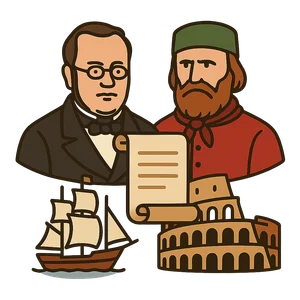
Unification of Italy
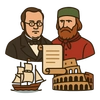
The Unification of Italy, also known as the Risorgimento…
Reads at Grades 6–8 Listens at Grades 4–8
Print & create
Answer keys·No prep·Free with an account
28 worksheets · answer keys · full story · quiz · Ages 10-12 · CEFR B2
Plus adds 116,000+ more stories in 27 languages, audio for every one, and printables for all of them.
Just want Unification of Italy?
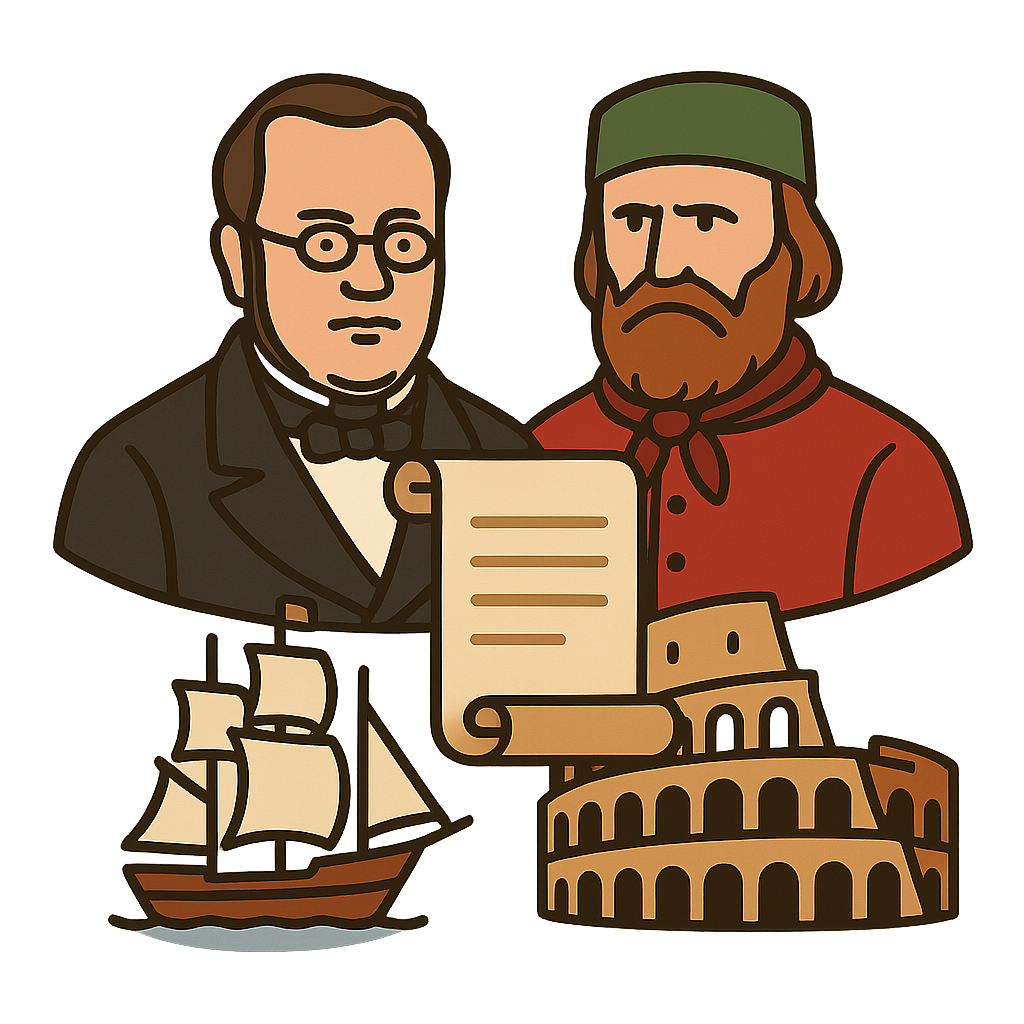
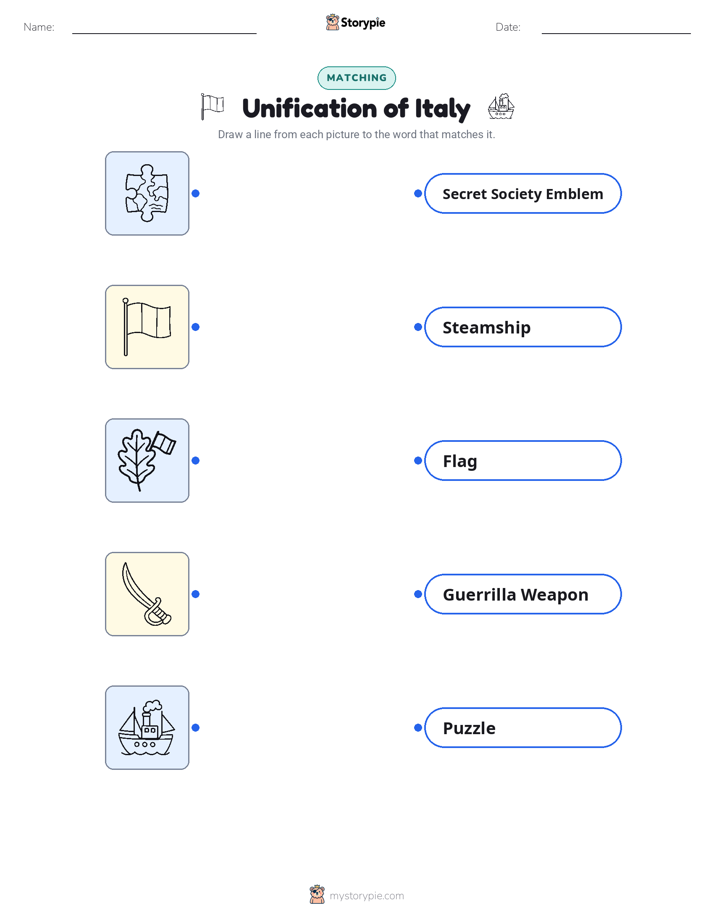
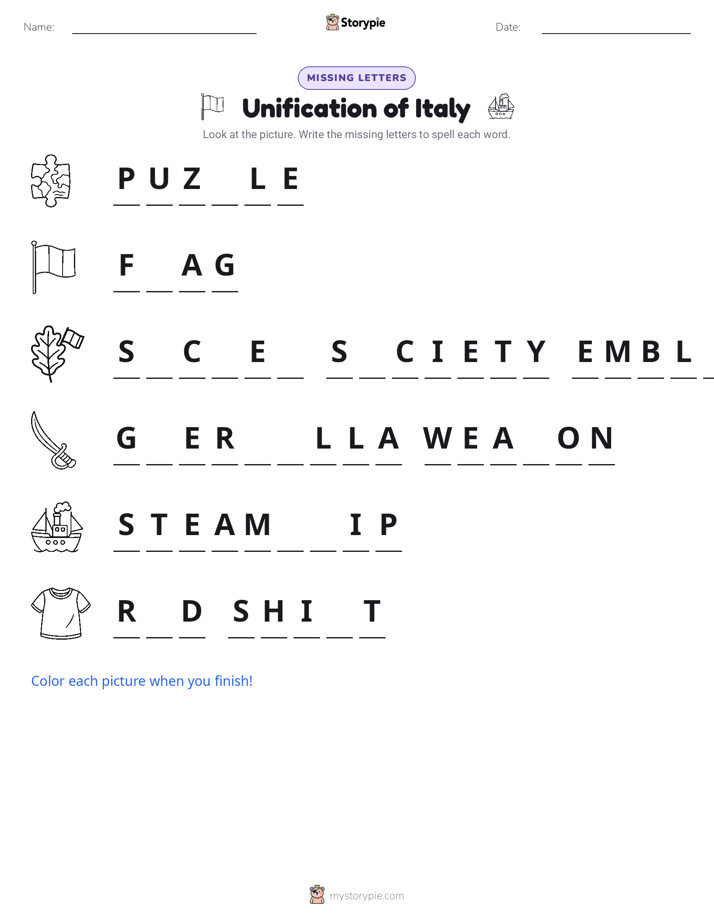
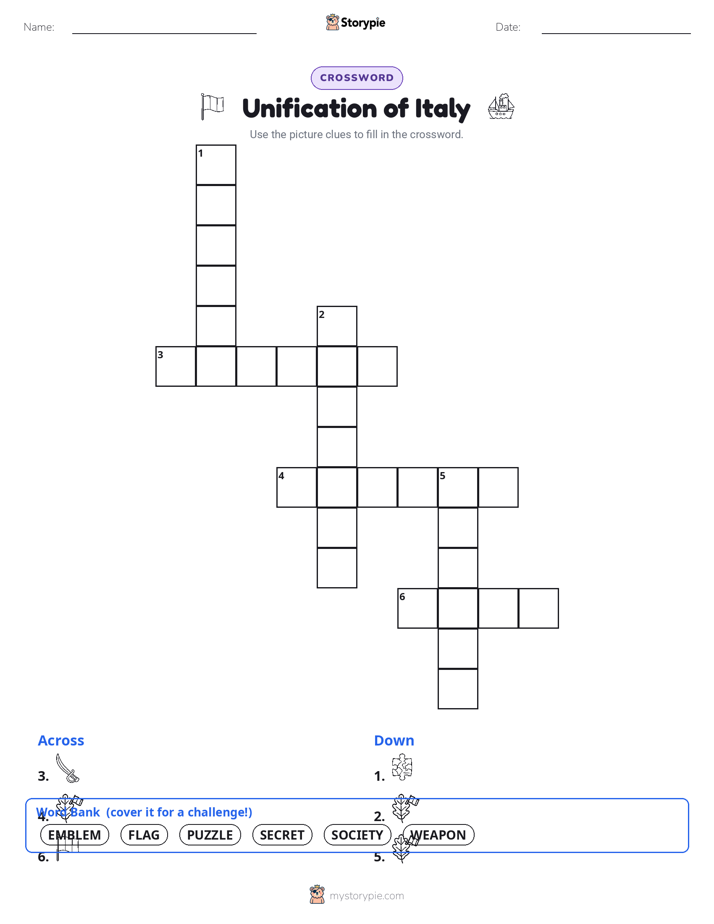
My name is Giuseppe Garibaldi, and though I have been called a soldier and a hero, I have always thought of myself first as an Italian. When I was a young man, born in the city of Nice in 1807, the idea of "Italy" was more of a dream than a reality. Imagine a beautiful puzzle, but with all its pieces scattered across a table. That was Italy. It was not one country, but a collection of separate kingdoms, duchies, and states. The north was largely under the control of the Austrian Empire, the south was ruled by the Bourbon dynasty of Spain, and the Pope governed the Papal States in the center. We spoke the same language and shared a rich history, yet we were divided and often ruled by foreigners. This never felt right to me. From my earliest days as a sailor on the Mediterranean Sea, I saw the world and felt a burning desire for my homeland to be whole, free, and united.
This dream had a name: the Risorgimento, which means "the Resurgence." It was a powerful idea that captured the hearts of many patriots, like the writer and thinker Giuseppe Mazzini. In 1831, he founded a secret society called Young Italy, which I eagerly joined. Its goal was simple and bold: to transform Italy into a single, independent republic. We believed that the Italian people deserved to govern themselves, to have their own flag, and to stand together as one nation. This belief became the compass for my entire life. It led me into exile, into battles in South America where I learned the art of guerrilla warfare, and it gave me a purpose that was stronger than any fear. The scattered pieces of the puzzle needed to be put together, and I felt it was my destiny to help do it.
Giuseppe Garibaldi and the Unification of Italy
My name is Giuseppe Garibaldi, and though I have been called a soldier and a hero, I have always thought of myself first as an Italian. When I was a young man, born in the city of Nice in 1807, the idea of "Italy" was more of a dream than a reality. Imagine a beautiful puzzle, but with all its pieces scattered across a table. That was Italy. It was not one country, but a collection of separate kingdoms, duchies, and states. The north was largely under the control of the Austrian Empire, the south was ruled by the Bourbon dynasty of Spain, and the Pope governed the Papal States in the center. We spoke the same language and shared a rich history, yet we were divided and often ruled by foreigners. This never felt right to me. From my earliest days as a sailor on the Mediterranean Sea, I saw the world and felt a burning desire for my homeland to be whole, free, and united.
This dream had a name: the Risorgimento, which means "the Resurgence." It was a powerful idea that captured the hearts of many patriots, like the writer and thinker Giuseppe Mazzini. In 1831, he founded a secret society called Young Italy, which I eagerly joined. Its goal was simple and bold: to transform Italy into a single, independent republic. We believed that the Italian people deserved to govern themselves, to have their own flag, and to stand together as one nation. This belief became the compass for my entire life. It led me into exile, into battles in South America where I learned the art of guerrilla warfare, and it gave me a purpose that was stronger than any fear. The scattered pieces of the puzzle needed to be put together, and I felt it was my destiny to help do it.
The moment I had been waiting for arrived in the spring of 1860. Word reached me in the north that the people of Sicily had risen up against their Bourbon rulers. It was a spark of rebellion that could light the fire of unification across the entire peninsula. I knew I could not stand by. My friend, the prime minister Camillo di Cavour, was cautious, but I felt the pull of destiny. I began to gather volunteers for a daring expedition. They came from all over—students, lawyers, doctors, and craftsmen, none of them professional soldiers, but all of them burning with patriotic fire. We became known as the "Mille," or the Thousand, and our uniform was simple but soon became famous: a plain red shirt. These shirts were actually a practical choice from my past; they were cheap and had been worn by workers in Argentina where I once fought. But for us, they became a symbol of our courage and our cause.
On the night of May 5th, 1860, we secretly set sail from near Genoa on two rickety steamships, the Piemonte and the Lombardo. Our journey across the Mediterranean was fraught with danger. We were a tiny, poorly armed force heading to challenge an entire kingdom. We landed at Marsala, on the western coast of Sicily, on May 11th. The king's army was much larger and better equipped, but we had something they lacked: the passion of a people fighting for their freedom. Our first major test came at the Battle of Calatafimi. The enemy held the high ground, and my men began to falter. I rode among them, shouting, "Here we either make Italy, or we die!". Those words renewed their spirit, and we charged up the hill to a stunning victory.
That victory was a turning point. It showed the people of Sicily that we could win. Soon, local rebels and ordinary citizens began to join our ranks. The Thousand quickly grew into an army of thousands. We marched across the island, and the Bourbon forces seemed to melt away before us. We captured the capital, Palermo, after fierce street fighting. The support from the people was overwhelming; they saw us not as conquerors, but as liberators. After securing Sicily, we crossed the Strait of Messina to the Italian mainland in August. Our march north towards Naples was less of a military campaign and more of a triumphant parade. Entire towns greeted us with cheers and flowers. The Bourbon king, Francis II, fled Naples before we even arrived. On September 7th, 1860, I entered the city, not with an army, but on a train, welcomed by a joyous crowd. We had liberated Southern Italy.
After the victory in Naples, I faced the most difficult decision of my life. In the north, King Victor Emmanuel II of Sardinia-Piedmont and his army were marching south. He, too, wanted a united Italy, but under his monarchy. I had always been a republican, believing that a king was not necessary for a free country. My followers urged me to establish a republic in the south and march on Rome. But I knew this would lead to a terrible civil war between Italians, shattering our dream just as it was within reach. My goal had always been a united Italy, not a divided one led by me. The cause was greater than any one person, including myself.
So, I made a choice for the sake of unity. On October 26th, 1860, near the town of Teano, I rode out to meet the king. As he approached, I took off my hat and shouted, "I salute the first King of Italy!". In that moment, I handed over control of all of Southern Italy to him. It was a sacrifice of my personal ideals for the good of the nation. Some of my men were disappointed, but it was the only way to make the puzzle of Italy whole without breaking the pieces in the process. With the north and south joined, the final steps could be taken. On March 17th, 1861, the Kingdom of Italy was officially proclaimed. It would take another decade, until 1871, for Rome to become its capital and for the unification to be truly complete. My part in the fighting was over. I had offered my sword to Italy and helped create a nation. My hope was that the Italian people, now united, would build a future worthy of the sacrifices we had all made.
Wow facts
About
The Unification of Italy, also known as the Risorgimento, was the 19th-century political and social movement that resulted in the consolidation of different states of the Italian Peninsula into a single state, the Kingdom of Italy.
Take a Quiz
Question 1 of 5
Why did Garibaldi use the metaphor of a 'scattered puzzle' to describe Italy in his youth?
Explore next



Want to do even more?
Go beyond exploring. Unlock tools that turn every story into real learning.

Storypie Plus for families
Full stories, quizzes, and printables. Nights and car rides, sorted.
- Unlimited audio stories
- Create Mode: your child stars in the story
- Offline downloads
- Printable worksheets & coloring pages

Why Storypie for Schools
Students engaged. Prep in seconds. Evenings back to you.
- Worksheets & Quizzes
- Classroom Management
- Formative Assessment
- Custom Curriculum & Lesson Plans
- 27 Languages

Why Storypie for Homeschool
Curriculum done. They'll ask for more. Hours back in your day.
- Worksheet Generator
- First-Person Audio Stories
- Built-in Comprehension Quizzes
- Custom Curriculum & Lesson Plans
- Print & Go Activities