English

Mardi Gras - American
Mardi Gras, French for 'Fat Tuesday,' is a carnival celebration culminating on the day before Ash Wednesday.
Reads at Grades 6–8 Listens at Grades 4–8
Print & create
Answer keys·No prep·Free with an account
28 worksheets · answer keys · full story · quiz · Ages 10-12 · CEFR B2
Plus adds 279,000+ more stories in 27 languages, audio for every one, and printables for all of them.
Just want Mardi Gras - American?
I am Mardi Gras, a name that means “Fat Tuesday” in the French language. My identity is closely tied to the Christian calendar. I am the final, vibrant day of a longer festive season known as Carnival. The Carnival season itself begins on January 6th and builds in excitement until it reaches its peak on my day, the Tuesday before Ash Wednesday. Ash Wednesday marks the beginning of Lent, a period of forty days leading up to Easter. In many Christian traditions, Lent is a time for fasting, prayer, and more solemn reflection. Because of this, I represent a grand finale—one last opportunity for communities to come together for feasting, music, and elaborate celebration before the quieter Lenten season begins.
My story in North America began with French explorers who carried their customs across the Atlantic Ocean. The first documented observance of me in the region that would become the United States took place on March 3rd, 1699. An expedition led by the French-Canadian explorer Pierre Le Moyne d'Iberville was navigating the Mississippi River. They made camp about 60 miles south of the area where New Orleans, Louisiana, would later be founded. As they settled in for the evening, d'Iberville realized that back in his home country of France, it was Fat Tuesday. To mark the occasion in this new land, he named the campsite Point du Mardi Gras. This simple act of naming the location was the first official record of my presence in the American Gulf Coast.
From that single point on a map, my traditions began to take root and grow, especially in the city of New Orleans. Throughout the 18th and early 19th centuries, the city’s French and Creole residents transformed me from a simple observance into a major social season. Elegant and exclusive masquerade balls became a hallmark of the celebrations, allowing high society to gather in elaborate costumes and masks. As the city grew, my festivities spilled out into the open. By the 1830s, spontaneous and sometimes chaotic street processions became more common. Groups of people in masks and colorful costumes would parade through the streets, creating a lively public spectacle that set the stage for the more organized events that would come to define me.
I Am Mardi Gras
I am Mardi Gras, a name that means “Fat Tuesday” in the French language. My identity is closely tied to the Christian calendar. I am the final, vibrant day of a longer festive season known as Carnival. The Carnival season itself begins on January 6th and builds in excitement until it reaches its peak on my day, the Tuesday before Ash Wednesday. Ash Wednesday marks the beginning of Lent, a period of forty days leading up to Easter. In many Christian traditions, Lent is a time for fasting, prayer, and more solemn reflection. Because of this, I represent a grand finale—one last opportunity for communities to come together for feasting, music, and elaborate celebration before the quieter Lenten season begins.
My story in North America began with French explorers who carried their customs across the Atlantic Ocean. The first documented observance of me in the region that would become the United States took place on March 3rd, 1699. An expedition led by the French-Canadian explorer Pierre Le Moyne d'Iberville was navigating the Mississippi River. They made camp about 60 miles south of the area where New Orleans, Louisiana, would later be founded. As they settled in for the evening, d'Iberville realized that back in his home country of France, it was Fat Tuesday. To mark the occasion in this new land, he named the campsite Point du Mardi Gras. This simple act of naming the location was the first official record of my presence in the American Gulf Coast.
From that single point on a map, my traditions began to take root and grow, especially in the city of New Orleans. Throughout the 18th and early 19th centuries, the city’s French and Creole residents transformed me from a simple observance into a major social season. Elegant and exclusive masquerade balls became a hallmark of the celebrations, allowing high society to gather in elaborate costumes and masks. As the city grew, my festivities spilled out into the open. By the 1830s, spontaneous and sometimes chaotic street processions became more common. Groups of people in masks and colorful costumes would parade through the streets, creating a lively public spectacle that set the stage for the more organized events that would come to define me.
My evolution took a significant turn in 1857. Before this time, my public celebrations could be disorganized. A group of men formed a secret society they called the Mistick Krewe of Comus, wanting to create a more beautiful and orderly public celebration. They organized my first-ever themed parade, complete with torchlights, music, and large, decorated platforms known as floats. This single event was a sensation and changed my character forever. The idea inspired other social groups to form their own organizations, which became known as “krewes.” These krewes began to compete to see who could create the most spectacular parades and host the most lavish balls. Today, dozens of these krewes are the backbone of my celebrations in New Orleans. They spend the entire year designing themes, building floats, and preparing for the Carnival season.
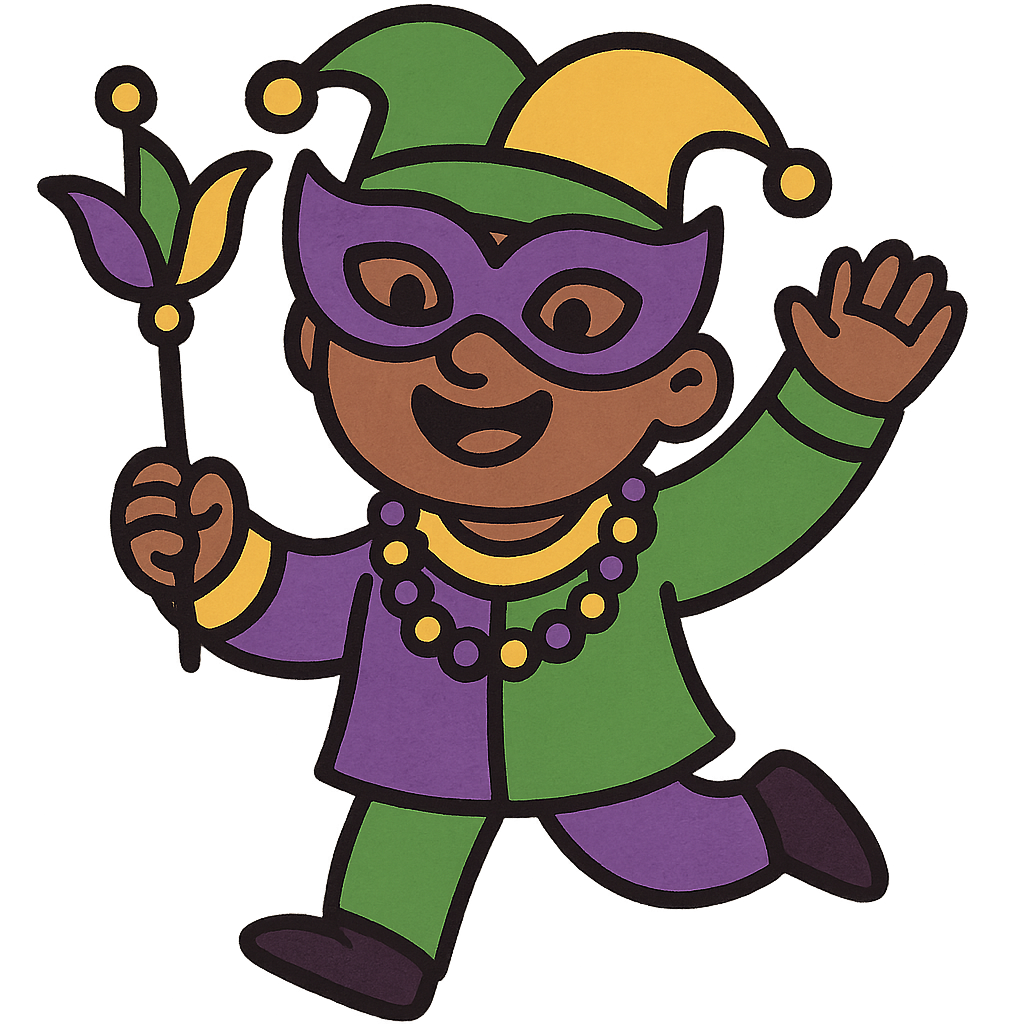
Even my official colors have a specific history. For many years, there were no set colors associated with me, but that changed in 1872. That year, the Krewe of Rex, another one of my most famous and influential krewes, was formed to help organize the daytime festivities. To honor the visit of Russian Grand Duke Alexei Alexandrovich Romanov, the Krewe of Rex selected purple, green, and gold as the official colors of the celebration. They declared that purple represents justice, green stands for faith, and gold symbolizes power. This declaration was widely adopted, and these three colors quickly became an essential part of my identity. People now see them everywhere during the Carnival season, from the beads thrown from floats to the icing on cakes and the decorations on houses.
One of my most delicious and cherished traditions is the King Cake. This is not just any cake; it is a central part of the entire Carnival season, which is sometimes called King Cake season. The tradition begins on January 6th, a Christian feast day known as Epiphany, and continues until my final day, Fat Tuesday. The cake itself is a sweet ring of pastry, often braided and decorated with icing and sprinkles in my official colors of purple, green, and gold. Hidden inside each King Cake is a small trinket, which was historically a bean or a coin but is now most often a tiny plastic baby. According to tradition, the person who finds the token in their slice of cake is crowned “king” or “queen” for the day, is said to receive good luck, and is responsible for buying or baking the next King Cake for the next gathering.
Today, I am observed with great enthusiasm in many places, but my most famous home is New Orleans. However, other cities along the Gulf Coast, such as Mobile, Alabama—which has its own claim to some of my earliest American traditions—also host major and historic festivities. While the large-scale parades with their elaborate floats and the tradition of krewes throwing beaded necklaces to cheering crowds are my most recognizable features, my celebrations are diverse. For many, I am a time for family gatherings, community get-togethers, and sharing special foods. For others, attending the formal, invitation-only balls hosted by the krewes is the highlight of the season. My customs continue to grow and change over time, but my core spirit remains a joyful and festive celebration of community before a period of reflection.
Wow facts
About
Mardi Gras, French for 'Fat Tuesday,' is a carnival celebration culminating on the day before Ash Wednesday. In the United States, it is most famously celebrated in New Orleans and other Gulf Coast cities with parades, masquerade balls, and festive traditions.
Take a Quiz
Question 1 of 5
Based on the text, what is the connection between Mardi Gras and the Christian observance of Lent?
Want to do even more?
Go beyond exploring. Unlock tools that turn every story into real learning.

Storypie Plus for families
Full stories, quizzes, and printables. Nights and car rides, sorted.
- Unlimited audio stories
- Create Mode: your child stars in the story
- Offline downloads
- Printable worksheets & coloring pages

Why Storypie for Schools
Students engaged. Prep in seconds. Evenings back to you.
- Worksheets & Quizzes
- Classroom Management
- Formative Assessment
- Custom Curriculum & Lesson Plans
- 27 Languages

Why Storypie for Homeschool
Curriculum done. They'll ask for more. Hours back in your day.
- Worksheet Generator
- First-Person Audio Stories
- Built-in Comprehension Quizzes
- Custom Curriculum & Lesson Plans
- Print & Go Activities