English


Camera Obscura
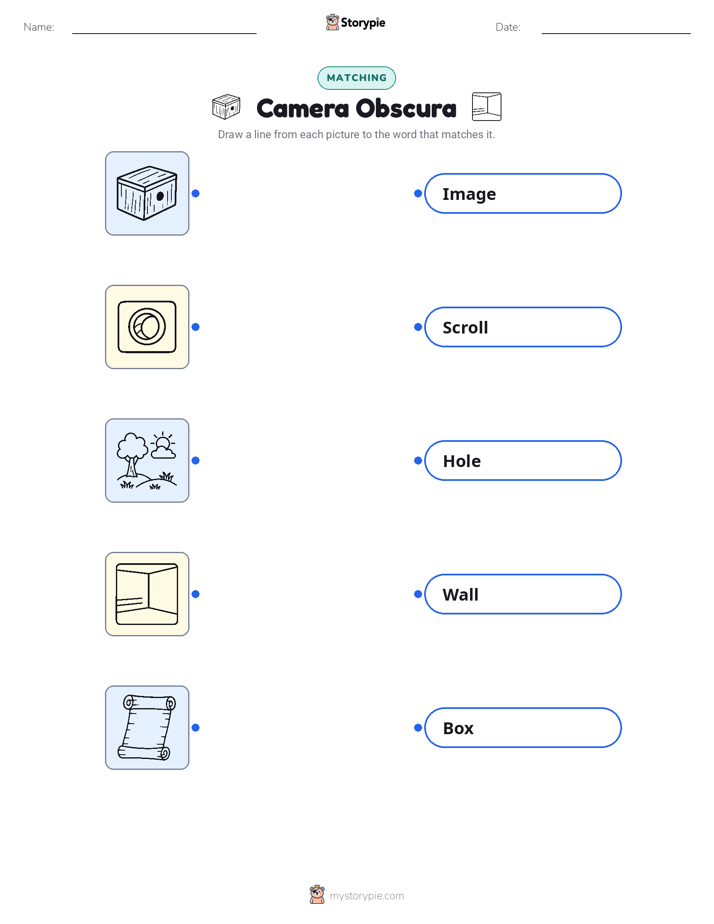
An early optical device that projects an image of its surroundings onto a screen.
Reads at Grades 3–5 Listens at Grades 1–5
Print & create
Answer keys·No prep·Free with an account
28 worksheets · answer keys · full story · quiz · Ages 8-10 · CEFR B1
Plus adds 208,000+ more stories in 27 languages, audio for every one, and printables for all of them.
Just want Camera Obscura?

Hello. You may not know my name, but you see my work every day. I am a Camera Obscura, which is a fancy way of saying “dark room.” Before a single photograph existed, I was the first spark of an idea, a little bit of real-world magic. Imagine a room with no windows, completely dark. But on one wall, there is a tiny, pin-sized hole. Through that little opening, a secret appears on the opposite wall: a beautiful, colorful picture of the world outside. There is one funny thing about my picture, though. The trees’ leaves point to the floor and the grass seems to grow from the ceiling. Everything is flipped upside down. Long before anyone could snap a picture with a phone, people dreamed of capturing the world just as they saw it. They saw a beautiful sunset or a smiling face and wished they could keep that image forever. I was the very first whisper of an answer to that dream, the first step to solving that amazing puzzle.
My story is very, very old. It begins long ago, in the 5th century BCE in a land we now call China. A wise philosopher named Mozi was the first person to write down my secret. He watched the world carefully and noticed how light, when it traveled through a small hole into a dark space, could create a perfect, upside-down copy of whatever was outside. He didn't build a big version of me, but he understood the science behind my magic and wrote it down for others to learn. Centuries later, my journey took me to the year 1021 CE. A brilliant scholar named Ibn al-Haytham invited me to help him with his experiments. He created a large, dark tent—a giant, portable version of me. He used me to study how light travels in perfectly straight lines. He even used my projected image to safely watch a solar eclipse, proving that you should not look directly at the sun, but you could safely watch its moving shadow through me.
I Am the Camera Obscura
Hello. You may not know my name, but you see my work every day. I am a Camera Obscura, which is a fancy way of saying “dark room.” Before a single photograph existed, I was the first spark of an idea, a little bit of real-world magic. Imagine a room with no windows, completely dark. But on one wall, there is a tiny, pin-sized hole. Through that little opening, a secret appears on the opposite wall: a beautiful, colorful picture of the world outside. There is one funny thing about my picture, though. The trees’ leaves point to the floor and the grass seems to grow from the ceiling. Everything is flipped upside down. Long before anyone could snap a picture with a phone, people dreamed of capturing the world just as they saw it. They saw a beautiful sunset or a smiling face and wished they could keep that image forever. I was the very first whisper of an answer to that dream, the first step to solving that amazing puzzle.
My story is very, very old. It begins long ago, in the 5th century BCE in a land we now call China. A wise philosopher named Mozi was the first person to write down my secret. He watched the world carefully and noticed how light, when it traveled through a small hole into a dark space, could create a perfect, upside-down copy of whatever was outside. He didn't build a big version of me, but he understood the science behind my magic and wrote it down for others to learn. Centuries later, my journey took me to the year 1021 CE. A brilliant scholar named Ibn al-Haytham invited me to help him with his experiments. He created a large, dark tent—a giant, portable version of me. He used me to study how light travels in perfectly straight lines. He even used my projected image to safely watch a solar eclipse, proving that you should not look directly at the sun, but you could safely watch its moving shadow through me.
After my time helping scientists understand the mysteries of light, I found a new job during a wonderfully creative period called the Renaissance, in the 1500s. Artists became my biggest fans. Imagine being a great painter like Leonardo da Vinci, trying to make your painting of a castle or a garden look perfectly real. It was very tricky to get all the lines and shapes just right. That is where I came in to help. Artists would set me up in a room or a portable box, and I would project the scene they wanted to paint right onto their canvas or paper. They could see the perfect outline of the buildings, the trees, and the people, all in proportion. They could simply trace my light-painting. It was their secret tool for making art that looked almost alive. My projections helped them understand something very important called perspective, which is the technique artists use to make flat paintings look like they have real depth. Then, around the year 1550, someone had a brilliant idea. They fitted a glass lens into my tiny hole. Suddenly, my projected pictures were not dim and fuzzy anymore. They became bright, sharp, and crystal clear, making me even more popular.
You might think my story ends there, with me being a simple box for artists. But really, that was just the beginning. I am the great-great-grandparent of every single camera that exists today. Think about it: a modern camera is just a dark box that lets in light through a lens to make an image. Does that sound familiar to you. The camera in your family's phone, the giant cameras that film your favorite movies, and the powerful cameras that take pictures of faraway stars all started with my simple idea. It took many clever people hundreds of years to figure out how to capture my light-painting permanently, which is what we now call photography. But my ancient magic was the spark that started it all. Looking back, I see that I did more than just project pictures on a wall. I helped people see the world in a new way and gave them the dream of saving their most precious moments. Every time you look at a photograph, you can remember me, the simple dark room that first showed humanity how to capture a piece of the world forever.
Wow facts
About
An early optical device that projects an image of its surroundings onto a screen. It consists of a dark room or box with a small hole or lens on one side, and is the precursor to the modern photographic camera.
Take a Quiz
Question 1 of 5
Who was the first person mentioned in the story to write down the secret of how the Camera Obscura works?
Explore next





Want to do even more?
Go beyond exploring. Unlock tools that turn every story into real learning.

Storypie Plus for families
Full stories, quizzes, and printables. Nights and car rides, sorted.
- Unlimited audio stories
- Create Mode: your child stars in the story
- Offline downloads
- Printable worksheets & coloring pages

Why Storypie for Schools
Students engaged. Prep in seconds. Evenings back to you.
- Worksheets & Quizzes
- Classroom Management
- Formative Assessment
- Custom Curriculum & Lesson Plans
- 27 Languages

Why Storypie for Homeschool
Curriculum done. They'll ask for more. Hours back in your day.
- Worksheet Generator
- First-Person Audio Stories
- Built-in Comprehension Quizzes
- Custom Curriculum & Lesson Plans
- Print & Go Activities