

 English

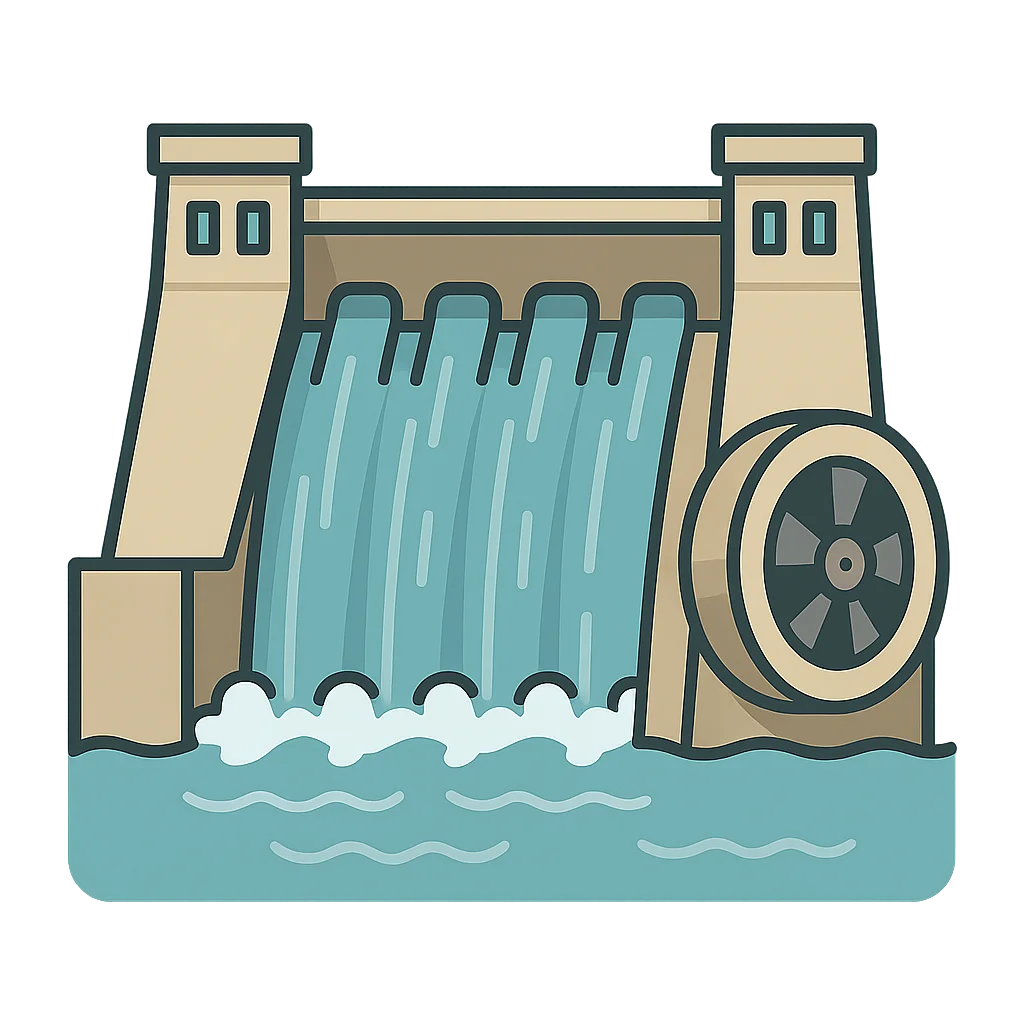
I Am the River's Power
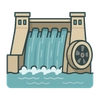
I am a Hydroelectric Dam. Before you think of me as just a wall of concrete, imagine holding the weight of an entire river on your shoulders. Feel the deep, constant hum of millions of gallons of water pressing against you, a sleeping giant of energy waiting to be awakened. The river and I are partners. It provides the muscle, and I provide the purpose. For centuries, my ancestors were simple wooden water wheels, dipping their paddles into streams to grind grain or saw lumber. They were a hint of what was possible, a whisper of the power flowing endlessly toward the sea. In those days, the world grew dark when the sun went down, lit only by the flicker of candles and the glow of oil lamps. Work was done by the strength of human and animal hands. I existed then only as a dream in the minds of clever people who looked at a rushing river and saw not just water, but light, warmth, and progress. I am the physical form of that dream, a bridge between the raw force of nature and the bright world of human invention.
My true story begins in an age of incredible change. A man named Thomas Edison had captured lightning in a glass bulb, and suddenly, everyone wanted this magical thing called electricity. The demand was enormous, and people needed a powerful, reliable way to create it. That’s where I was born. My first real self was the Vulcan Street Plant in Appleton, Wisconsin. On the evening of September 30th, 1882, a local paper mill owner named H.J. Rogers connected a generator to a water wheel on the Fox River, and for the first time, I sent electricity through wires to light up his home. It was a quiet beginning, but it was a revolution. The science behind me is a beautiful dance of physics. Water, guided by my structure, rushes through a channel and spins a giant, fan-like wheel called a turbine. This turbine is connected to a generator, a machine filled with magnets and copper wire. As the turbine spins, the generator spins with it, converting the motion into electrical energy. It’s a clean and elegant process. But in my early days, I had a serious limitation. The direct current (DC) electricity I made couldn't travel very far. My power faded after just a mile or two. For a while, it seemed I would only ever serve small, local communities. Then, a brilliant inventor named Nikola Tesla perfected a system called alternating current, or AC. His work was the key that unlocked my potential. With AC, my electrical energy could be 'stepped up' to a high voltage, sent across hundreds of miles with little loss of power, and then 'stepped down' again to be used safely in homes and factories. Tesla gave me the long reach I needed to power the world.
After my humble start in Wisconsin, my family began to grow, and we grew mighty. The 20th century became my era, the age of megastructures. My siblings and I rose across the great rivers of the world, transforming landscapes and civilizations. Perhaps my most famous relative is the Hoover Dam, a true giant born during the Great Depression of the 1930s. Taming the wild and unpredictable Colorado River was one of the greatest engineering feats in history. Thousands of workers toiled under the desert sun, blasting through canyon walls and pouring mountains of concrete to build a curved wall over 700 feet high. The sound of construction was a constant roar, a testament to human determination. When the last block of concrete was poured in 1935, the world looked on in awe. I wasn't just a dam anymore; I was a symbol of what people could achieve when they worked together. My impact was immediate and profound. I began generating immense amounts of clean electricity for the growing cities of the Southwest, like Los Angeles and Las Vegas. But my job didn't stop there. By controlling the river's flow, I prevented the devastating floods that had once plagued the region. The massive reservoir I created, Lake Mead, stored precious water, allowing vast stretches of desert to be transformed into fertile farmland. I became a source of life and prosperity, a cornerstone upon which the modern American West was built.
Today, my role is more important than ever. In a world searching for ways to power itself without harming the planet, I stand as a reliable and powerful source of renewable energy. Unlike power plants that burn fossil fuels, I don't release harmful greenhouse gases into the atmosphere. I am a part of the Earth’s natural water cycle. The sun evaporates water from the ocean, clouds carry it over land, and rain and snow fall in the mountains, feeding the rivers that flow through me. It is a continuous, clean loop powered by the sun. Of course, with great power comes great responsibility. Modern engineers understand that my presence changes the river's ecosystem. They now design me with features like fish ladders to help salmon migrate upstream and operate my turbines in ways that protect aquatic life. My story is one of partnership—a partnership between human ingenuity and the immense, renewable power of nature. Every time you flip a switch, you might be tapping into the strength of a river, a force I have been honored to harness for over a century. I am a quiet, steady worker, a concrete giant with a watery heart, and I will continue to help power our world cleanly and sustainably for generations to come.
Activities
Take a Quiz
Test what you learned with a fun quiz!
Get creative with colors!
Print a coloring book page of this topic.










 Free for Educators