

 English

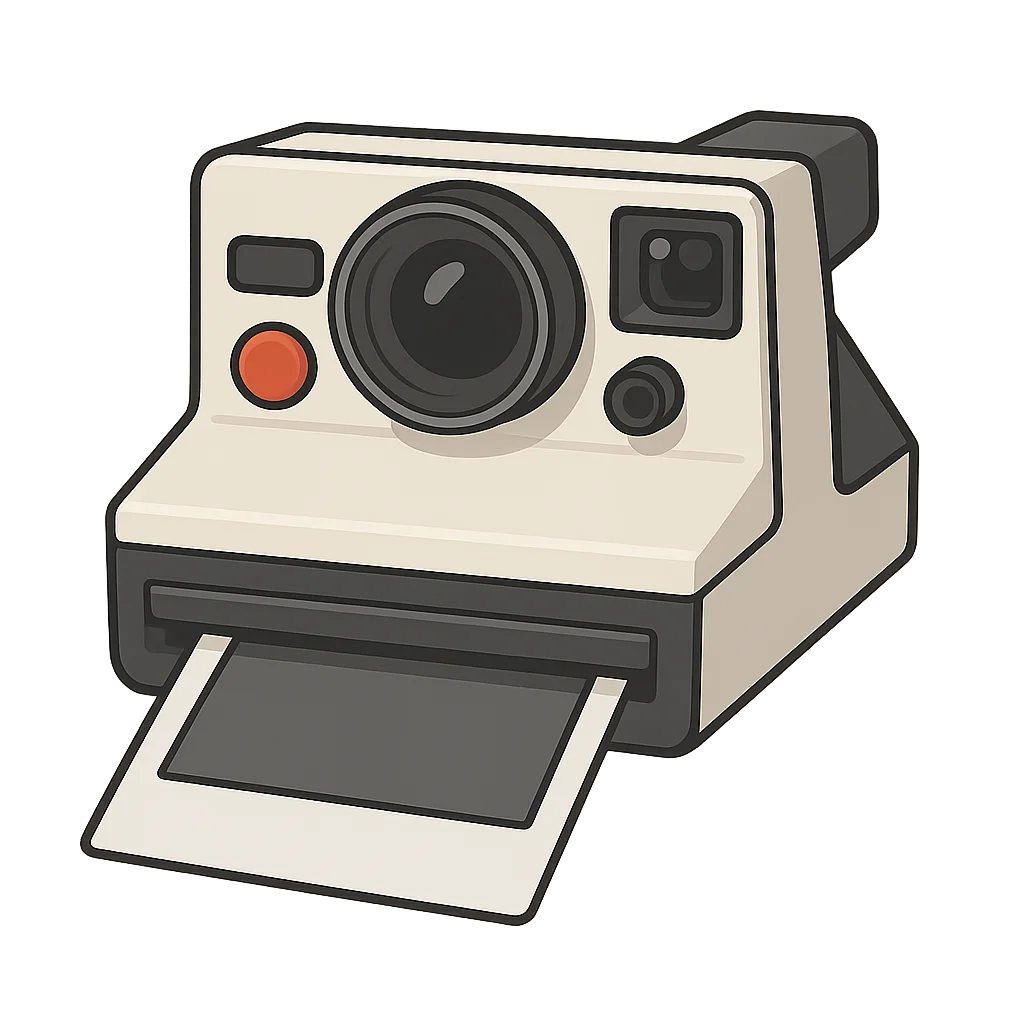
The Camera That Made Magic
Before I existed, a photograph was a promise, a whisper of a memory that you wouldn't see for days or even weeks. It was a secret tucked away inside a roll of film, waiting for the dark, chemical-filled sanctuary of a darkroom to reveal itself. I am the Instant Camera, and I was born from a simple, impatient question on a sunny vacation day. The year was 1943, and my inventor, a brilliant man named Edwin Land, was in Santa Fe, New Mexico, with his family. He raised his camera and took a picture of his three-year-old daughter, Jennifer. She looked at him with all the curiosity a child can muster and asked a question that would change everything: “Why can’t I see the picture now?”. That simple question was like a spark in the vast, creative mind of her father. He told her later that in that single moment, he imagined a camera that could do exactly what she asked. He saw a machine that could capture a moment and deliver it into your hands, a tangible piece of time, almost as quickly as it happened. That question wasn't just a child's wish; it was the seed from which I would grow, a challenge to turn the slow, deliberate process of photography into something immediate, something magical.
That magical idea was one thing, but bringing me to life was an entirely different challenge. Imagine trying to fit a whole room—with its trays of chemicals, timers, and special red lights—onto a single, flat piece of paper. That was the monumental task Edwin Land and his team at his company, Polaroid, set for themselves. For years after that day in 1943, they worked tirelessly. The central problem was how to start, stop, and control a series of chemical reactions within a sealed package, all in under a minute. The breakthrough came with a beautifully simple, yet revolutionary, idea: tiny pods. My inventor designed a negative sheet that contained microscopic pods filled with a jelly-like reagent, the developer chemicals needed to bring the image to life. My film wasn't just film; it was a miniature, self-contained laboratory. When a picture was taken, the film would be pulled through a pair of rollers inside my body. These rollers applied precise pressure, bursting the pods and spreading the chemical reagent evenly between the negative and a positive sheet of photo paper. It was a perfectly choreographed dance of physics and chemistry. After years of relentless experimentation, the moment finally came. On February 21st, 1947, Edwin Land stood before the Optical Society of America, held up a camera—my earliest ancestor—and took a picture of himself. He pulled the film from the camera, and sixty seconds later, he peeled it apart to reveal a perfectly developed, sepia-toned portrait. The audience gasped. It was pure magic. This magic was finally shared with the world when I, the Polaroid Land Camera Model 95, went on sale at a department store in Boston on November 26th, 1948. The fifty-seven of us that were available sold out within hours. People had been waiting for a miracle, and I was ready to deliver it.
Suddenly, I was everywhere. I was the guest of honor at birthday parties, capturing the exact moment the candles were blown out. I was passed around at family reunions, creating keepsakes that didn't have to wait. I gave people the power to see and share their lives as they were living them. I wasn't just for families, either. Artists and scientists found me invaluable. The famous nature photographer Ansel Adams used me to test his lighting and composition, and pop artist Andy Warhol used my unique images to create some of his most iconic works. I was more than a gadget; I was a creative tool. And just like any living thing, I grew and changed. At first, my pictures were a warm brown-and-white sepia, but soon I was producing true black-and-white images. The most exciting leap came in 1963 with the invention of Polacolor film. For the first time, I could capture the world's vibrant hues instantly. Then, in 1972, my most famous sibling was born: the SX-70. It was a marvel of engineering and design, a sleek, collapsible camera that was fully automatic. It did something I never could. Instead of peeling apart the film, the SX-70 gracefully ejected the photo all on its own, and you could watch in wonder as the colors and shapes slowly emerged from a blank square, developing right before your very eyes. This was the peak of my magic, an experience that felt futuristic and left everyone who saw it in awe.
Today, you live in a world where a camera is in nearly every pocket. Your smartphones capture and share images across the globe in less than a second. In many ways, you are living the ultimate fulfillment of that little girl's wish from all those years ago. You might think that my time has passed, that I am just a relic from a slower, analog world. But my story isn't over. My legacy is in every instantly shared photo, in every social media post that connects people through a captured moment. I pioneered the idea of instant visual communication. More than that, I taught the world the unique joy of holding a photograph. A digital picture is fleeting, one of thousands on a screen, but a physical print is a real object. It's a memory you can touch, put in a frame, or tuck into a letter. That tangible connection to a moment is a special kind of magic that I helped people appreciate. Even now, artists and photographers are rediscovering me and my descendants, drawn to the unique beauty and deliberate nature of an instant print. My story proves that a single question can ignite a revolution, and that the desire to hold a piece of a cherished moment in your hand is a timeless human need that will never truly fade away.
Activities
Take a Quiz
Test what you learned with a fun quiz!
Get creative with colors!
Print a coloring book page of this topic.














 Free for Educators