English

Maya Glyphs
The sophisticated writing system of the ancient Maya civilization in Mesoamerica…
Reads at Grades 6–8 Listens at Grades 4–8
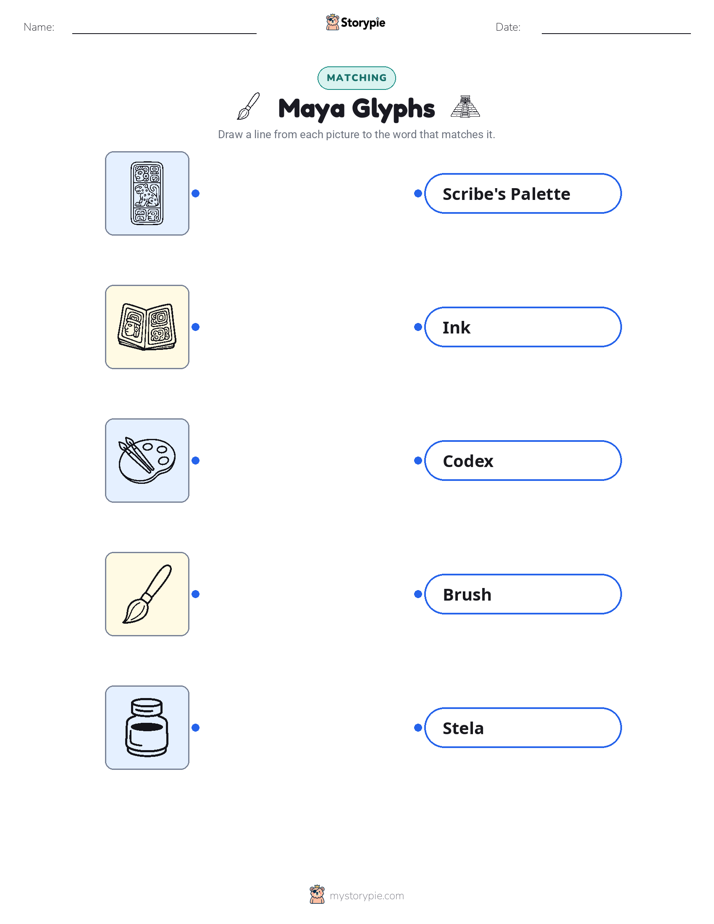
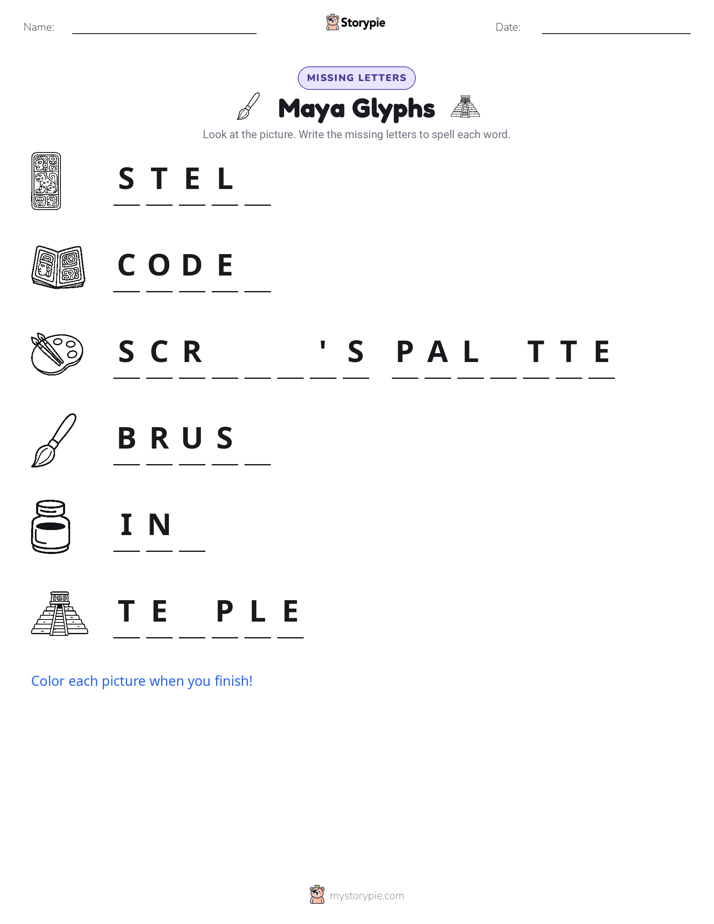
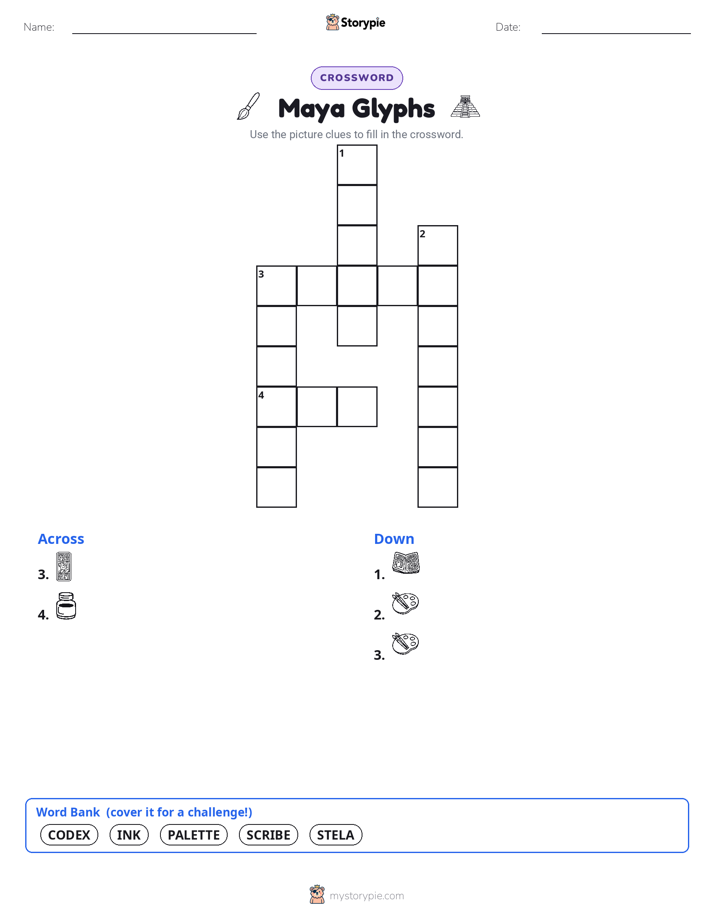
Print & create
Answer keys·No prep·Free with an account
28 worksheets · answer keys · full story · quiz · Ages 10-12 · CEFR B2
Plus adds 208,000+ more stories in 27 languages, audio for every one, and printables for all of them.
Just want Maya Glyphs?
I am not a single object you can hold in your hand, but an entire world of meaning captured in stone and on paper. My name is Maya Glyphs, and I am the voice of one of the great civilizations of the Americas. Before my story was almost lost to time, I lived and breathed in the bustling cities of the Maya people, magnificent places like Tikal and Palenque nestled in the heart of the jungle. My face is a gallery of beautiful and complex pictures, each one carefully carved by master artists into towering stone monuments they called stelae, which stood like silent storytellers in the plazas. I was also painted with delicate brushstrokes onto the pages of books made from fig tree bark, books filled with knowledge and reverence. I was born from a need to remember, to record the passage of time and the lives of kings, sometime around the 3rd century BCE. I was not just art; I was history, I was science, I was the sacred words of priests. I was a living memory, a way for the past to speak to the future.
To understand me is to understand a clever and beautiful puzzle. I speak in two ways at once, a feature that made me a mystery for so long. Some of my parts are logograms, which are pictures that stand for an entire word. Imagine a detailed drawing of a jaguar's head; for the Maya, that image meant 'b'alam,' the word for jaguar. It was a direct and powerful way to communicate. But I am more than just pictures. I am also sound. Many of my glyphs are syllabograms, symbols that represent the sound of a syllable, like building blocks of a word. A scribe could combine these sound-symbols to spell out nearly anything, from the name of a queen to the description of a star. The men and women who mastered this art, the scribes, were highly respected figures in Maya society. During the Classic Period, from 250 to 900 CE, I was at my most eloquent. In those centuries, I flourished. My glyphs covered temples and monuments, recording the precise dates of royal births, the outcomes of great battles, and the complex movements of the planets and stars. I was the keeper of their calendar, the record of their dynasties, and the voice of their worldview.
The Voice of the Maya Glyphs
I am not a single object you can hold in your hand, but an entire world of meaning captured in stone and on paper. My name is Maya Glyphs, and I am the voice of one of the great civilizations of the Americas. Before my story was almost lost to time, I lived and breathed in the bustling cities of the Maya people, magnificent places like Tikal and Palenque nestled in the heart of the jungle. My face is a gallery of beautiful and complex pictures, each one carefully carved by master artists into towering stone monuments they called stelae, which stood like silent storytellers in the plazas. I was also painted with delicate brushstrokes onto the pages of books made from fig tree bark, books filled with knowledge and reverence. I was born from a need to remember, to record the passage of time and the lives of kings, sometime around the 3rd century BCE. I was not just art; I was history, I was science, I was the sacred words of priests. I was a living memory, a way for the past to speak to the future.
To understand me is to understand a clever and beautiful puzzle. I speak in two ways at once, a feature that made me a mystery for so long. Some of my parts are logograms, which are pictures that stand for an entire word. Imagine a detailed drawing of a jaguar's head; for the Maya, that image meant 'b'alam,' the word for jaguar. It was a direct and powerful way to communicate. But I am more than just pictures. I am also sound. Many of my glyphs are syllabograms, symbols that represent the sound of a syllable, like building blocks of a word. A scribe could combine these sound-symbols to spell out nearly anything, from the name of a queen to the description of a star. The men and women who mastered this art, the scribes, were highly respected figures in Maya society. During the Classic Period, from 250 to 900 CE, I was at my most eloquent. In those centuries, I flourished. My glyphs covered temples and monuments, recording the precise dates of royal births, the outcomes of great battles, and the complex movements of the planets and stars. I was the keeper of their calendar, the record of their dynasties, and the voice of their worldview.
My vibrant life, however, was destined for a long and tragic silence. It began around the year 900 CE, when, for reasons that are still debated, the great cities of the southern lowlands were slowly abandoned. The plazas grew quiet, and vines began to creep over the stones where my stories were carved. I was left alone, a silent witness in the encroaching jungle. My greatest sorrow, however, arrived centuries later. In the 16th century, Spanish explorers came to the lands of the Maya. They brought with them a different way of life and a different faith. In the year 1562, a Spanish bishop named Diego de Landa, believing my beautiful bark-paper books were filled with dangerous ideas, committed a devastating act. In a great fire, he ordered my codices to be burned. Almost all of them, holding centuries of astronomy, history, and ritual, were turned to ash. With their destruction, my voice was almost entirely extinguished. The keys to my language were lost, and I became a collection of beautiful but incomprehensible symbols. For hundreds of years, I could not speak.
For centuries, I waited. Explorers and scholars would look at my carved portraits on crumbling monuments and see only strange, artistic decorations. They could not hear the words I held. The silence was finally broken in the 20th century by brilliant people who refused to see me as just a mystery. In the 1950s, a Russian scholar named Yuri Knorozov had a monumental insight. He argued that I was not just a collection of pictures, but a mixed system, using both logograms for words and syllabograms for sounds. This was the key that began to unlock my grammar. Then, in the 1960s, an American researcher named Tatiana Proskouriakoff made another incredible breakthrough. While studying the stelae at a site called Piedras Negras, she noticed that the dates carved on them followed a pattern that matched the lifespan of a human. She realized I wasn't just recording myths or rituals; I was telling the true histories of real kings and queens—their birth dates, their rise to power, and their deaths. These two scholars, and others who followed, were like detectives of the past. With patience and brilliance, they pieced me back together and gave me my voice again.
Today, I am no longer silent. Thanks to the hard work of generations of scholars, most of my glyphs can be read and understood. I am no longer a mystery but a testament to the incredible intelligence and creativity of the Maya people. I tell the world of their profound understanding of mathematics, including their use of the concept of zero. I speak of their astronomers who mapped the stars with breathtaking accuracy, creating calendars more precise than those used in Europe at the time. My stories reveal a world of complex politics, powerful rulers, and deep spiritual beliefs. Most importantly, I am a bridge to the past for the millions of modern Maya people who live today. I connect them to the voices of their ancestors, affirming their rich heritage and their place in history. My journey proves that even after centuries of silence, a story as powerful as a civilization can never truly be lost. A voice, if it is true, will always find a way to be heard.
Wow facts
About
The sophisticated writing system of the ancient Maya civilization in Mesoamerica, which used a combination of logograms (word-pictures) and syllabic signs (sound symbols) to record history, astronomy, and mythology.
Take a Quiz
Question 1 of 5
What two types of symbols did the Maya Glyphs use to form its writing system?
Explore next



Want to do even more?
Go beyond exploring. Unlock tools that turn every story into real learning.

Storypie Plus for families
Full stories, quizzes, and printables. Nights and car rides, sorted.
- Unlimited audio stories
- Create Mode: your child stars in the story
- Offline downloads
- Printable worksheets & coloring pages

Why Storypie for Schools
Students engaged. Prep in seconds. Evenings back to you.
- Worksheets & Quizzes
- Classroom Management
- Formative Assessment
- Custom Curriculum & Lesson Plans
- 27 Languages

Why Storypie for Homeschool
Curriculum done. They'll ask for more. Hours back in your day.
- Worksheet Generator
- First-Person Audio Stories
- Built-in Comprehension Quizzes
- Custom Curriculum & Lesson Plans
- Print & Go Activities