English
 For Schools
 For Homeschool

The Talking Machine
Hello there. My name is the Phonograph, but you can think of me as the world's very first talking machine. Before I came along, the world was full of beautiful sounds that would vanish in an instant. A happy laugh, a sweet lullaby, or an exciting story would float in the air for a moment and then disappear forever, living only in memory. You couldn't catch a sound and save it for later. It was like trying to catch the wind in a jar. But a brilliant man with a mind full of sparks and ideas dreamed of changing that. His name was Thomas Edison, and he was a famous inventor. He looked at photographs, which could capture a moment in time and hold it still on paper, and he wondered, 'Why can't we do the same thing with sound?'. He imagined a machine that could 'hold onto' a voice or a piece of music, keeping it safe so it could be heard again and again. That wonderful, impossible-sounding dream was the seed that grew into me.
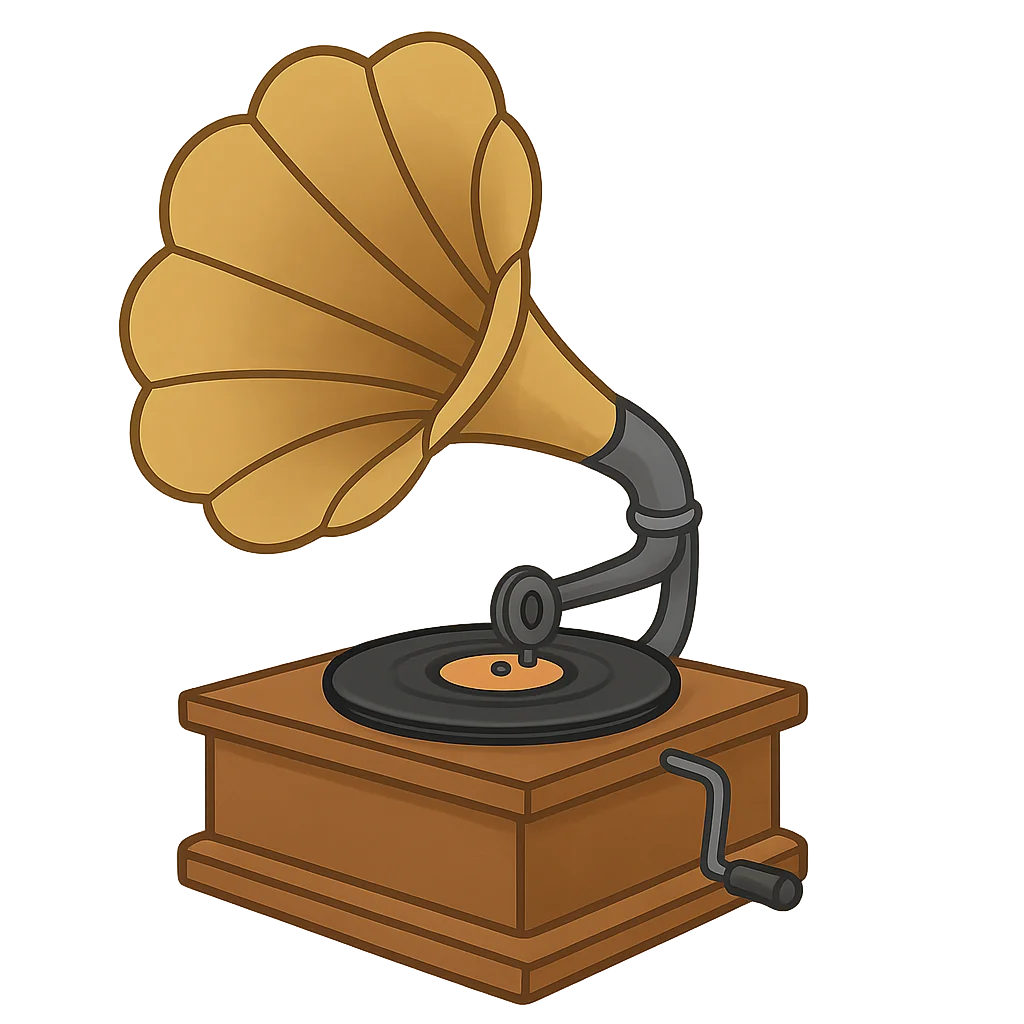
My life began in a place that buzzed with excitement and smelled of wood, metal, and new ideas: Thomas Edison’s laboratory in Menlo Park, New Jersey. Throughout the summer and fall of 1877, he and his team worked tirelessly to bring me to life. At first, I was a strange-looking contraption. My main part was a metal cylinder with grooves, which was carefully wrapped in a delicate sheet of tinfoil. I had a sharp needle, called a stylus, that would gently press into the foil. And to catch the sound, I had a horn that looked like a big metal flower. The idea was simple but genius. When someone spoke into the horn, the vibrations of their voice would make the stylus tremble and etch a tiny, wiggly line into the spinning tinfoil. To play it back, another needle would trace that same wiggly line, recreating the vibrations and sending the sound back out of the horn. For months, they tested and tweaked me. Then came the magical day: December 6th, 1877. The air in the lab was thick with anticipation. Mr. Edison leaned close to my horn, turned the crank to make my cylinder spin, and spoke a simple nursery rhyme: 'Mary had a little lamb, its fleece was white as snow'. Then, he moved the needle back to the beginning and let it trace the new groove in the tinfoil. A hush fell over the room. From my horn, in a tinny but clear voice, came the exact same words: 'Mary had a little lamb…'. The men in the room gasped. Their eyes grew wide with disbelief and wonder. It was as if magic had happened. I had spoken. A machine had captured a human voice and set it free again.
That incredible moment was only my beginning. I soon left the laboratory and traveled out into the world. For the first time, families could gather in their living rooms and listen to their favorite songs or the voices of famous people whenever they wished. I brought music and stories into homes in a way no one had ever experienced. I wasn't alone for long, either. Other clever inventors were inspired by me. A man named Emile Berliner created my cousin, the Gramophone, which used flat discs instead of my tinfoil cylinders. His invention made it easier to make many copies of a recording, so more people could share the same music. Together, we started a revolution in sound. Over the years, I continued to change and grow, becoming the record players your grandparents might have used. My spirit lives on today in every device that records and plays back sound. When you listen to a song on a smartphone, play a voice message from a friend, or listen to a story through your headphones, you are experiencing the legacy of that first, shaky voice I spoke so long ago. I am the Phonograph, and I am proud that I gave the world a voice that never has to fade away.
Activities
Take a Quiz
Test what you learned with a fun quiz!
Get creative with colors!
Print a coloring book page of this topic.