

 English

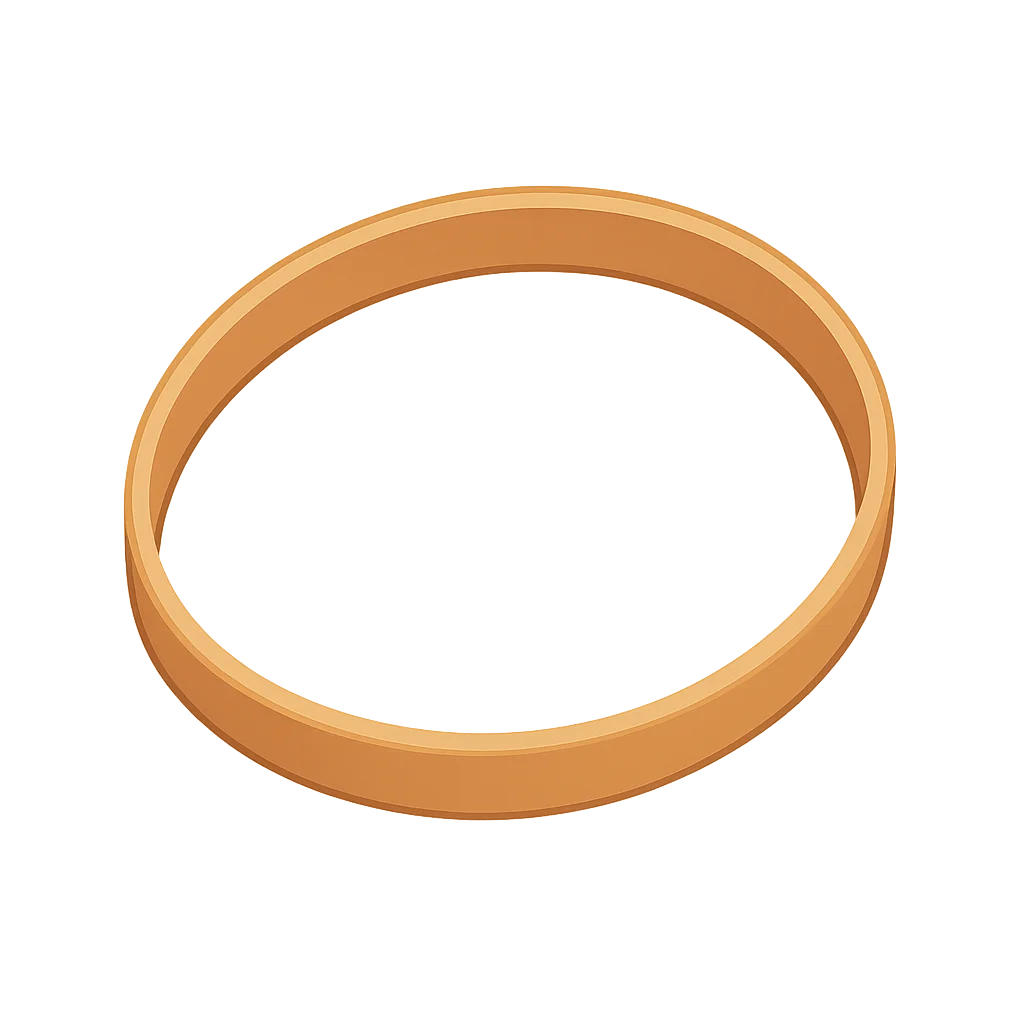
A Stretchy Story
Hello there. You can call me the rubber band. You probably know me as that stretchy little loop you use to hold your pencils together, or maybe to launch a carefully folded paper airplane across the classroom. Before I came along, the world was a bit more… disorganized. Imagine trying to keep a stack of precious letters together with just a piece of twine that could fray and break, or bundling fresh market vegetables with a flimsy piece of vine. It was clumsy, and things often fell apart. I was born from a simple need for something reliable, strong, and incredibly flexible. My story, however, doesn't start in a factory or an inventor's workshop. It begins long before I was a perfect little circle, deep in the warm, humid rainforests of the Amazon, as a milky white sap called latex, dripping slowly from the bark of a very special tree. I am a child of nature, shaped by human curiosity.
For centuries, people native to the Amazon rainforest knew about my ancestor, latex, but it was a tricky and unpredictable material. In the sweltering heat, it would become a gooey, sticky mess, and in the cold, it would turn hard and brittle, easily snapping. My potential was locked away. That all changed thanks to a wonderfully curious and persistent man named Charles Goodyear. He was utterly convinced that he could stabilize rubber. For years, he experimented tirelessly, mixing it with different substances, but nothing seemed to work. Then, in 1839, a moment of pure chance changed everything. He accidentally dropped a mixture of rubber and sulfur onto a hot stove. Instead of melting into a puddle, it charred like leather but remained remarkably flexible, waterproof, and strong. He had discovered vulcanization. This process was my secret recipe; it gave me my strength, my resilience, and my signature bounce. A few years later, on March 17th, 1845, an English inventor named Stephen Perry recognized the potential in this new, improved rubber. He understood that a simple loop of this material could be the perfect fastener for papers and envelopes. He took sheets of vulcanized rubber, cut them into thin strips, and joined the ends to create the very first of my kind. He patented me that day, officially introducing me to the world as the 'rubber band.'
After my official debut, I was suddenly everywhere. My simple, effective design was revolutionary. Post offices were among the first to truly embrace me, using me to bundle letters and packages, which made mail delivery faster and much more organized. Banks quickly followed, finding me perfect for wrapping stacks of money securely. Soon, people found endless uses for me in their homes, schools, and offices. I held food containers sealed, kept hairstyles in place, and became a crucial part of countless science projects. Because my design was so simple, I was easy and cheap to produce, which meant almost everyone could have me. I may be small and often overlooked, but my impact has been huge. I am a tiny piece of clever engineering, born from a natural gift and human ingenuity. The next time you stretch one of me around a deck of cards or hear that satisfying snap as you let me go, remember my long journey. I traveled from a tree in the rainforest, through a happy accident on a hot stove, to becoming one of the most useful little inventions in the world. I am proof that sometimes, the simplest ideas are the ones that can stretch the farthest and hold everything together.
Activities
Take a Quiz
Test what you learned with a fun quiz!
Get creative with colors!
Print a coloring book page of this topic.










 Free for Educators