

 English

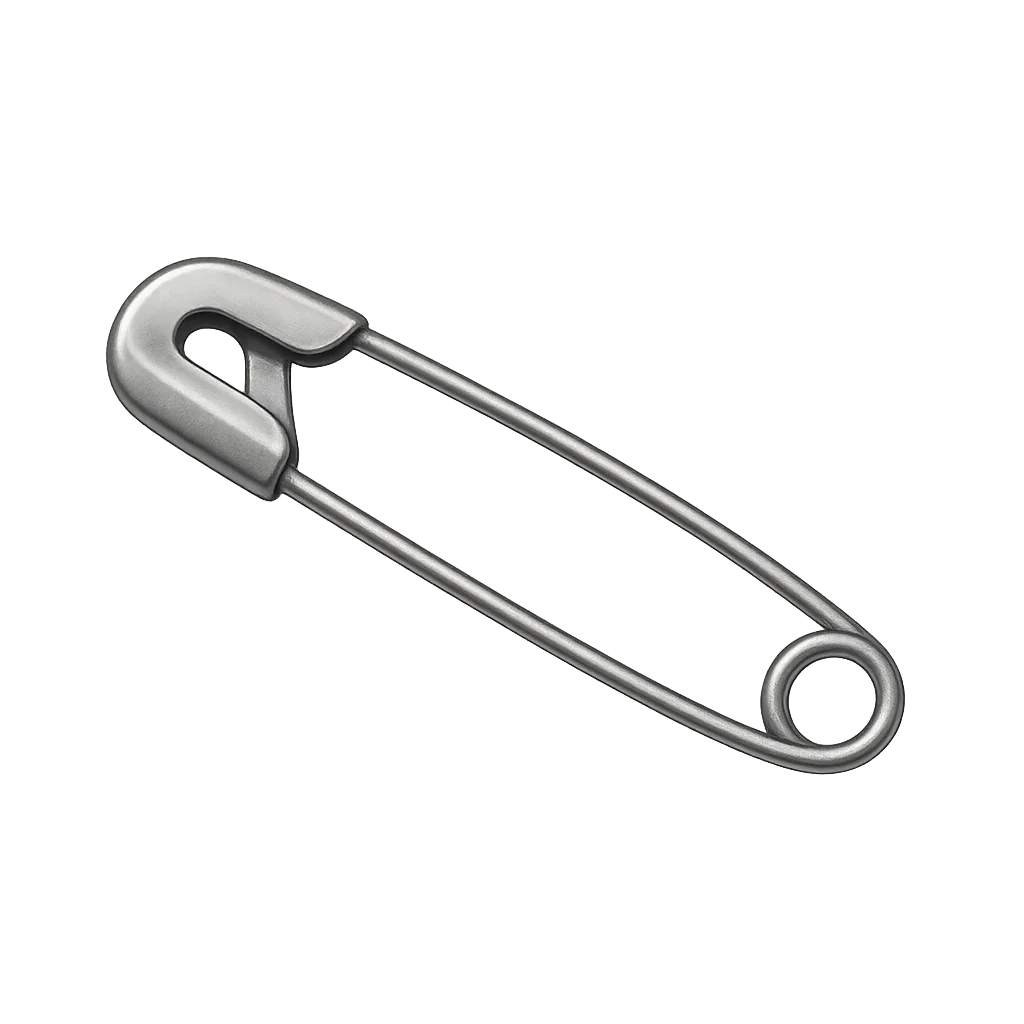
The Pointed Tale of the Safety Pin
Before you get to know me, I want you to imagine a world full of little dangers. A world where holding a baby’s diaper together or temporarily mending a torn hem came with the constant risk of a sharp poke. My name is the Safety Pin, and before I came along, my ancestors, the straight pins, were the only option. They were simple, slender pieces of metal with a sharp point on one end and a small head on the other. They did their job, but they were unapologetically pointy. They pricked fingers, snagged fabrics, and sometimes came loose at the worst possible moments. Life was a bit more precarious, you could say. It was in this world of tiny hazards that my story begins, with a man named Walter Hunt. He was an inventor living in New York, a man whose mind was always whirring with new ideas for machines and gadgets. In the year 1849, however, his mind was particularly focused. He owed a friend a debt of fifteen dollars. It wasn’t a fortune, but it was enough to weigh on him. He needed a brilliant, simple idea that he could create and sell quickly. He didn’t know it yet, but the solution to his financial problem—and a solution for countless people to come—was about to take shape in his very own hands.
One afternoon, while deep in thought, Walter picked up a piece of brass wire about eight inches long. He began to twist it and turn it, his fingers moving almost unconsciously as his mind wrestled with his problem. He twisted the middle of the wire into a neat, circular coil. He bent one end back toward the other, then fashioned a small, clever clasp on the opposite end. Suddenly, he stopped. He looked down at the object in his hand. The coil in the middle wasn't just decorative; it acted as a spring, creating tension that held the pin firmly in place. The pin’s sharp point, when closed, was now nestled safely inside the protective clasp. There was no exposed tip to poke or prick anyone. It was a pin, but it was safe. It was a flash of genius born from an idle moment. He had done it. He had invented me. He knew immediately that he had created something special, something that solved a universal problem with elegant simplicity. He wasted no time. On April 10th, 1849, he secured a patent for his creation, officially documenting me as his invention. The story of what happened next is a testament to the power of a good idea. He showed me to a company, and they immediately saw my potential. Walter sold all the rights to his patent for four hundred dollars. With that money, he paid back his fifteen-dollar debt and still had a handsome sum left over. I was proof that sometimes the most valuable solutions aren't the most complicated, but the ones that are born from a simple twist of fate.
My journey into the world was swift. I was small, inexpensive to make, and incredibly useful. One of my first and most important jobs was with the youngest members of society. I became the trusted fastener for cloth diapers, keeping them secure without ever pricking a baby’s delicate skin. Mothers everywhere breathed a sigh of relief. From the nursery, I moved into every corner of the home. I was used for quick clothing repairs, holding a fallen hem in place until it could be properly sewn. I held together papers, pinned on badges, and became an essential tool in every sewing kit. I was a humble, reliable servant. But my story took an unexpected turn in the 1970s. A new generation of musicians and artists, part of the punk rock movement, saw something different in me. They saw my simple, utilitarian form as a symbol of rebellion and a do-it-yourself attitude. They wore me on their jackets and shirts, not just as a fastener, but as a statement. I became an icon of fashion and culture, something my practical inventor, Walter Hunt, could never have imagined. From a solution to a fifteen-dollar debt to a symbol on a rockstar’s jacket, my life has been quite a journey. My story is a reminder that even the smallest and simplest of ideas can make a huge difference in the world, solving everyday problems and sometimes even changing culture itself.
Activities
Take a Quiz
Test what you learned with a fun quiz!
Get creative with colors!
Print a coloring book page of this topic.














 Free for Educators