

 English

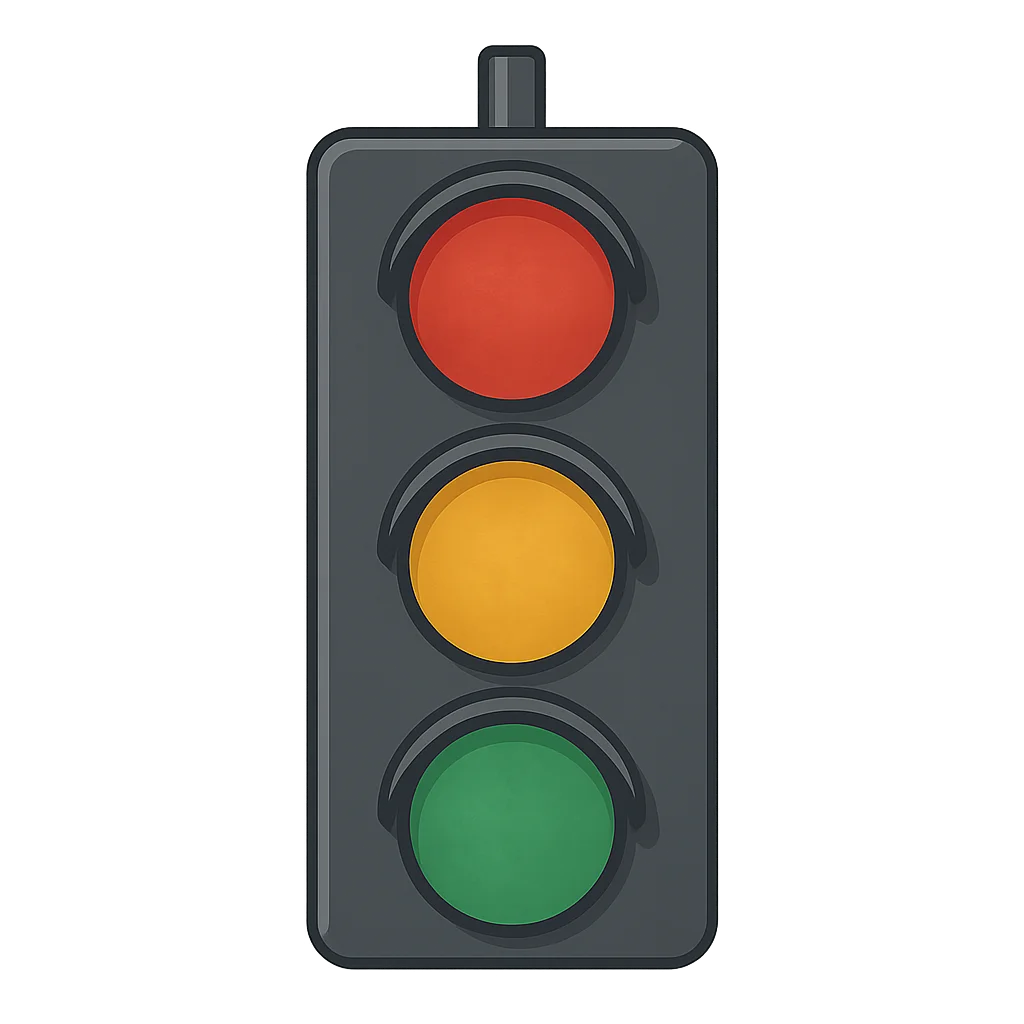
I Am the Traffic Light
Hello. You probably see me every day, standing tall at the corner of busy streets. I am the Traffic Light, and while I may seem simple with my blinking red, yellow, and green eyes, my story is one of big ideas, explosive failures, and brilliant teamwork. Before I came along, the world was a very different, and much messier, place. Imagine a street with no rules. Horse-drawn carriages clattered alongside the first noisy automobiles, which sputtered and coughed black smoke. People on bicycles swerved to avoid pedestrians who were just trying to cross the road. It was a constant tangle of movement, a dangerous jumble where crashes were common and getting anywhere was a stressful adventure. The air was filled with the sounds of shouting drivers, whinnying horses, and honking horns. Someone needed to bring order to all that chaos, and that someone was going to be me.
My story begins not with a flash of electricity, but with a flicker of fire. My earliest ancestor was born across the ocean in London, England. A railway manager named John Peake Knight saw how signals kept trains from crashing and thought, “Why not use that for streets?”. On December 9th, 1868, he put his idea into action. This first version of me was quite grand, with arms that would stick out to say “stop” or “go,” but at night, I glowed. A police officer would turn a crank to switch between a red and a green gas lamp. For a few weeks, it worked. The chaotic London intersection became a little calmer. But gas is tricky, and one cold night, a leak caused a terrible explosion that injured the police officer. My fiery career was over before it truly began. It was a scary failure, but sometimes, the biggest failures are just lessons that light the way for a much better idea to come.
My real bright idea came from America, where electricity gave me a new, safer life. On August 5th, 1914, the very first electric me was installed in Cleveland, Ohio. I was simpler then, with only two eyes: a red one for stop, and a green one for go. I was a big help, but there was still a problem. Cars would slam on their brakes when I suddenly turned red, or they would race to get through before the light changed. A police officer in Detroit, Michigan, named William Potts knew there had to be a better way. In 1920, he gave me my third eye: the yellow light. This was a brilliant idea. The yellow light became a warning, a signal to drivers to slow down and prepare to stop. It made intersections much safer. But another clever inventor, Garrett Morgan, made me even smarter. In 1923, he patented a system that included an “all-stop” period. For a moment, all my lights would be red in every direction. This cleared the whole intersection, making sure no one started moving until it was completely safe. Thanks to people like William Potts and Garrett Morgan, I wasn't just a simple switch anymore; I was a thoughtful guardian of the crossroads.
Today, my family has grown. You can find us in nearly every city and town all around the world. From the busy streets of Tokyo to the quiet corners of a small town, we stand watch. We don’t need to speak English, Spanish, or Japanese because we all share a universal language that everyone understands: Red means stop. Yellow means slow down. Green means go. We are the quiet guardians that keep the rhythm of the city flowing smoothly and safely. My journey started with a dangerous flicker of gas and grew with a safe spark of electricity, improved by the bright ideas of many different people. Looking back, I see that I am more than just a light on a pole. I am a promise of order, a symbol of safety, and a silent helper that allows millions of people to get to school, work, and home again, safely, every single day.
Activities
Take a Quiz
Test what you learned with a fun quiz!
Get creative with colors!
Print a coloring book page of this topic.













 Free for Educators