English

Voltaic Pile
The Voltaic Pile was the first electrical battery that could provide a continuous electrical current to a…
Reads at Grades 6–8 Listens at Grades 4–8
Print & create
Answer keys·No prep·Free with an account
28 worksheets · answer keys · full story · quiz · Ages 10-12 · CEFR B2
Plus adds 116,000+ more stories in 27 languages, audio for every one, and printables for all of them.
Just want Voltaic Pile?
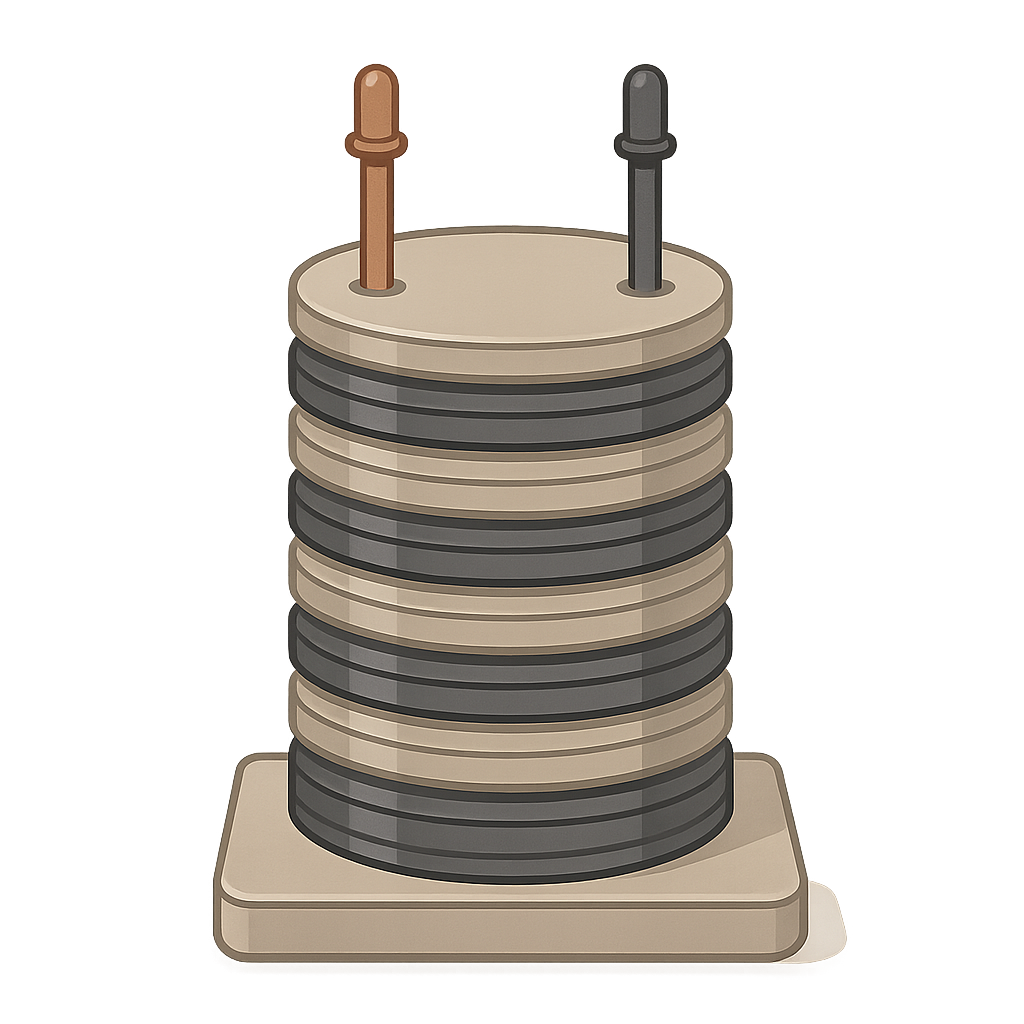
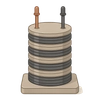
You might not think much of me at first glance. I am the Voltaic Pile, and when I was first assembled, I was just a humble stack of metal discs—copper and zinc—separated by pieces of cardboard soaked in saltwater. I wasn't shiny or impressive, just a damp, metallic column. But within my simple layers, I held a secret that would change the world. Before I came to be, electricity was a wild and mysterious thing, a flash of lightning in a stormy sky or a crackling spark from rubbing amber. It was a force of nature you could witness but never truly hold or command. The world was lit by flame and powered by muscle or steam. The idea of a quiet, steady, portable source of power was pure imagination. My story begins not with a grand plan, but with a scientific puzzle that started with a twitching frog's leg in the late 1700s. It was a small, strange observation, but it sparked a great debate between two brilliant Italian scientists, Luigi Galvani and my creator, Alessandro Volta. I was born from their disagreement, a testament to how curiosity can turn a simple question into a revolution.
It all started around the year 1780. A scientist named Luigi Galvani was conducting experiments and noticed something peculiar. When he touched a dead frog's leg with two different types of metal, the leg twitched as if it were still alive. He was astonished. He believed he had discovered a new kind of energy, an electrical fluid flowing within living things, which he called 'animal electricity.' For a time, this was a thrilling idea that captured the imagination of the scientific community. But another scientist, my creator Alessandro Volta, was skeptical. He was a thoughtful and methodical man, and he suspected the frog was not the source of the electricity, but merely a detector of it. He believed the true source was the contact between the two different metals. This disagreement set him on a long path of experimentation that would last for years. Patiently, he tested every combination he could think of. He tried different pairs of metals and different liquids to separate them, which he called 'electromotive fluids.' He would touch a strip of zinc to his tongue, then a strip of copper, and when they were connected, he felt a strange, sour taste—a sign of a weak electrical current. He carefully noted which pairings produced the strongest effect. Finally, in the year 1800, he found the perfect arrangement. He built a column, a pile: a disc of zinc, then a piece of brine-soaked cardboard, then a disc of copper. He repeated this pattern over and over, stacking them high. With each new layer, I grew stronger. I wasn't just creating a spark; I was producing a continuous, flowing current. On March 20th, 1800, Alessandro Volta wrote a detailed letter to the Royal Society of London, proudly announcing my existence to the world. I was born.
The Voltaic Pile: A Story of First Power
You might not think much of me at first glance. I am the Voltaic Pile, and when I was first assembled, I was just a humble stack of metal discs—copper and zinc—separated by pieces of cardboard soaked in saltwater. I wasn't shiny or impressive, just a damp, metallic column. But within my simple layers, I held a secret that would change the world. Before I came to be, electricity was a wild and mysterious thing, a flash of lightning in a stormy sky or a crackling spark from rubbing amber. It was a force of nature you could witness but never truly hold or command. The world was lit by flame and powered by muscle or steam. The idea of a quiet, steady, portable source of power was pure imagination. My story begins not with a grand plan, but with a scientific puzzle that started with a twitching frog's leg in the late 1700s. It was a small, strange observation, but it sparked a great debate between two brilliant Italian scientists, Luigi Galvani and my creator, Alessandro Volta. I was born from their disagreement, a testament to how curiosity can turn a simple question into a revolution.
It all started around the year 1780. A scientist named Luigi Galvani was conducting experiments and noticed something peculiar. When he touched a dead frog's leg with two different types of metal, the leg twitched as if it were still alive. He was astonished. He believed he had discovered a new kind of energy, an electrical fluid flowing within living things, which he called 'animal electricity.' For a time, this was a thrilling idea that captured the imagination of the scientific community. But another scientist, my creator Alessandro Volta, was skeptical. He was a thoughtful and methodical man, and he suspected the frog was not the source of the electricity, but merely a detector of it. He believed the true source was the contact between the two different metals. This disagreement set him on a long path of experimentation that would last for years. Patiently, he tested every combination he could think of. He tried different pairs of metals and different liquids to separate them, which he called 'electromotive fluids.' He would touch a strip of zinc to his tongue, then a strip of copper, and when they were connected, he felt a strange, sour taste—a sign of a weak electrical current. He carefully noted which pairings produced the strongest effect. Finally, in the year 1800, he found the perfect arrangement. He built a column, a pile: a disc of zinc, then a piece of brine-soaked cardboard, then a disc of copper. He repeated this pattern over and over, stacking them high. With each new layer, I grew stronger. I wasn't just creating a spark; I was producing a continuous, flowing current. On March 20th, 1800, Alessandro Volta wrote a detailed letter to the Royal Society of London, proudly announcing my existence to the world. I was born.
My arrival caused an immediate sensation. For centuries, the only electricity scientists could study came from static electricity generators that produced a powerful but fleeting zap. It was like trying to study a river by looking at a single, quick splash. I changed everything. I was the river itself—a constant, reliable stream of electrical current that could be controlled and directed. Scientists everywhere were eager to see what I could do. Just weeks after Volta's announcement, two English scientists, William Nicholson and Anthony Carlisle, connected me to a container of water. They watched in amazement as bubbles began to rise from the wires. I was splitting water into its fundamental elements: hydrogen and oxygen. This process, called electrolysis, opened up a whole new field of chemistry. I became the must-have tool for every serious laboratory. The famous chemist Sir Humphry Davy built enormous versions of me at the Royal Institution in London, with hundreds and hundreds of my paired plates. With my immense power, he was able to melt substances that were previously thought to be indestructible and, in doing so, he discovered brand new chemical elements like sodium, potassium, calcium, and magnesium. I was no longer just a curious pile of metal; I was the key that unlocked the very building blocks of matter, revealing a hidden world that scientists had only dreamed of exploring.
My journey was only the beginning. I must admit, I wasn't perfect. I could be a bit messy, with my saltwater-soaked layers, and my power would eventually fade as the chemical reactions slowed down. More efficient and longer-lasting designs would soon follow. But my legacy was secure. I was the very first battery. I am the great-great-great-grandparent of every battery that exists today, from the tiny one in your watch to the powerful ones that run electric cars and store energy from the sun. The fundamental principle that my creator discovered—that a chemical reaction between different materials could produce a steady electrical current—is still the heart of how we carry power in our pockets and make technology portable. My story is a reminder that sometimes the most world-changing inventions come not from a single moment of genius, but from patient curiosity, careful observation, and even a friendly scientific disagreement. And as a final honor to the man who stacked me into existence, the very unit used to measure electrical potential was named the 'volt.' So every time you see that word, you can remember my creator, Alessandro Volta, and me, the humble pile that first taught humanity how to hold the power of lightning in its hands.
Wow facts
About
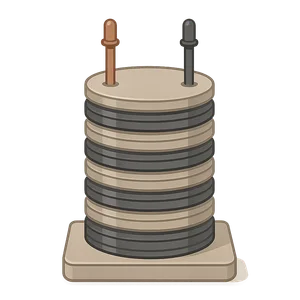
The Voltaic Pile was the first electrical battery that could provide a continuous electrical current to a circuit. Invented by Alessandro Volta in 1800, it was made of a stack of copper and zinc discs separated by brine-soaked cloth or cardboard.
Take a Quiz
Question 1 of 5
Retell the key events that led to the invention of the Voltaic Pile, starting with Luigi Galvani's experiment.
Explore next





Want to do even more?
Go beyond exploring. Unlock tools that turn every story into real learning.

Storypie Plus for families
Full stories, quizzes, and printables. Nights and car rides, sorted.
- Unlimited audio stories
- Create Mode: your child stars in the story
- Offline downloads
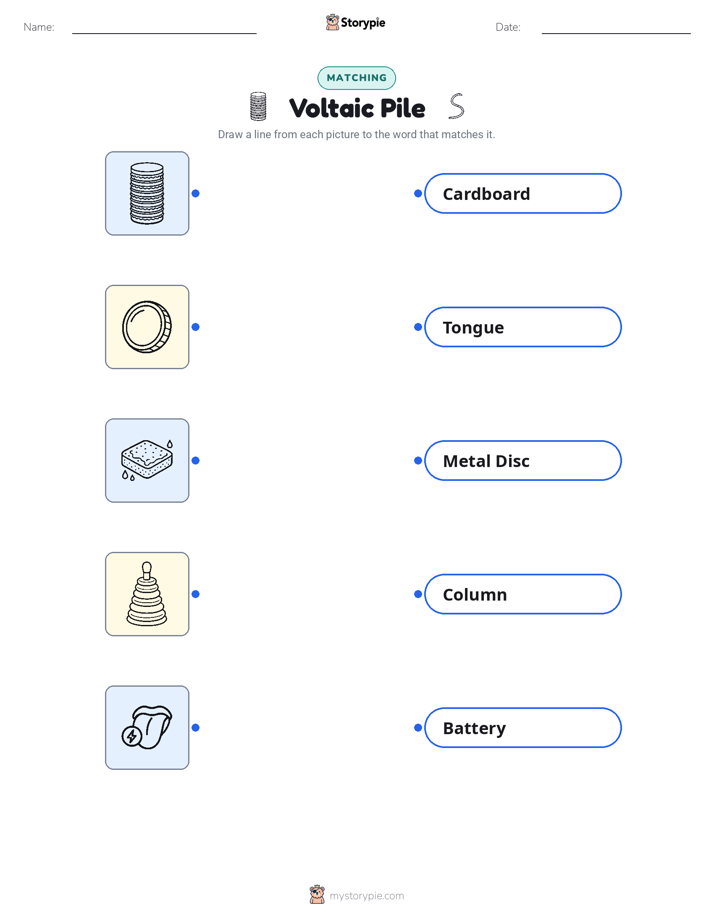
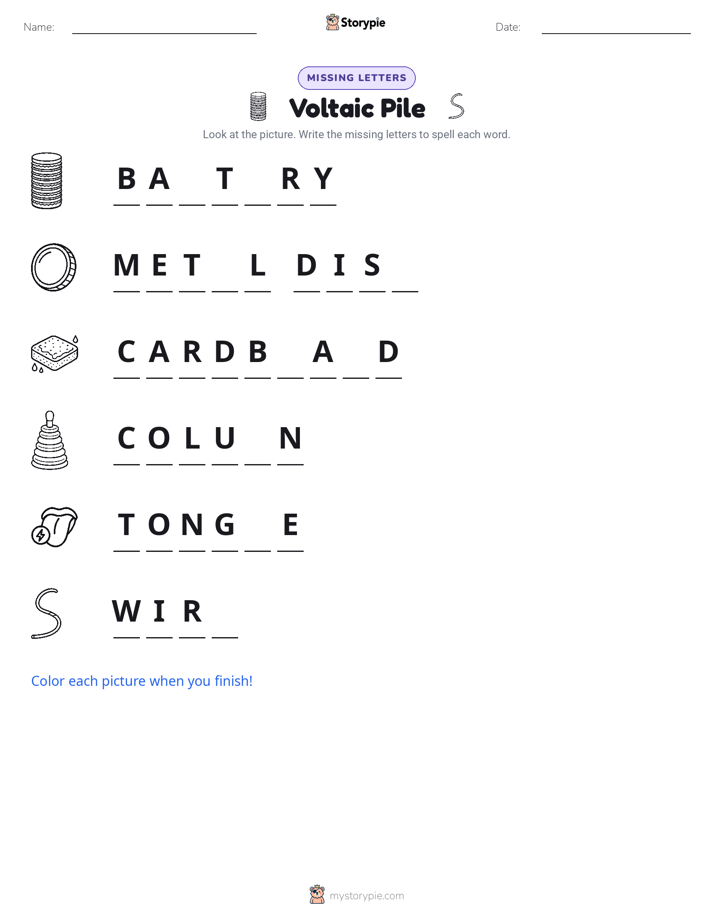
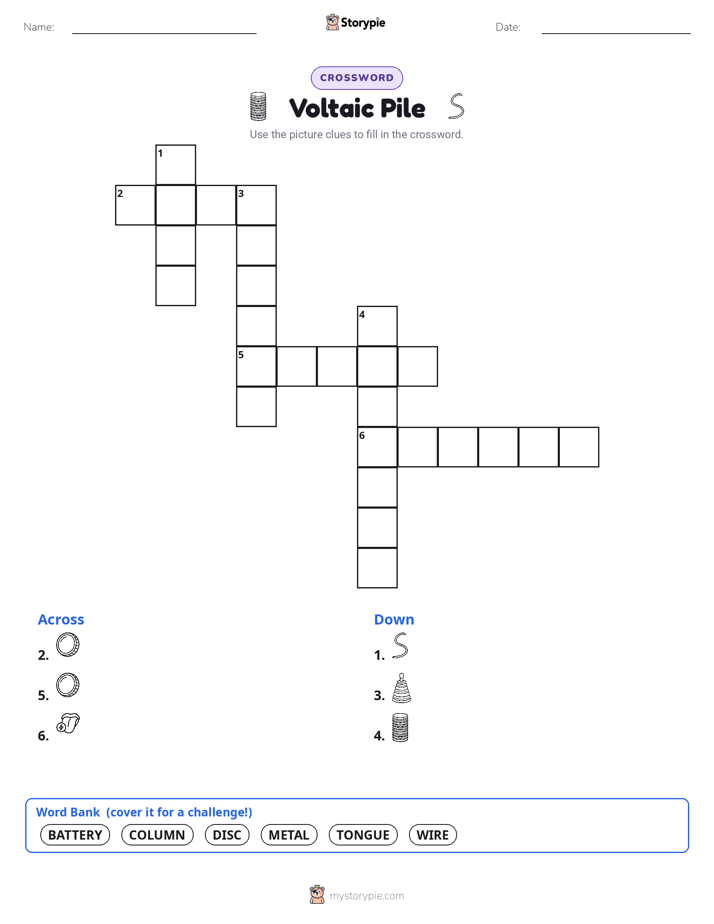
- Printable worksheets & coloring pages

Why Storypie for Schools
Students engaged. Prep in seconds. Evenings back to you.
- Worksheets & Quizzes
- Classroom Management
- Formative Assessment
- Custom Curriculum & Lesson Plans
- 27 Languages

Why Storypie for Homeschool
Curriculum done. They'll ask for more. Hours back in your day.
- Worksheet Generator
- First-Person Audio Stories
- Built-in Comprehension Quizzes
- Custom Curriculum & Lesson Plans
- Print & Go Activities