A Bear of a Tale
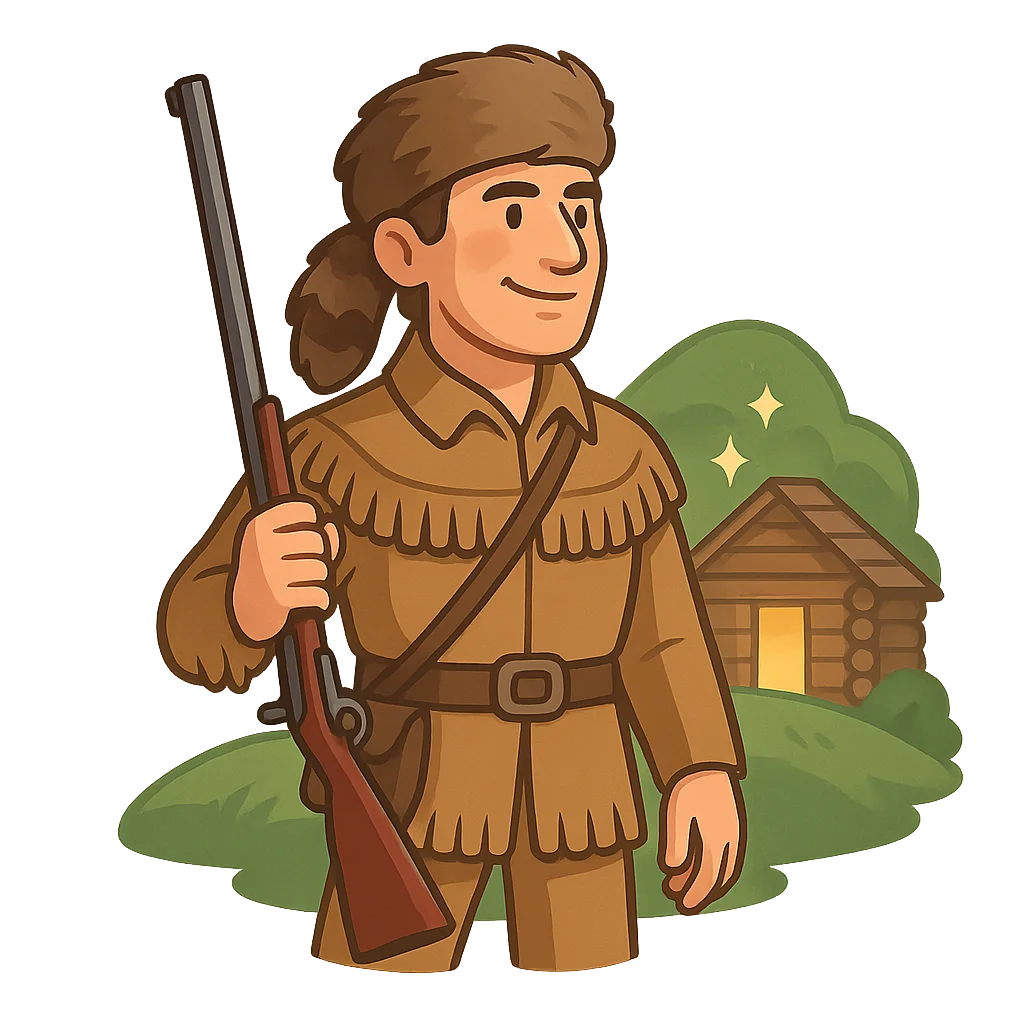
Howdy! The name's Davy Crockett, and the wild American frontier was my home, my playground, and the place where my story grew taller than the oldest oak tree. Back in the early 1800s, this land was a vast, untamed wilderness of shadowy forests, roaring rivers, and mountains that scraped the sky. It was a place where a man had to be tough, quick-witted, and maybe just a little bit larger than life to get by. Folks would gather 'round the campfire at night, and with the flames dancing and the coyotes howling, they'd spin yarns to pass the time. My own adventures got caught up in those yarns, and before I knew it, the stories about me became a legend all their own. They started calling me the 'King of the Wild Frontier,' and the tales they told were about the legend of Davy Crockett. This is the story of how a real man from the mountains of Tennessee became an American tall tale, a symbol of the grit and spirit of a young nation finding its way.
Now, a good story needs a little spice, and the folks telling mine sure didn't hold back. They said I was born on a mountaintop in Tennessee and that I could ride a streak of lightning and tote a hurricane in my pocket. One of the most famous tales they told was about the time I met the biggest, meanest bear in the whole state. Instead of reaching for my rifle, Old Betsy, I just stared that bear right in the eyes and gave him my best grin. They say my grin was so powerful it scared the bark right off a tree, and that bear? He just turned tail and ran! Then there was the story of the 'Great Freeze of '36,' when the sun got stuck and the whole world froze solid. The storytellers claimed I put bear grease on the Earth's frozen axle, gave it a mighty kick, and sent it spinning again, saving everyone from an icy end. These stories were told in almanacs, little books filled with jokes, weather predictions, and fantastic tales. People read them, laughed, and passed them on, and with each telling, my adventures grew wilder. Did I really wrestle an alligator and tie him in a knot? Did I ride a comet across the sky? Well, a good frontiersman never lets the plain truth get in the way of a great story.
Beneath all those tall tales, though, was a real fella named David Crockett, born on August 17th, 1786. I wasn't born on a mountaintop, but in a small cabin in East Tennessee. I learned to hunt and track before I could hardly write my own name. The frontier was my teacher, and it taught me to be honest, to work hard, and to stand up for my neighbors. My motto was simple: 'Be sure you're right, then go ahead.' It was this belief that led me away from the forest and into the world of politics. I served the people of Tennessee in the United States Congress. I wore my buckskin clothes right into the halls of government because I wanted everyone to remember where I came from and who I was fighting for—the common folk. I wasn't always popular, especially when I stood up against President Andrew Jackson to defend the rights of Native Americans who were being forced from their lands. It wasn't the easy path, but it was the right one. That part of my story isn't as flashy as wrestling a bear, but it's the part I'm proudest of. It shows that courage isn't just about facing wild animals; it's about facing down injustice, too.
A last Stand for Freedom
My path eventually led me to Texas, a place fighting for its own freedom. I ended up at a small, dusty mission called the Alamo. There, alongside about 200 other brave men, we made a stand against a much larger army. We knew the odds were against us, but we believed in the cause of liberty. For 13 days, we held our ground. The fight was fierce, and in the end, on the morning of March 6th, 1836, we were overcome. We all lost our lives that day, but our stand at the Alamo wasn't a failure. It became a rallying cry: 'Remember the Alamo!' Our sacrifice inspired others to pick up the fight, and soon after, Texas won its independence. That final battle became the last chapter of my life, but it was the chapter that sealed my legend. It blended the real man who fought for what he believed in with the mythical hero who was never afraid of a fight, no matter the odds.
The Legend Lives On
So, who was Davy Crockett? Was I the man who could grin down a bear, or the congressman who fought for the underdog? I reckon I was a bit of both. My story, a mix of fact and folklore, became a symbol of the American spirit—adventurous, independent, and always ready to stand for what's right. For generations, people have shared my tales in books, songs, and movies, each one capturing a piece of that frontier spirit. The stories were first shared to entertain and to create a hero for a young country, a hero who was strong, brave, and a little bit wild. Today, my legend isn't just about history; it's a reminder that there's a little bit of the 'King of the Wild Frontier' in everyone. It’s the part of you that wants to explore, to be courageous in the face of challenges, and to write your own great story. And that's a tale worth telling for a long, long time.
Reading Comprehension Questions
Click to see answer