English

Legend of the Eagle and the Serpent
The Aztec (Mexica) origin myth that prophesied the location for the founding of their capital city…
Reads at Grades 6–8 Listens at Grades 4–8
Print & create
Answer keys·No prep·Free with an account
28 worksheets · answer keys · full story · quiz · Ages 10-12 · CEFR B2
Plus adds 244,000+ more stories in 27 languages, audio for every one, and printables for all of them.
Just want Legend of the Eagle and the Serpent?
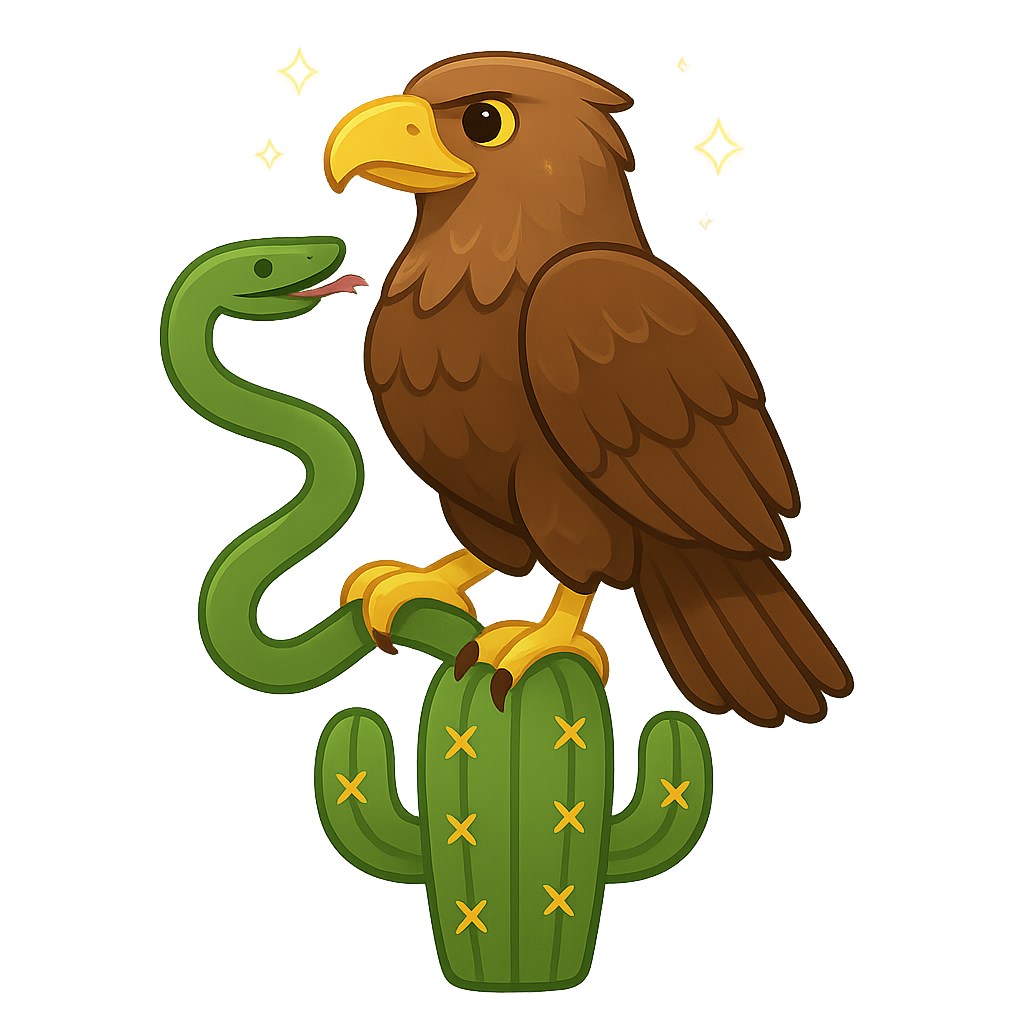
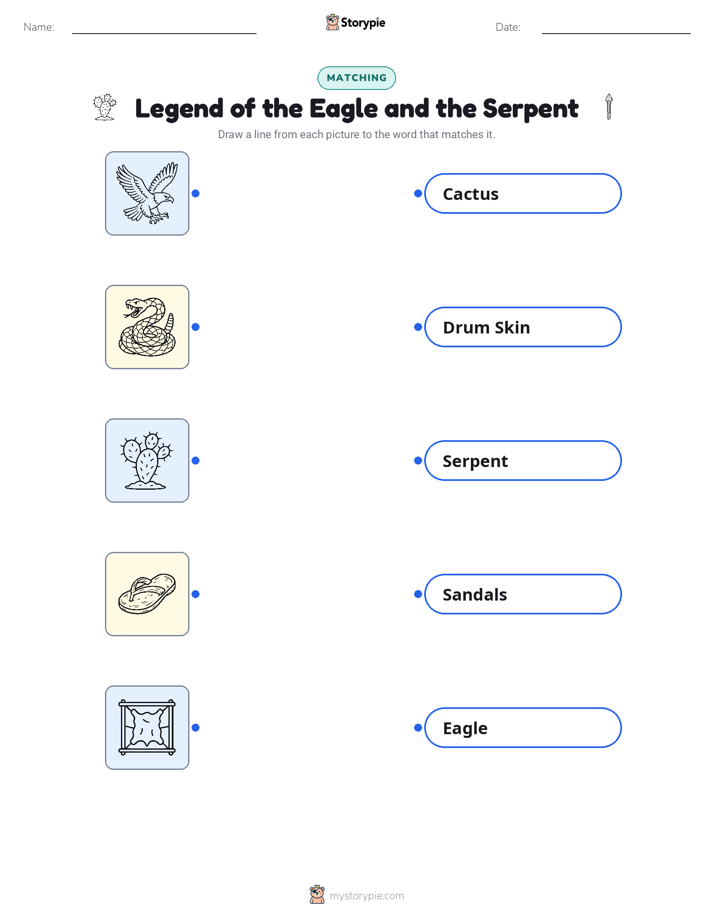
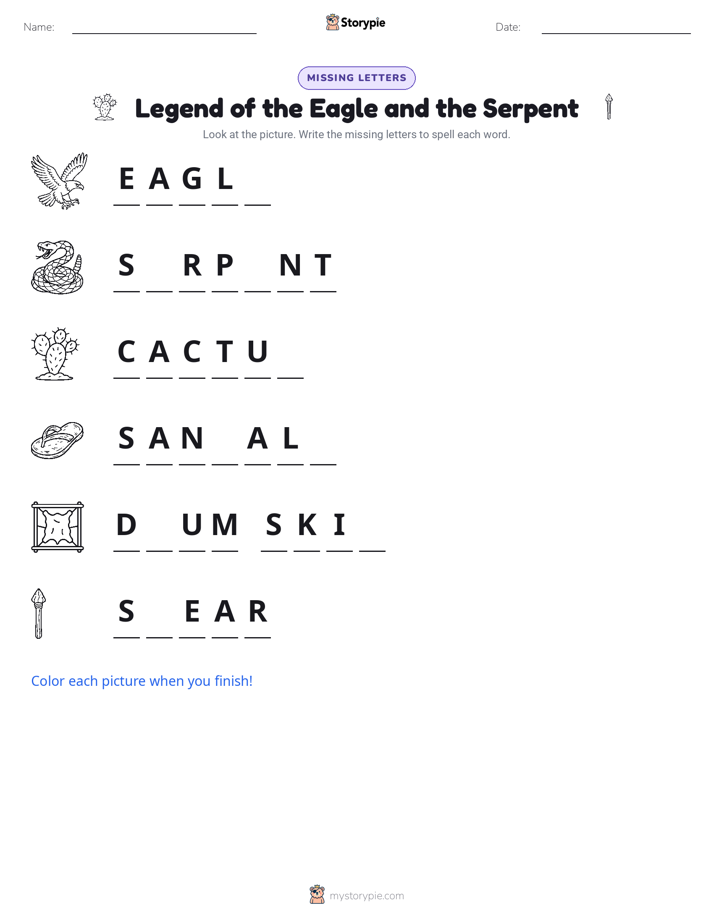
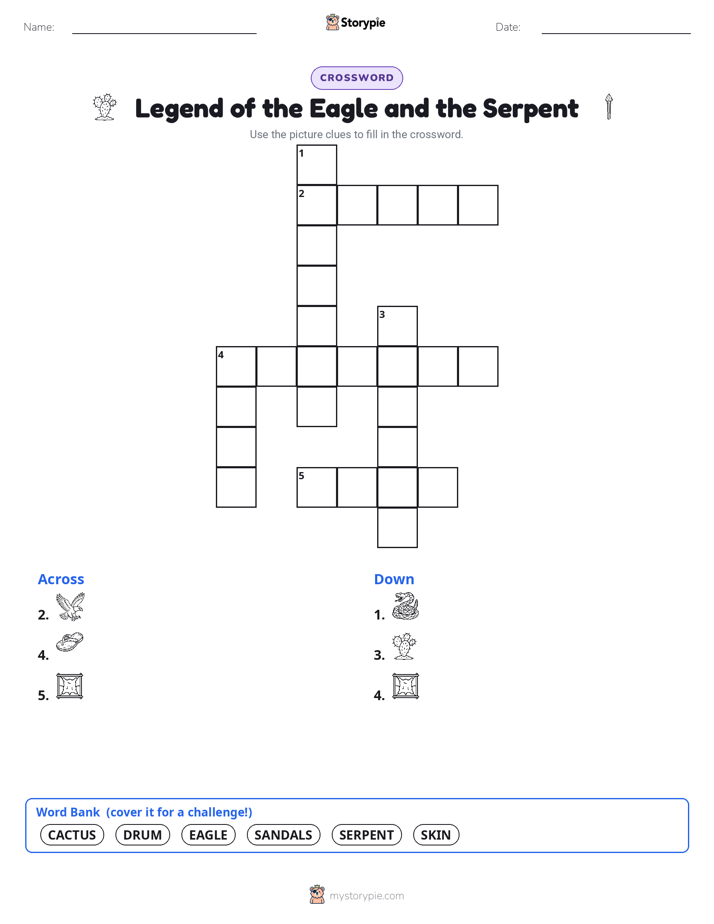
My name is Tēucpatl, and I was a priest of the Mexica people when our world was still being born. I remember the weariness in our bones as we journeyed through harsh deserts and unfamiliar valleys, our sandals worn thin and our spirits stretched taut like a drum skin. We were carrying the hope of a promised land, a whispered secret from our god that fueled us when food was scarce and the path ahead seemed to vanish into the horizon. For generations, we had walked, guided by the words of our powerful god, Huitzilopochtli, who had spoken to our ancestors in visions that burned as brightly as the midday sun. He commanded us to leave our ancestral home of Aztlan and search for a new one, a place we would recognize by an extraordinary, almost unbelievable sign. This journey, and the sign we sought, is the story known as the Legend of the Eagle and the Serpent. Our people were nomads, wanderers with a fierce heart but no earth to call our own. We faced scarcity that hollowed our cheeks, doubt that crept into our dreams, and the hostility of other tribes who saw our dust cloud on the horizon and sharpened their spears. Yet, we held onto the prophecy, repeating it like a prayer in the cold nights. "You will find," Huitzilopochtli had promised, "a place where an eagle stands triumphant upon a nopal cactus, devouring a serpent. There, you will build your city and your name will be known across the world." When we finally arrived in the Valley of Mexico, it felt like a paradise. The basin shimmered with five great lakes, a mirror for the sky, and the land was green and fertile. But this paradise was already claimed. The powerful tribes who lived there looked at us with suspicion and offered us only the land they deemed worthless. We were forced to the swampy, unwelcoming shores of Lake Texcoco, a place of buzzing insects, slithering snakes, and mud that clung to everything. It felt like the end of our quest, a final, cruel joke. But our faith, though tested and frayed, was not yet broken.
The Eagle, the Serpent, and the City of Destiny
My name is Tēucpatl, and I was a priest of the Mexica people when our world was still being born. I remember the weariness in our bones as we journeyed through harsh deserts and unfamiliar valleys, our sandals worn thin and our spirits stretched taut like a drum skin. We were carrying the hope of a promised land, a whispered secret from our god that fueled us when food was scarce and the path ahead seemed to vanish into the horizon. For generations, we had walked, guided by the words of our powerful god, Huitzilopochtli, who had spoken to our ancestors in visions that burned as brightly as the midday sun. He commanded us to leave our ancestral home of Aztlan and search for a new one, a place we would recognize by an extraordinary, almost unbelievable sign. This journey, and the sign we sought, is the story known as the Legend of the Eagle and the Serpent. Our people were nomads, wanderers with a fierce heart but no earth to call our own. We faced scarcity that hollowed our cheeks, doubt that crept into our dreams, and the hostility of other tribes who saw our dust cloud on the horizon and sharpened their spears. Yet, we held onto the prophecy, repeating it like a prayer in the cold nights. "You will find," Huitzilopochtli had promised, "a place where an eagle stands triumphant upon a nopal cactus, devouring a serpent. There, you will build your city and your name will be known across the world." When we finally arrived in the Valley of Mexico, it felt like a paradise. The basin shimmered with five great lakes, a mirror for the sky, and the land was green and fertile. But this paradise was already claimed. The powerful tribes who lived there looked at us with suspicion and offered us only the land they deemed worthless. We were forced to the swampy, unwelcoming shores of Lake Texcoco, a place of buzzing insects, slithering snakes, and mud that clung to everything. It felt like the end of our quest, a final, cruel joke. But our faith, though tested and frayed, was not yet broken.
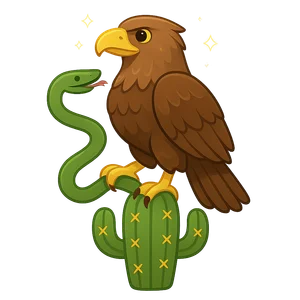
The days on the swampy island were a test of our very soul. The air was thick with moisture and the smell of decay, and the ground beneath our feet was unstable. Our spirits, once so resilient, were now as waterlogged as the earth. Many began to mutter that we had misunderstood the prophecy, or worse, that our great god had abandoned us to this miserable fate. "Perhaps the sign was a metaphor," one elder suggested, his voice heavy with disappointment. "Perhaps we were meant to be as strong as the eagle, not to find one." Doubt was a poison spreading through our camp. It was on a morning like any other, on what historians would later call a day in the year 1325, that everything changed. Our scouts, who had gone out at dawn, returned not with tales of game or enemies, but with breathless urgency. Their eyes were wide with an emotion I had never seen before: not fear, but pure, unadulterated awe. They spoke in frantic, hushed tones, gesturing for our leaders to follow. I walked with them, my heart pounding a rhythm of both hope and dread, through the thick reeds to a small, muddy islet we had previously overlooked. And there it was. The world seemed to fall silent, every buzzing insect and lapping wave holding its breath. Bathed in the golden morning light, a magnificent golden eagle was perched atop a prickly pear cactus that grew defiantly from the mud. Its powerful talons, sharp as obsidian knives, gripped the thorny plant without effort. Its feathers shone like hammered gold, a beacon of celestial light in this dreary swamp. In its strong, curved beak, it held a writhing rattlesnake, a symbol of the earth and the underworld, its scales glittering as it struggled in vain. The eagle was a creature of the sky and the sun; the serpent, a creature of the earth and darkness. In that single, frozen moment, we saw not just a bird eating its prey, but the entire cosmos in perfect balance. It was the triumph of the sun over the darkness, of our divine destiny over our earthly struggles. It was exactly as Huitzilopochtli had described. A quiet reverence fell over our people. Tears streamed down weathered faces. This was not just land; it was our destiny made manifest. We had been led here for a reason. This was the place we would build our home.
On that very island, a place others had scorned, we began to build our city. We called it Tenochtitlan, which means "the place of the prickly pear cactus," to honor the sign that had ended our long pilgrimage. The work was monumental. We drove thousands of wooden stakes deep into the soft lakebed to create a stable foundation. We ingeniously created floating gardens, which we called chinampas, by weaving webs of reeds and piling nutrient-rich mud on top, allowing us to grow bountiful crops of maize, beans, and flowers right on the water. We built great stone causeways to connect our island city to the mainland and dug canals that served as our streets, bustling with canoes carrying goods and people. From that muddy islet, a magnificent city of towering pyramids, grand palaces, and vibrant markets rose as if by magic, eventually becoming one of the greatest and most populous cities in the entire world. The story of the eagle and the serpent became our founding truth, the very heart of our identity as the Mexica. It was more than a story; it was a constant reminder that we were a chosen people with a divine purpose. It taught us that even from the most humble and difficult beginnings, greatness could rise. The story was told to every child, carved into stone monuments, and painted in our sacred books for all to see. Centuries have passed since I lived, and Tenochtitlan is now buried beneath the sprawling, modern metropolis of Mexico City. But the legend has not been forgotten. Today, that same powerful image of the eagle, the serpent, and the cactus is the coat of arms emblazoned at the center of the Mexican flag. It flies proudly over schools, government buildings, and homes, a daily reminder of the nation's incredible origins. This ancient story of hope, perseverance, and destiny continues to inspire artists, poets, and all people who see it, connecting them to the deep history of the land and the enduring strength of its people. It shows us that a home is not just a place you find, but a destiny you build.
Wow facts
About
The Aztec (Mexica) origin myth that prophesied the location for the founding of their capital city, Tenochtitlan. The sign was an eagle devouring a serpent while perched on a nopal cactus.
Take a Quiz
Question 1 of 5
Why did the Mexica people endure such a long and difficult journey to the Valley of Mexico?
Explore next




Want to do even more?
Go beyond exploring. Unlock tools that turn every story into real learning.

Storypie Plus for families
Full stories, quizzes, and printables. Nights and car rides, sorted.
- Unlimited audio stories
- Create Mode: your child stars in the story
- Offline downloads
- Printable worksheets & coloring pages

Why Storypie for Schools
Students engaged. Prep in seconds. Evenings back to you.
- Worksheets & Quizzes
- Classroom Management
- Formative Assessment
- Custom Curriculum & Lesson Plans
- 27 Languages

Why Storypie for Homeschool
Curriculum done. They'll ask for more. Hours back in your day.
- Worksheet Generator
- First-Person Audio Stories
- Built-in Comprehension Quizzes
- Custom Curriculum & Lesson Plans
- Print & Go Activities