English


The Headless Horseman - American
The Headless Horseman is the ghostly figure from Washington Irving's 1820 short story…
Reads at Grades 3–5 Listens at Grades 1–5
Print & create
Answer keys·No prep·Free with an account
28 worksheets · answer keys · full story · quiz · Ages 8-10 · CEFR B1
Plus adds 279,000+ more stories in 27 languages, audio for every one, and printables for all of them.
Just want The Headless Horseman - American?

My name is Ichabod Crane, and not so long ago, I was the schoolmaster in a drowsy, dreamy little place called Sleepy Hollow. The valley was nestled along the Hudson River, and the air there always felt heavy with quiet magic and spooky stories. Every hoot of an owl or snap of a twig seemed to whisper of ghosts and strange happenings from long ago. People who lived there seemed to move a little slower, dream a little bigger, and believe a little more in the supernatural. Of all the tales they told around their crackling fires, the most famous and fearsome was the legend of The Headless Horseman.
One crisp autumn night, I attended a grand party at the farm of the wealthy Van Tassel family. The barn was aglow with lanterns, and the air was sweet with the scent of spiced cider and pumpkin pie. After we danced and feasted, we all gathered to tell ghost stories. The local farmers spoke of the Galloping Hessian, the ghost of a soldier who had lost his head to a cannonball during the Revolutionary War. They said his spirit was trapped, forever riding through the hollow on his powerful black horse, searching for his lost head before sunrise. They warned that he was often seen near the Old Dutch Burying Ground and that the safest place to be was across the covered bridge by the church, for he could not cross it.
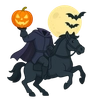
As I rode my old horse, Gunpowder, home that night, the moon cast long, spooky shadows through the bare trees. The stories from the party echoed in my mind, and my imagination turned every stump and rustling bush into something frightening. Suddenly, I heard another set of hooves thundering behind me. I turned to look and my heart leaped into my throat. There he was—a towering figure on a massive steed, just as the stories described. And in his hand, where his head should have been, he carried a glowing jack-o'-lantern! Fear gave me speed, and I urged Gunpowder to race for the church bridge. The horseman chased me, his horse's hooves shaking the very ground. I made it to the bridge, thinking I was safe, but as I glanced back, I saw him raise his arm and hurl the fiery pumpkin straight at me.
The Legend of Sleepy Hollow
My name is Ichabod Crane, and not so long ago, I was the schoolmaster in a drowsy, dreamy little place called Sleepy Hollow. The valley was nestled along the Hudson River, and the air there always felt heavy with quiet magic and spooky stories. Every hoot of an owl or snap of a twig seemed to whisper of ghosts and strange happenings from long ago. People who lived there seemed to move a little slower, dream a little bigger, and believe a little more in the supernatural. Of all the tales they told around their crackling fires, the most famous and fearsome was the legend of The Headless Horseman.
One crisp autumn night, I attended a grand party at the farm of the wealthy Van Tassel family. The barn was aglow with lanterns, and the air was sweet with the scent of spiced cider and pumpkin pie. After we danced and feasted, we all gathered to tell ghost stories. The local farmers spoke of the Galloping Hessian, the ghost of a soldier who had lost his head to a cannonball during the Revolutionary War. They said his spirit was trapped, forever riding through the hollow on his powerful black horse, searching for his lost head before sunrise. They warned that he was often seen near the Old Dutch Burying Ground and that the safest place to be was across the covered bridge by the church, for he could not cross it.
As I rode my old horse, Gunpowder, home that night, the moon cast long, spooky shadows through the bare trees. The stories from the party echoed in my mind, and my imagination turned every stump and rustling bush into something frightening. Suddenly, I heard another set of hooves thundering behind me. I turned to look and my heart leaped into my throat. There he was—a towering figure on a massive steed, just as the stories described. And in his hand, where his head should have been, he carried a glowing jack-o'-lantern! Fear gave me speed, and I urged Gunpowder to race for the church bridge. The horseman chased me, his horse's hooves shaking the very ground. I made it to the bridge, thinking I was safe, but as I glanced back, I saw him raise his arm and hurl the fiery pumpkin straight at me.
After that night, I was never seen in Sleepy Hollow again. The next morning, villagers found my hat lying in the dirt and, beside it, the mysterious remains of a shattered pumpkin. My story became woven into the town's folklore, another spooky chapter in the legend of the Headless Horseman. This tale, first written down by an author named Washington Irving, has become one of America's most famous ghost stories. It reminds us of the thrill of a spooky night and the power of our imaginations. Today, the story inspires Halloween costumes, movies, and parades, and people visit the real Sleepy Hollow in New York to feel the mystery for themselves. The legend of the Headless Horseman continues to gallop through our dreams, a timeless story that connects us to the past and the fun of a good scare.
Wow facts
About
The Headless Horseman is the ghostly figure from Washington Irving's 1820 short story, 'The Legend of Sleepy Hollow,' said to be a Hessian soldier who lost his head to a cannonball during the American Revolutionary War and now haunts the village of Sleepy Hollow.
Take a Quiz
Question 1 of 5
The story says Sleepy Hollow was a 'drowsy, dreamy little place.' What do you think 'drowsy' means in this sentence?
Explore next




Want to do even more?
Go beyond exploring. Unlock tools that turn every story into real learning.

Storypie Plus for families
Full stories, quizzes, and printables. Nights and car rides, sorted.
- Unlimited audio stories
- Create Mode: your child stars in the story
- Offline downloads
- Printable worksheets & coloring pages

Why Storypie for Schools
Students engaged. Prep in seconds. Evenings back to you.
- Worksheets & Quizzes
- Classroom Management
- Formative Assessment
- Custom Curriculum & Lesson Plans
- 27 Languages

Why Storypie for Homeschool
Curriculum done. They'll ask for more. Hours back in your day.
- Worksheet Generator
- First-Person Audio Stories
- Built-in Comprehension Quizzes
- Custom Curriculum & Lesson Plans
- Print & Go Activities