English

Crete
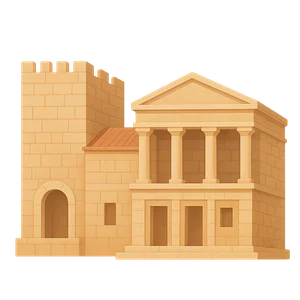
The largest of the Greek islands, Crete is renowned for its ancient Minoan civilization…
Reads at Grades 6–8 Listens at Grades 4–8
Print & create
Answer keys·No prep·Free with an account
28 worksheets · answer keys · full story · quiz · Ages 10-12 · CEFR B2
Plus adds 208,000+ more stories in 27 languages, audio for every one, and printables for all of them.
Just want Crete?
Feel the warm Mediterranean sun on your skin and breathe in the scent of wild herbs and ancient olive groves. Listen closely, and you can hear the rhythm of waves washing over shores of sand and stone. All around you, rugged mountains rise to meet a brilliant blue sky, holding secrets thousands of years old. I am a place where myths feel real and history is carved into the very landscape. I am an island of myths and memories. I am Crete.
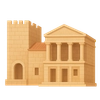
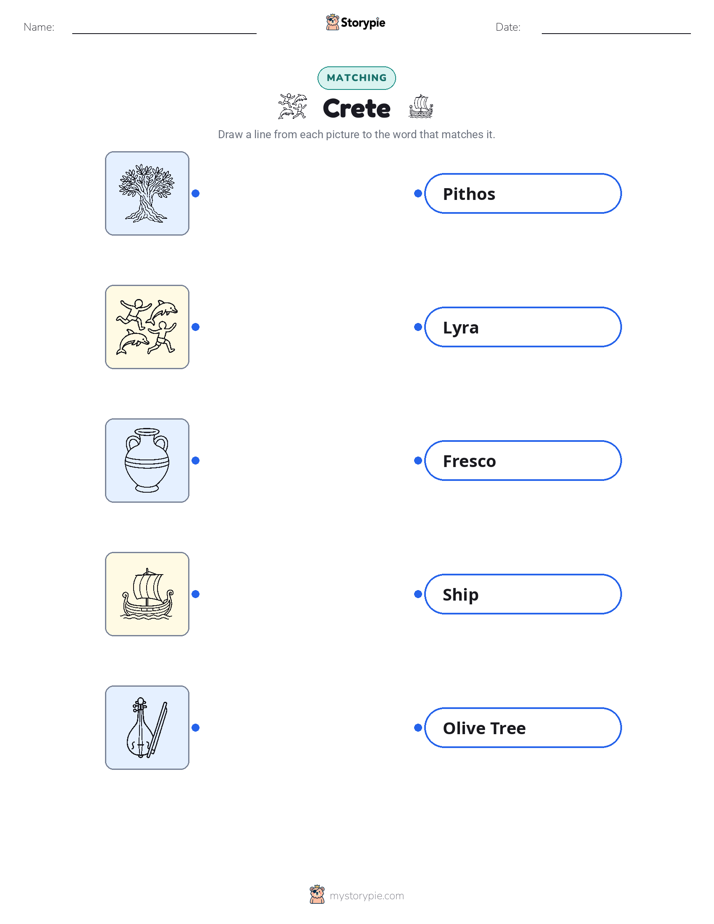
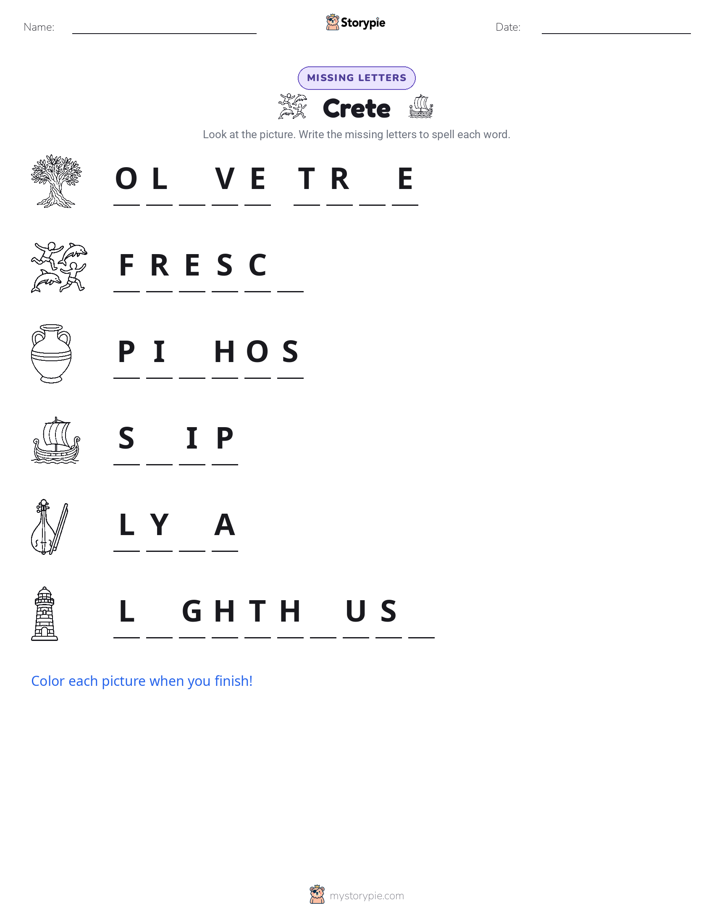
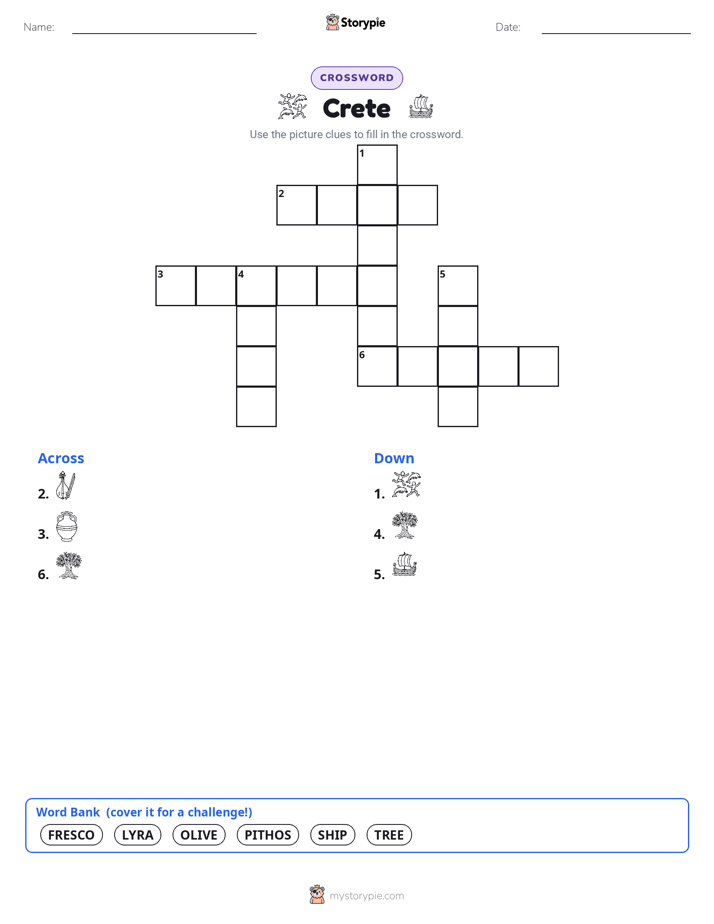
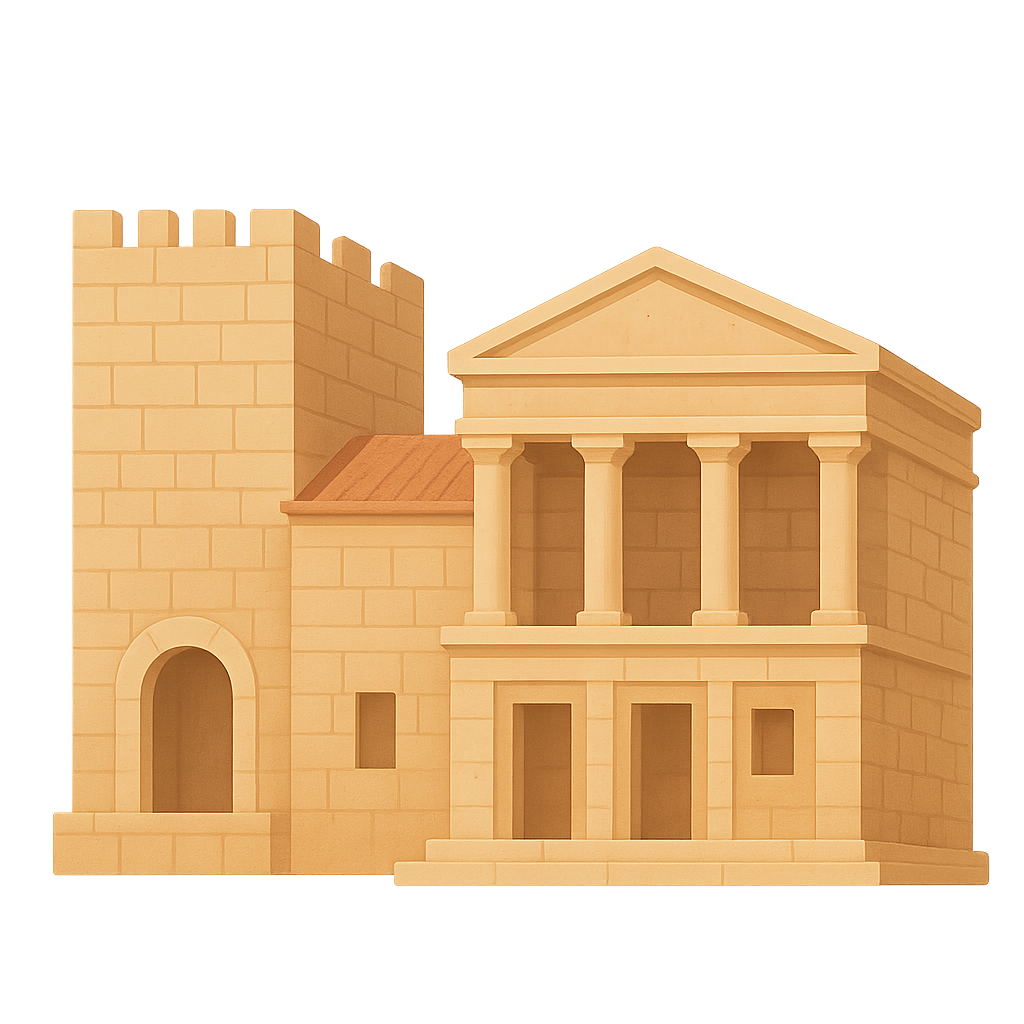
My story begins long, long ago, with a clever and artistic people called the Minoans. They were Europe’s first great civilization, and they made me their home around 3000 BCE. They were not warriors building grim fortresses; they were artists, sailors, and engineers who built magnificent palaces. The greatest of all was the Palace of Knossos, whose construction began around 1900 BCE. In its time, it was not a quiet ruin but a bustling city. Imagine walls painted with vibrant frescoes of athletes leaping over bulls and graceful dolphins swimming in a sea of blue. Water flowed through advanced clay pipes, a marvel of plumbing for the ancient world. Giant storerooms held enormous clay jars, called pithoi, filled with olive oil, wine, and grain from my fertile lands. The Minoans sailed their ships across the sea, trading with Egypt and the Near East. It was during this time that the famous legend of King Minos and the labyrinth, home to the fearsome Minotaur, was born—a story whispered about me for centuries. But this brilliant chapter came to a mysterious end. Around 1600 BCE, the nearby island of Thera erupted in a volcanic explosion so massive it shook the world. This event weakened the Minoans, and by 1450 BCE, their great civilization had faded into memory, leaving only their beautiful palaces behind.
The Island of Whispering Stones
Feel the warm Mediterranean sun on your skin and breathe in the scent of wild herbs and ancient olive groves. Listen closely, and you can hear the rhythm of waves washing over shores of sand and stone. All around you, rugged mountains rise to meet a brilliant blue sky, holding secrets thousands of years old. I am a place where myths feel real and history is carved into the very landscape. I am an island of myths and memories. I am Crete.
My story begins long, long ago, with a clever and artistic people called the Minoans. They were Europe’s first great civilization, and they made me their home around 3000 BCE. They were not warriors building grim fortresses; they were artists, sailors, and engineers who built magnificent palaces. The greatest of all was the Palace of Knossos, whose construction began around 1900 BCE. In its time, it was not a quiet ruin but a bustling city. Imagine walls painted with vibrant frescoes of athletes leaping over bulls and graceful dolphins swimming in a sea of blue. Water flowed through advanced clay pipes, a marvel of plumbing for the ancient world. Giant storerooms held enormous clay jars, called pithoi, filled with olive oil, wine, and grain from my fertile lands. The Minoans sailed their ships across the sea, trading with Egypt and the Near East. It was during this time that the famous legend of King Minos and the labyrinth, home to the fearsome Minotaur, was born—a story whispered about me for centuries. But this brilliant chapter came to a mysterious end. Around 1600 BCE, the nearby island of Thera erupted in a volcanic explosion so massive it shook the world. This event weakened the Minoans, and by 1450 BCE, their great civilization had faded into memory, leaving only their beautiful palaces behind.
After the Minoans, my shores saw many new faces and heard many new languages. First came the Mycenaean warriors from mainland Greece, who adopted and adapted Minoan ways. Centuries later, in 69 BCE, the powerful Roman Empire arrived. They were organized and practical, making the city of Gortyn their capital and building temples, theaters, and aqueducts. With the rise of the Byzantine Empire in the 4th century CE, a new faith, Christianity, spread across my hills and valleys. Tiny, beautiful churches decorated with stunning icons began to appear, many of which you can still visit today. In 1204 CE, sailors from the wealthy city of Venice took control. For over four hundred years, they built mighty fortresses to protect my coasts, like the magnificent Fortezza of Rethymno. They also created elegant cities with charming harbors, like Chania, whose Venetian lighthouse still guides ships into port. Then, in 1669 CE, a new power arrived from the east: the Ottoman Empire. This was a time of great change and struggle, as two cultures and religions lived side-by-side. Mosques with tall minarets were built near ancient churches, adding another layer to my complex identity.
Through all these centuries of being ruled by others, the spirit of my people never broke. They held onto their language, their music, and their fierce desire for freedom. They dreamed of the day they would unite with their Greek brothers and sisters. That dream finally came true. On December 1st, 1913, the Greek flag was officially and joyfully raised over the fortress in Chania, a moment of immense pride and celebration. My people’s courage was tested again during World War II. In May of 1941, during the Battle of Crete, ordinary villagers and farmers bravely resisted a powerful invading army, showing the world the meaning of resilience. Around this time, my most ancient secrets were being rediscovered. In 1900 CE, an English archaeologist named Sir Arthur Evans began excavating a large hill. He uncovered the lost Palace of Knossos, piecing together the forgotten story of the Minoans. His work allowed me to share the wonders of my earliest civilization with the entire world, reminding everyone of the incredible creativity that blossomed here thousands of years ago.
Today, my heart beats on, stronger than ever. The past is not just in my stones; it lives in the vibrant culture of my people. You can hear it in the stirring music of the Cretan lyra, a traditional stringed instrument played at festivals and family gatherings. You can taste it in the healthy and delicious food—fresh vegetables, golden olive oil, and sharp cheeses. Most of all, you can feel it in the warm hospitality, the 'filoxenia', that my people show to every visitor. My ancient spirit is still alive. It’s in the stories told by grandparents, in the ruins that whisper of kings and queens, and in the strength of the ancient olive trees that have witnessed all of my long history. I invite you to come walk my ancient paths, listen to my stories, and feel the history that lives in my very soil. I am a place where the past and present dance together under the Mediterranean sun.
Wow facts
About
The largest of the Greek islands, Crete is renowned for its ancient Minoan civilization, rich history spanning millennia, and its vibrant modern culture.
Take a Quiz
Question 1 of 5
In your own words, describe the period when the Venetians ruled Crete and what they built.
Explore next

Want to do even more?
Go beyond exploring. Unlock tools that turn every story into real learning.

Storypie Plus for families
Full stories, quizzes, and printables. Nights and car rides, sorted.
- Unlimited audio stories
- Create Mode: your child stars in the story
- Offline downloads
- Printable worksheets & coloring pages

Why Storypie for Schools
Students engaged. Prep in seconds. Evenings back to you.
- Worksheets & Quizzes
- Classroom Management
- Formative Assessment
- Custom Curriculum & Lesson Plans
- 27 Languages

Why Storypie for Homeschool
Curriculum done. They'll ask for more. Hours back in your day.
- Worksheet Generator
- First-Person Audio Stories
- Built-in Comprehension Quizzes
- Custom Curriculum & Lesson Plans
- Print & Go Activities