English

Dolomites
A mountain range in northeastern Italy, part of the Southern Limestone Alps…
Reads at Grades 6–8 Listens at Grades 4–8
Print & create
Answer keys·No prep·Free with an account
28 worksheets · answer keys · full story · quiz · Ages 10-12 · CEFR B2
Plus adds 116,000+ more stories in 27 languages, audio for every one, and printables for all of them.
Just want Dolomites?
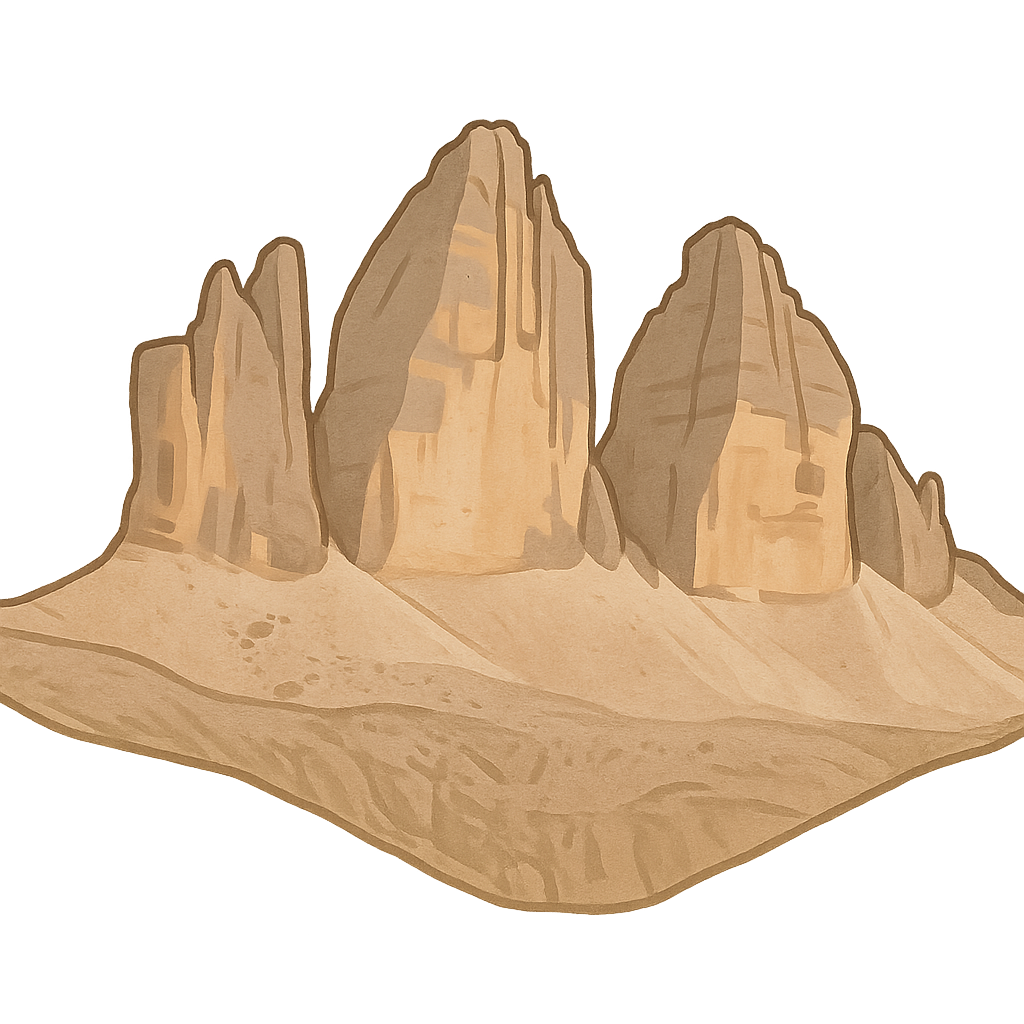
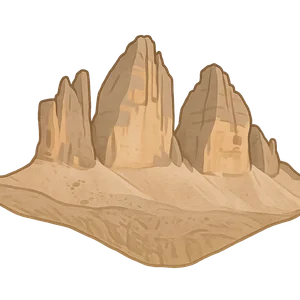
In the early morning, before the world is fully awake, a magical light paints my highest peaks. It starts as a soft pink, then deepens to fiery orange and a gentle purple before the sun climbs high. People who see it call it 'Enrosadira,' the alpenglow. I feel myself blushing under the sun's first touch. My stone is naturally pale, a ghostly white that gives me my nickname, the Pale Mountains. But this color hides a secret, a story that began long ago in a place you would never expect: deep beneath the waves of an ancient sea. My towering cliffs and sharp spires hold the memory of a world lost to time. They call me the Dolomites, and my story was written by oceans, continents, and time itself.
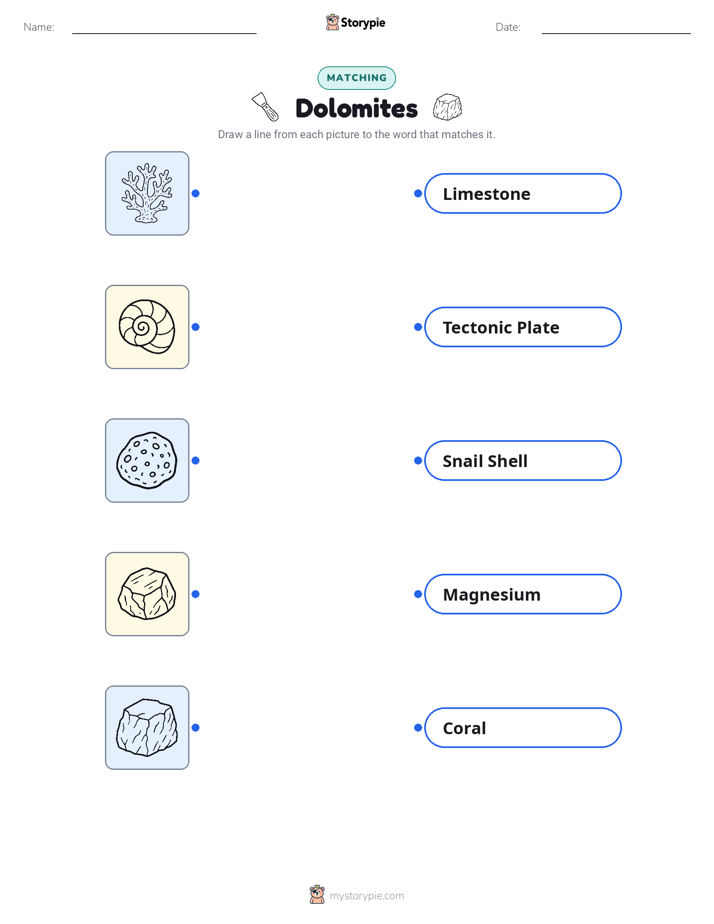
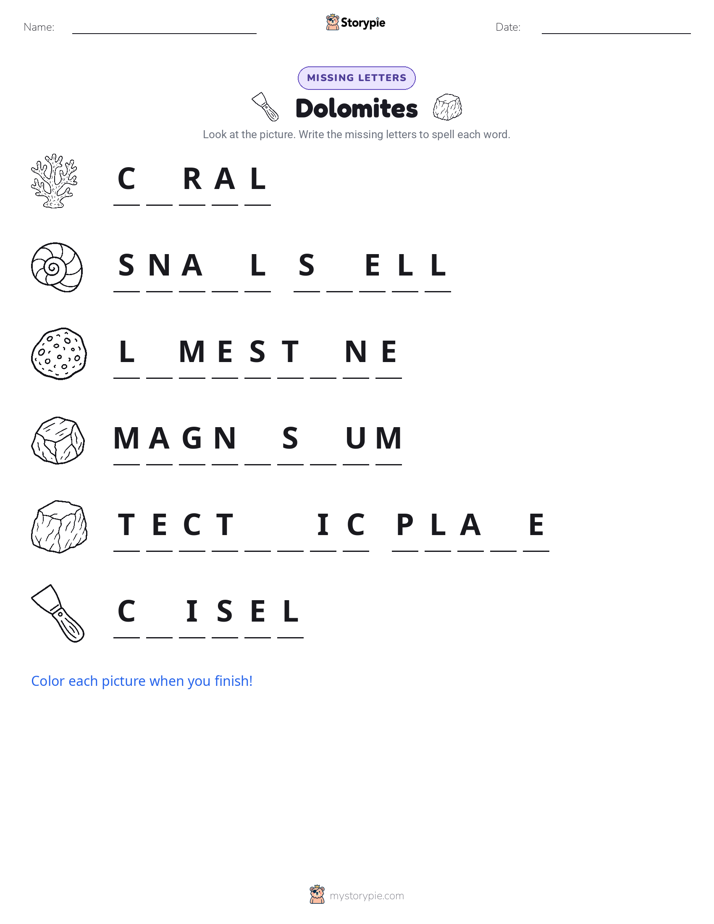
Travel back with me, far back, over 250 million years ago to the Triassic period. The land you know as Italy did not exist. Instead, there was a warm, shallow tropical sea called the Tethys Ocean. I was not a mountain then; I was the floor of this vibrant ocean, teeming with life. Imagine vast reefs of coral, more colorful than any garden, stretching for miles. Snails with spiral shells, clams, and countless tiny microorganisms swam in the clear, sunlit water. For millions upon millions of years, as these creatures lived and died, their shells and skeletons drifted down to the seabed. Layer after layer piled up, the immense weight of the water above pressing down on them. This immense pressure, over an unimaginable length of time, compacted the remains into a unique, pale limestone. This special rock, rich in magnesium, was different from any other. It was strong, beautiful, and held the fossilized ghosts of the sea that had been my cradle. My very bones are made of ancient sea life, a testament to a warm, watery world.
The Pale Mountains That Touched the Sky
In the early morning, before the world is fully awake, a magical light paints my highest peaks. It starts as a soft pink, then deepens to fiery orange and a gentle purple before the sun climbs high. People who see it call it 'Enrosadira,' the alpenglow. I feel myself blushing under the sun's first touch. My stone is naturally pale, a ghostly white that gives me my nickname, the Pale Mountains. But this color hides a secret, a story that began long ago in a place you would never expect: deep beneath the waves of an ancient sea. My towering cliffs and sharp spires hold the memory of a world lost to time. They call me the Dolomites, and my story was written by oceans, continents, and time itself.
Travel back with me, far back, over 250 million years ago to the Triassic period. The land you know as Italy did not exist. Instead, there was a warm, shallow tropical sea called the Tethys Ocean. I was not a mountain then; I was the floor of this vibrant ocean, teeming with life. Imagine vast reefs of coral, more colorful than any garden, stretching for miles. Snails with spiral shells, clams, and countless tiny microorganisms swam in the clear, sunlit water. For millions upon millions of years, as these creatures lived and died, their shells and skeletons drifted down to the seabed. Layer after layer piled up, the immense weight of the water above pressing down on them. This immense pressure, over an unimaginable length of time, compacted the remains into a unique, pale limestone. This special rock, rich in magnesium, was different from any other. It was strong, beautiful, and held the fossilized ghosts of the sea that had been my cradle. My very bones are made of ancient sea life, a testament to a warm, watery world.
My quiet life as a seabed ended around 65 million years ago. Deep within the Earth, something monumental was happening. The planet's great tectonic plates were on the move. The African plate began a slow but unstoppable collision with the Eurasian plate. The force of this cosmic crash was beyond comprehension. The rock layers that had formed so peacefully on the ocean floor were caught in the middle. They were squeezed, folded, and buckled. With incredible power, the land began to rise. I was lifted from the dark depths of the sea, climbing higher and higher toward the sun. This upward journey took millions of years, a slow and powerful birth that raised me thousands of feet into the air. But my shaping was not yet complete. Great ice ages came, and massive glaciers slid down my slopes. They acted like giant chisels, carving my soft rock, sculpting sharp peaks, hollowing out deep valleys, and creating the dramatic, vertical cliffs that define me today.
For centuries, people lived in my valleys, but my stone kept its secret. Then, in the year 1791, a curious French scientist named Déodat de Dolomieu came to explore my slopes. He was a geologist, a man who read stories in rocks, and he noticed something peculiar about me. My pale stone didn't fizz and bubble when he dripped acid on it, the way ordinary limestone did. This puzzled him. He knew I must be made of something different. His scientific curiosity drove him to collect samples and send them away for analysis. The results were astounding. My rock was a previously unknown mineral, a double carbonate of calcium and magnesium. To honor the scientist whose keen observation had revealed my true nature, the scientific community named the mineral 'dolomite.' Soon after, the entire mountain range, my whole being, came to be known by the same name. I am the Dolomites because one man was curious enough to ask why.
My long history has not always been peaceful. My cliffs have witnessed incredible human courage in the face of great hardship. During World War I, from 1915 to 1918, my peaks became a brutal, high-altitude front line between the soldiers of Italy and the Austro-Hungarian Empire. To fight, and simply to survive in this vertical world of ice and rock, these young men had to become master builders. They constructed an astonishing network of pathways across my steepest faces, with iron ladders drilled into the cliffs, steel cables to hold onto, and precarious bridges spanning terrifying drops. These routes were called 'vie ferrate,' or 'iron paths.' They were lifelines, built with incredible ingenuity and endurance in the most difficult conditions imaginable. The echoes of that conflict have faded, but the paths remain. Today, hikers and climbers from all over the world follow these historic routes, not for war, but for adventure, challenging themselves on the very ladders and cables built by soldiers long ago.
After witnessing so much of Earth's history and human history, I received a special honor. On August 26th, 2009, I was officially recognized as a UNESCO World Heritage site. This title means that the whole world agrees that my beauty and my geological story are precious and must be protected for everyone, forever. Today, my slopes are alive with joy. I watch skiers glide down my winter snows and hikers explore my ancient trails in the summer. I listen to the unique Ladin language, an ancient tongue that has survived for centuries in my secluded valleys. I am more than just a pile of rock; I am a living museum of Earth's history, a monument to human resilience, and a source of inspiration. My story, written in stone and painted in the sky, is a testament to the power of nature and the endurance of the human spirit. I invite you to come, to walk my paths with respect, and to find your own story written on my stony heart.
Wow facts
About
A mountain range in northeastern Italy, part of the Southern Limestone Alps, famous for its unique pale carbonate rock and designated as a UNESCO World Heritage site.
Take a Quiz
Question 1 of 5
In your own words, describe the three main stages of the Dolomites' geological formation, starting from the Triassic period.
Explore next





Want to do even more?
Go beyond exploring. Unlock tools that turn every story into real learning.

Storypie Plus for families
Full stories, quizzes, and printables. Nights and car rides, sorted.
- Unlimited audio stories
- Create Mode: your child stars in the story
- Offline downloads
- Printable worksheets & coloring pages

Why Storypie for Schools
Students engaged. Prep in seconds. Evenings back to you.
- Worksheets & Quizzes
- Classroom Management
- Formative Assessment
- Custom Curriculum & Lesson Plans
- 27 Languages

Why Storypie for Homeschool
Curriculum done. They'll ask for more. Hours back in your day.
- Worksheet Generator
- First-Person Audio Stories
- Built-in Comprehension Quizzes
- Custom Curriculum & Lesson Plans
- Print & Go Activities